RAF 51 Operation Zeitz 16-17 January 1945 : The Role of the Flight Engineer
Royal Air Force
Bomber Command and No. 8 Group Pathfinder Force
RAF 51
16/17 January 2026
The Role of the Flight Engineer
Page 1
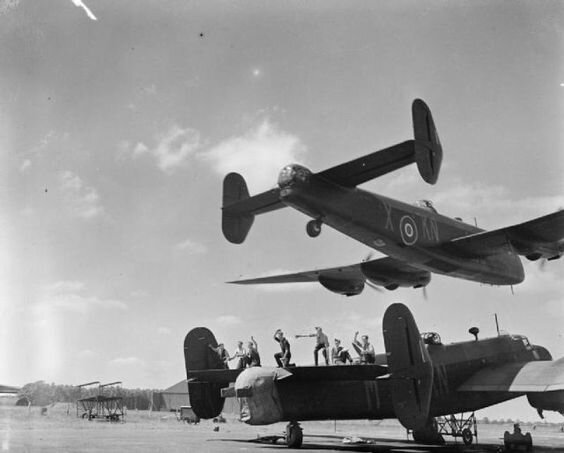
Take-Off at Dusk
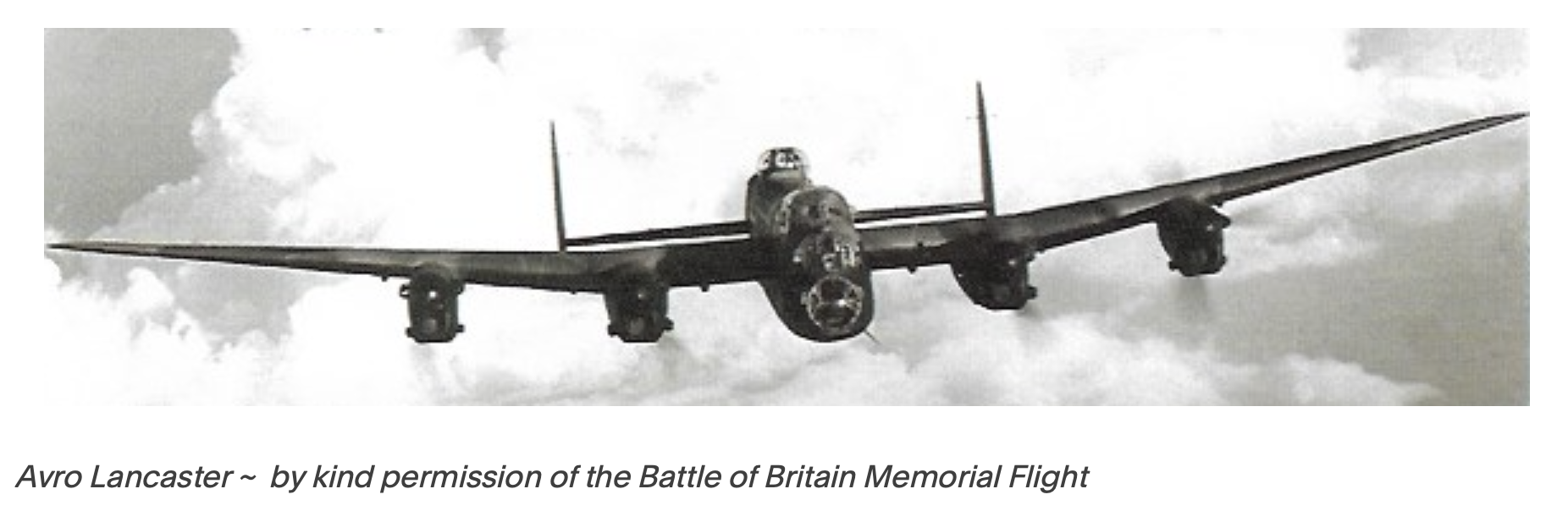
The Avro Lancaster ~ A Flight in line astern awaiting the Green Morse for Take Off ~ RAF Coninsby, Lincolnshire 1944
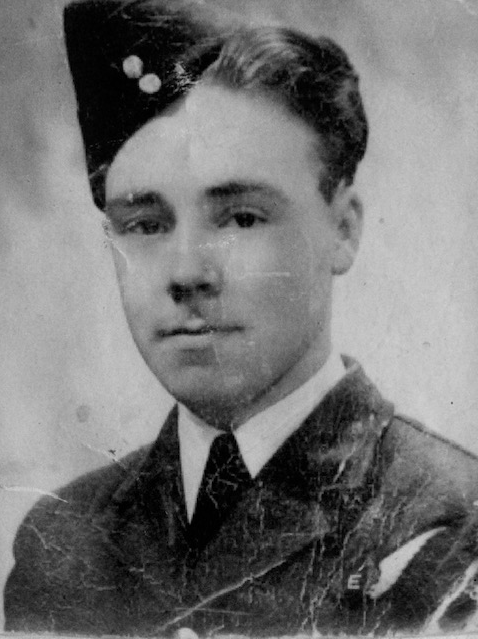
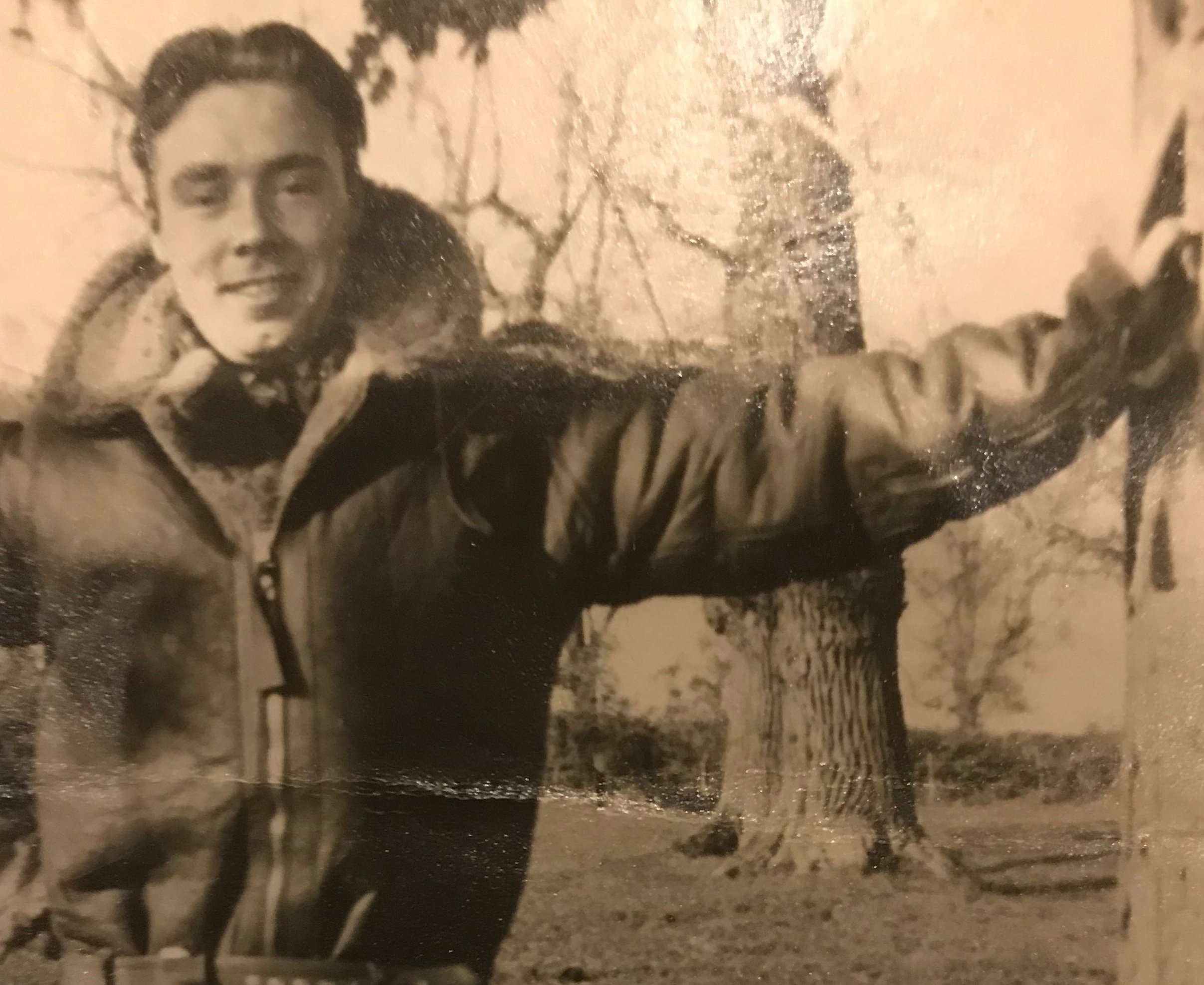
This portrait sitting would have been prior to being posted to 405 (City of Vancouver) Squadron RCAF No. 8 Pathfinder Group RAF Bomber Command. The Engineer’s brevet affirms that at the sitting Harry would have been a newly promoted Sergeant Flight Engineer Aircrew. That is a huge jump from LAC 2 (which is the same jump Ken did 14 months earlier as a Sergeant-Pilot).

Jack Marshall Martin Engineer Mechanic April 2025 and by kind permission of my First Nephew Christopher John Martin and Megan Adele Martin 2026
Page 2
The Payne Crew
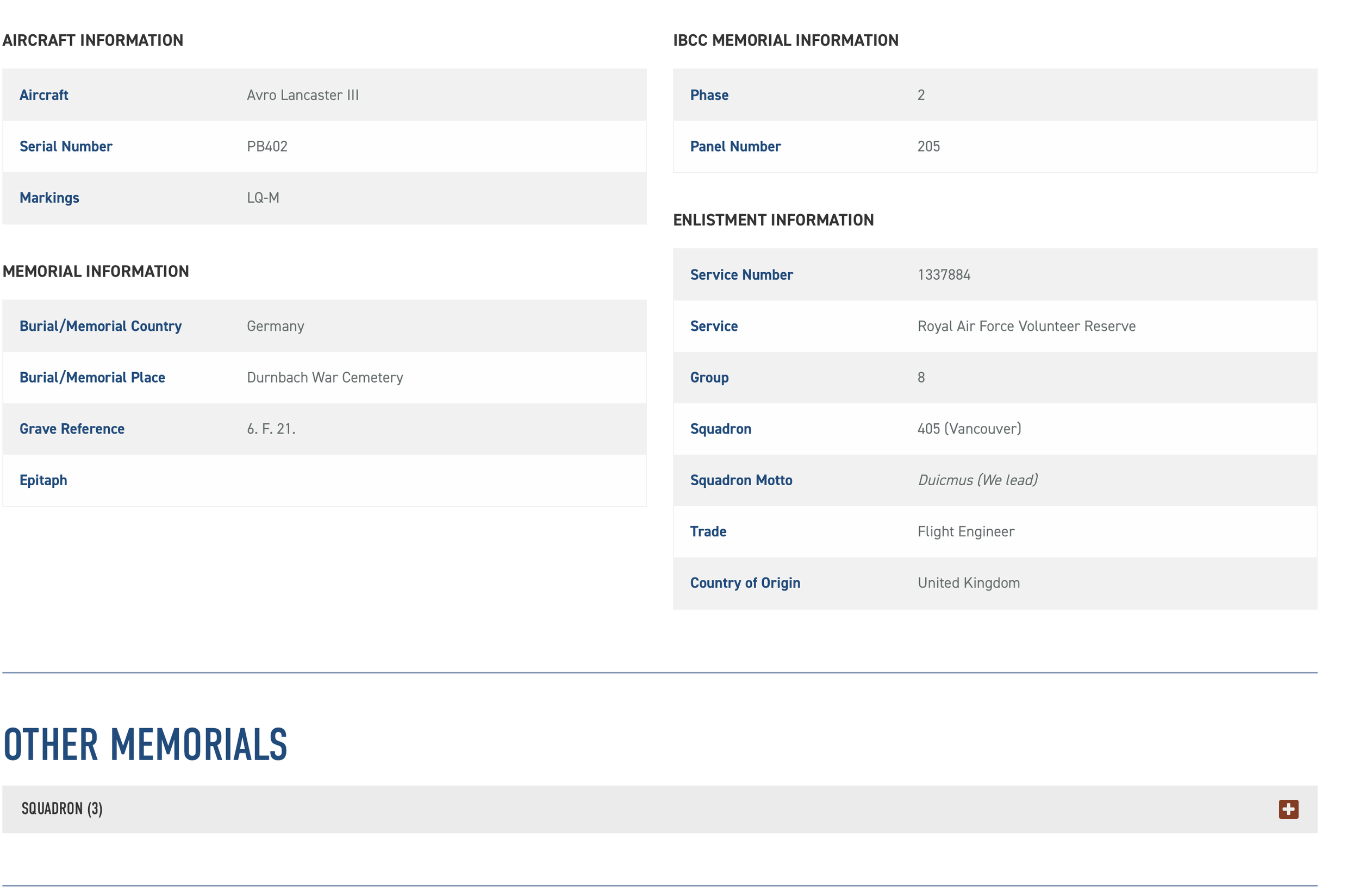
Avro Lancaster PB402 LQ-M
16-17 January 1945
405 (City of Vancouver) Squadron
Royal Canadian Air Force
RAF Gransden Lodge
Cambridgeshire
United Kingdom
Page 3
Introduction
I write this article in honour of our uncle, Harry Alfred Marshall a Flight Sergeant[1] with the Royal Air Force Bomber Command in 1943-1945.
My purpose it two-fold. To finally tell the family story regarding our uncle, Mum’s brother, and to also show that despite the horror of the Second World War and the unmitigated horror of the Third Reich 1933-1945, we do recover. If I do not write this account, then I do the greatest disservice to my parents’ brothers. All of us are here because they and millions of others are not, but chose to make the ultimate sacrifice.
Harry Alfred Marshall is named after his paternal uncle who died on 26 October 1918 as a prisoner of war in what they knew as The Great War, and we know as The First World War.
Harry was a Flight Engineer serving on 405 (City of Vancouver) Pathfinder Squadron Royal Canadian Air Force stationed at RAF Gransden Lodge, Cambridgeshire. Several of the crew including the pilot, Flight Lieutenant Leslie Payne RCAF, visited our Grandparents’ home in Cheltenham in November 1944 on a 48 hour leave pass.
The photographs displayed were taken before 16/17 January 1945 when a midair collision occurred between their Pathfinder Avro Lancaster PB402 LQ-M and Avro Lancaster – KB850 WL-O – B402 LQ-M coming down near Pfaffenhausen in Germany during Operation ZEITZ. All fourteen members of both the Payne Crew and the Kiehl Bauch Crew failed to survive.

A rendition of a mid-air collision ~ digital art by KTW
Page 4
No details are available as to the cause of the collision. It is not right to attempt to apportion blame.
Being now eighty-one years on, I write this as my final aviation paper and it is, for our family, the most important, because we, at last, find out much about Harry’s War Service and the incredibly close bond between him and Grandad which, for whatever reason, was lost in the mists of time. I know this to be true because our Uncle’s frequent letters home to Grandma and Grandad are very warm, incredibly so, and Uncle Harry often addresses his Dad in the main.
[1] Harry’s service ended in the temporary rank of Flight Sergeant. This is a battlefield rank, meaning that at the war’s end or upon death his rank would revert to the substantive rank of Sergeant Aircrew. Although I have a title Flight Lieutenant granted by the Secretary of State (Air) in 1991 unusually, as this is a junior officer rank, even had I attained the rank of Squadron leader (in the pipeline in 1991) or even Wing Commander, my substantive rank remained Flying officer, the rank between pilot officer and flight lieutenant. Sometimes, relatives express distress, anger even; but in my years as a probate, succession and trusts lawyer I would quietly venture, imagine the strain on the nation’s finances if we think of gratuities and pensions according to rank. Ah! I see what you mean Mr Webb. I would then ~ and I still do even now in Probus ~ reassure sons and daughters that I think of their fathers and mothers only as holding their battlefield ranks, not the substantive ranks they reverted to, and it is surprising how many times, I watch as if a weight removed from shoulders, a gentle smile arriving . KW
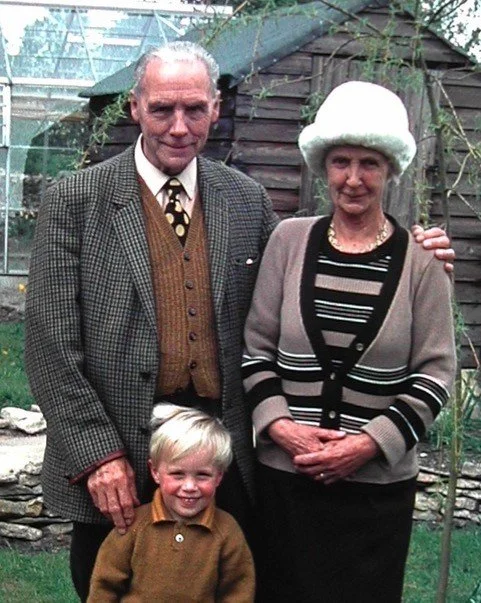
Grandma and Grandad with Chris at Nursery View. I love this, especially because, Boys and Girls, here’s Dad, my First Nephew.
Page 5
Chapter I
Until recently, I had never fully understood the role and complexity of the aircrew flight engineer, which specialism was created by Air Ministry Order A978/42 dated 15 August 1942 in order to govern the increasing complexity of all of the Royal Air Force four engine heavy bombers coming into Service with Bomber Command, the:
· The mighty Short Sunderland Flying Boat (June 1938)
· The Handley Page Halifax (November 1940)
· The American built B-24 Liberator (March 1941)
· The Short Sterling (February 1941)
· The American built Consolidated PBY Catalina Flying Boat (April 1941
· The Avro Lancaster (December 1941)
In RAF Heavy Bombers, the flight engineer replaced the second pilot.
This must be distinguished from the American B-17 Flying Fortress with a crew of thirteen, and the formal role of the pilot and captain and his second pilot.
The second pilot performed all of the duties of an RAF flight engineer for the pilot, as well as being a fully qualified pilot. If we think of air travel today, we catch a glimpse of the same system in place in airliners.
This was still the case in the RAF’s very heavy bomber, the Short Stirling which was the largest aircraft in Service operating in the European Theatre in any of the allied air forces throughout the Second World War.
However, the USAAF[1] operated the largest heavy bomber, the B-29 Super-Fortress, which first entered service in May 1944 in India and, of course, in the American Pacific Theatre to devastating effect both conventionally and otherwise.
In heavy bombers pilots were frequently seriously wounded, mortally even, during operations, but leaving the aircraft still fully operational. At the very least, aircraft might be serviceable enough to reach Britain reasonably safely.
Thus, the flight engineer received basic flying training, and augmented further by the pilot – the Captain - of the aircraft.
Mum recalled many times with enormous pride that her brother had mentioned to her that he always enjoyed piloting, or as Harry put it “taking the controls” of the Avro Lancaster “which is, Nance, an absolute beauty to fly”.
This additional flying training would take place usually on the homeward run of the operation as aircraft approached relatively safe territory, leaving occupied Europe and crossing the North Sea back to RAF Gransden Lodge and other bases.
There are numerous instances of flight engineers, even other crew members, successfully taking the controls when their pilot had been killed or wounded, yet were able to fly the aircraft back, some landing the aircraft with minimal damage and personal injury.
[1] The United States Army Air Force, which initially began operations as the United States Army Air Corps. USAAF then became a fully independent air force with the American Armed Forces in September 1947 as the United States Air Force (USAF). This followed the exact precedent set in the First World War when the Royal Flying Corps and the Royal Naval Air Service combined to become the Royal Air Force in April 1918, the world’s first independent air force. The RNAS became the legendary Fleet Air Arm of the Royal Navy and serves to this day independently of both the Army and the Royal Air Force. KW
Page 6
Chapter II
This speaks volumes for the level of expertise of every member of RAF aircrew. I cannot emphasise that enough.
It perfectly mirrors the absolute expertise and capability of all of the RAF Ground Units i.e. Ground Crews, without whom no aircrew would have been able to become airborne.
We tend to think of the glamour of aircrew and there is some justification.
However, there is no justification for not recognising the glamour of Ground Crews. To this day, the smell of an aviation hangar evokes enormous pride, comfort and thanks for me. A sense of awe even.
These men, and women, operated in the harshest conditions in all seasons.
To change an aero engine on an Avro Lancaster would normally take five days minimum and working full-time. The fact that our Ground Crews were achieving this in five hours on a regular basis and in the harshest winter conditions totally exposed to the elements in the dispersal areas on RAF stations, beggars belief.
Any engineer will say how difficult it is, impossible even, to properly work on an engine of any sort wearing any type of glove. Ask Jack!
From my own RAF service I also know how exposed Royal Air Force stations are. The bases are wide open to the Elements. They are unforgiving. There is no protection.
All of our heavy bombers stood 20 and 30 feet high (6.1-9.1 meters) and so if you can consider that we have ground crew members also repairing battle damage on the wings, fuselage and tail-fins of these mighty aircraft, and are doing it in clothing that in this century we would simply not countenance, then one begins to comprehend the sacrifice made by the entire crew of any aircraft.
“Whenever I speak of the crew of an aircraft, I do not speak only of aircrew. I speak also of the aircraft’s Ground Crew Unit under the command of the Ground Engineer Officer. Both elements are the sum of the whole crew. Without the GRU, the crew will not fly. Without the GRU, the damaged aircraft from the previous operation will not be repaired, rebuilt and ready for the next operation. I see air and ground as indivisible.”
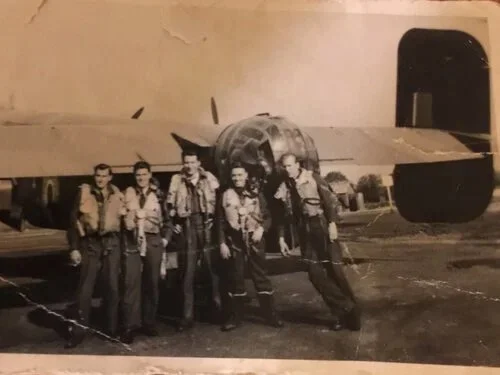
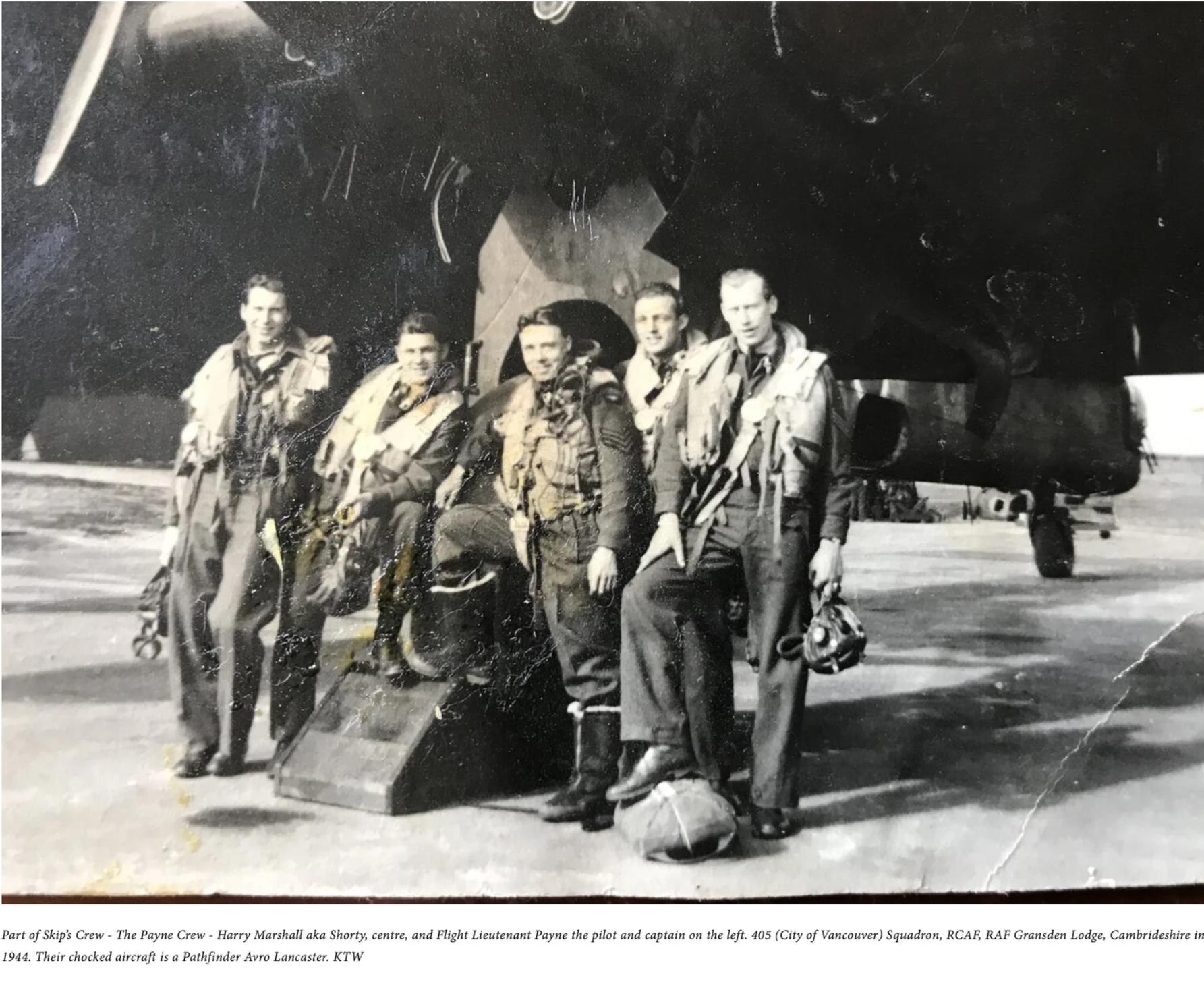
Five members of the Payne Crew, location not known, a Handley Page Halifax but Mk III identified by the large square tailfins that replaced the earlier triangular tailfins in order to solve stability problems in the earlier Mk II and Mk I. The Pilot (Flight Lieutenant Leslie Payne RCAF referred to in the family archive 1944 as Skip) stands centre, Harry, known as Shorty fourth from the left. I see just how tall all our Canadian friends are! A great bunch by all accounts when some visited on their last weekend leave in November 1944 at my Grandparents’ home in Elmfield Road, Cheltenham.
This is more fully written about in the family story ~ Windsor Street Days.
Page 7
Chapter III
Secondment of RAF Flight Engineers
to
Commonwealth Air Forces
Under Article XV of the 1939 Air Training Agreement, Squadrons belonging officially to the Royal Canadian Air Force, Royal Australian Air Force, and Royal New Zealand Air Force (known for the duration as XV Squadrons) were formed, equipped, and financed by the RAF for service in Europe. While it was intended that personnel would serve with their respective XV Squadrons, in practice many RAF personnel served in these squadrons and vice versa.
This arrangement resulted in many RAF flight engineers serving within RCAF squadrons as operational needs dictated, particularly as all Commonwealth Air Forces operated as an integrated force within RAF Bomber Command and, moreover, under Bomber Command’s overall direction.
Page 8
Chapter IV
Selection of Flight Engineers
The selection process was rigorous, and focused on identifying candidates that demonstrated the right combination of:
· technical aptitude,
· physical fitness, and
· mental acuity
Flight Engineer candidates were specifically chosen for their mechanical aptitude, this being critical given that their responsibilities included monitoring and maintaining every aircraft system throughout the aircraft during flight.
Aircraft systems were every part of the aircraft, not merely the four engines.
To illustrate this we can look at the career of Sergeant Robert Jay, a Flight Engineer serving with No. 75 (New Zealand) Squadron and which gives a real insight into the selection process. Robert Jay initially volunteered for the RAF Volunteer Reserve in 1942 but was not recommended for aircrew duties. The reason is not stated in his Record of Service, but his family history suggests it may have been due to an elevated temperature. Notwithstanding this set back, Robert Jay reapplied 10 months later and was instructed to attend RAF Doncaster, South Yorkshire, where he was assessed and interviewed by No. 1 Aviation Candidate Selection Board. This time he was successful and “recommended for training as a flight engineer”.
I'm so pleased to read about Sergeant Jay because this gives me an insight into Uncle Harry’s chosen path. At present I do not know Harry’s detailed service history, and this will be amended when I work through the informal family archive; I can then decide whether to apply for Uncle Harry’s Record of Service from the Military Archive.
Page 9
Chapter V
Having been selected, flight engineer candidates underwent a two-day assessment which included a medical examination, and we can determine that Harry was passed with “Medical Category Grade One”.
This is vitally important to acknowledge, for it demonstrates the weight placed upon physical fitness because it is clear from the syllabus that the role of the flight engineer was extremely demanding.
After successfully completing the selection process Uncle Harry would be enlisted for the “duration of present emergency” (DPE) and then initially assigned as Aircraft Hand/FE (ACH/FE) with the rank of Aircraftsman Second Class (AC 2).
Chapter VI
The Flight Engineer ~ The Linchpin
Between Aircrew and Ground Crew
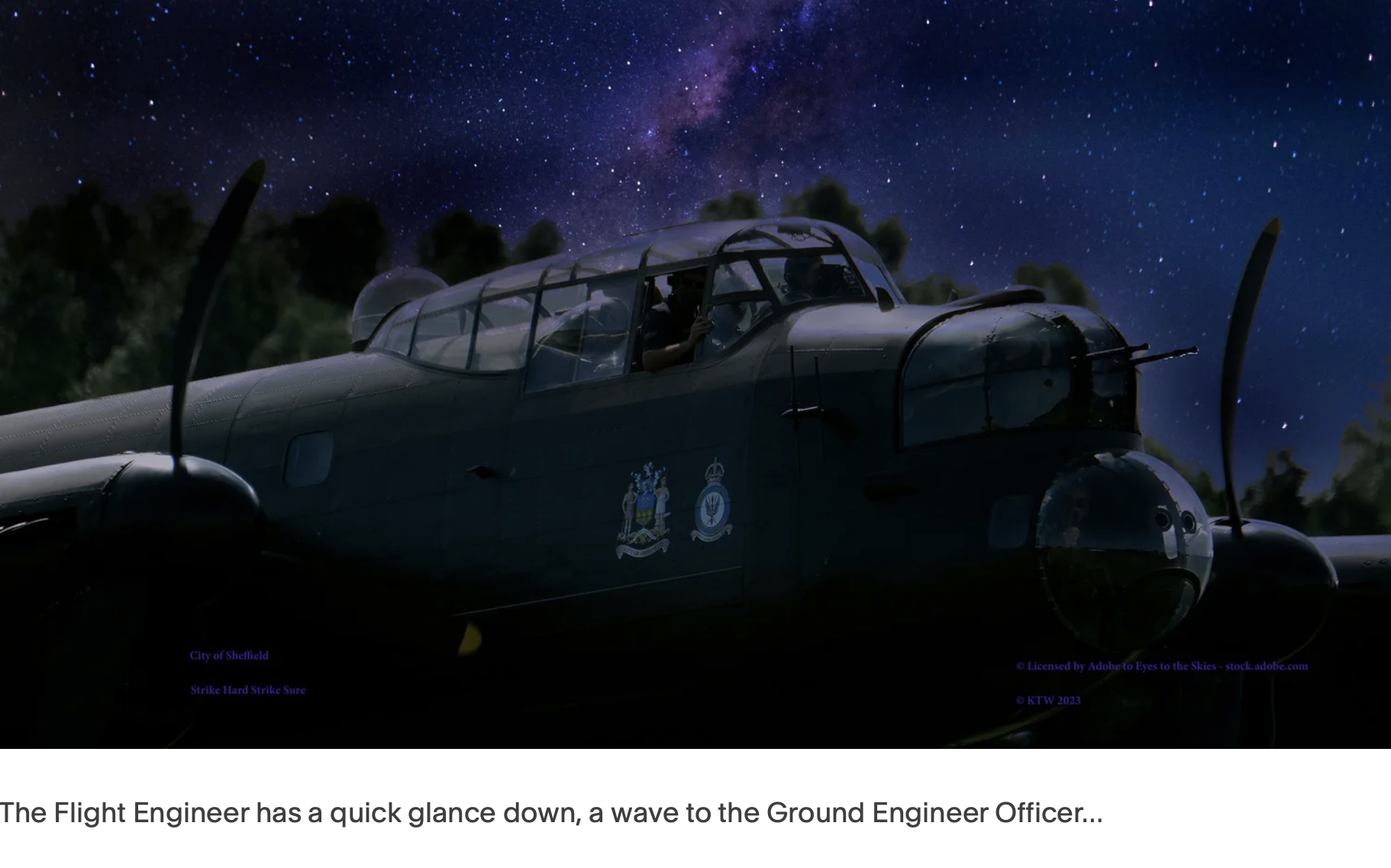
The flight engineer's role clearly positioned them as a critical connection between the technical ground operations and aerial combat missions.
Their extensive technical training gave them a comprehensive understanding of aircraft systems that paralleled the knowledge of ground maintenance crews, while their operational role integrated them fully with the flying aircrew.
The Ground Engineering Officer (GEO) was responsible for the maintenance of all aircraft and aircraft systems on his squadron, ensuring that as many serviceable aircraft were available for operations.[1] The GEO relied on a “dedicated group of highly skilled tradesmen, who took the service ability of the aircraft under their charge as a matter of immense pride”. I cannot emphasise this enough, in light of the regular demands by the AOC Air Chief Marshal Sir Arthur Harris that another “maximum effort” was required.
As I’ve mentioned in this paper, here is the kernel that enabled Ground Crews to regularly replace and fit an engine on a four-engine heavy bomber, in all weathers, in five hours, as opposed to the stipulated five days that engineers would work to in peacetime.
The Ground Engineering Officer’s opposite number, the Flight Engineer, with similar technical knowledge but serving as aircrew, effectively bridged these two operational domains.
[1] This was critical, as the Strategic Air Offensive was on a huge scale incomprehensible to us today, and which regularly flashed to all Station Commanders as “Maximum Effort”. A severely damaged heavy bomber was expected to fly within 24 hours on offensive operations, 48 hours at most. KW
Page 10
The flight engineer controlled the aircraft's mechanical, electrical, and hydraulic systems during flight, bringing technical expertise directly into the operational environment. Thus, training included exercises such as:
· Preflight checks
· Take-off procedures
· “Flying for economy”
· Landing procedures
All these work activities required intense coordination between both ground maintenance and flight operations.
This position ~ at the intersection of technical maintenance and flight operations ~ made the flight engineer uniquely valuable, as they could translate technical concerns into operational decisions and vice versa, thereby ensuring that the aircraft functioned at maximum capacity throughout each mission. And every member of air crew had complicated equipment to handle, and this equipment had to continue working through the most adverse weather conditions and, moreover, in the fiercest battle conditions.
The flight engineer was, in my lay language, ‘the man with the tool kit AND technical know-how’.
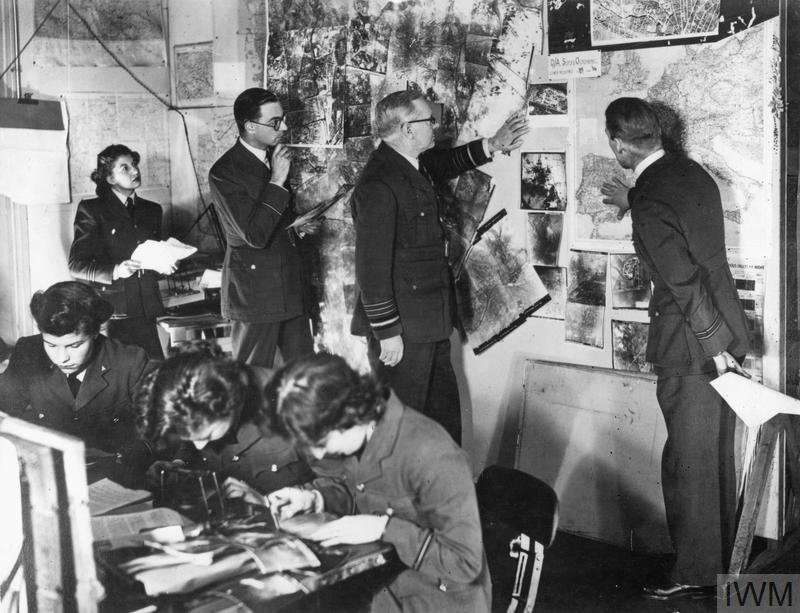
Air Chief Marshal Sir Arthur Harris, Air Officer Commanding-in-Chief RAF Bomber Command ~ Operations Room (HU 93068) Imperial War Museum
Page 11
Chapter VII
RAF St Athan Training Syllabus
The training of flight engineers was comprehensive and intensive, designed to produce technically proficient aircrew capable of managing complex aircraft systems under extreme combat conditions.
The syllabus evolved during the War, with the first course commencing on 30 May 1942. Harry had been a Cadet Sergeant serving in 125 (Cheltenham) Squadron, Air Training Corps until his entry into the RAF VR in 1941. His ATC syllabus (wartime standard) would have steered him into the Volunteer Reserve, and that had but one meaning ~ Harry was destined for aircrew.
There is a tendency for some to ponder that flight engineers were actually ‘failed’ trainee pilots. Throughout my service, and after, I’ve heard this many times. I have little time for such conjecture.
At its height in 1941-1943, the Air Training Corps comprised between 120,000-220,000 ATC air cadets. By late 1944 this was easing off to 110,000 as the Country tentatively began the gradual wind-down from total war which, in itself, would bring a host of post-war problems and into which we three were born. (Today our total Armed Forces stand at the moment at a worryingly 77,000).
Let us, therefore look at the complete training programme undertaken by Uncle Harry.

Detailed Drawing of the Handley Page Halifax and Crew Dispositions. This remarkable Template is by Copyright of © THE AEROPLANE to whom all rights are reserved. KW
Page 12
Carol, Ness, I include this detailed drawing precisely because Uncle Harry served for some time on Halifaxes. I wish I’d realised this decades ago. In time it might, for example, be of interest to all of your grandchildren.
The RAF complete training programme comprises 3 phases:
· Ten weeks ~ Preliminary
· Seven weeks ~ Intermediate
· Seven weeks ~ Final.
Completion of Phase 1 rolled straight into Phase 2 without leave.
Completion of phases 2 and 3 each resulted in Seven-Days Leave.
I want to look at these phases in detail because this enables me to see exactly what Uncle Harry was undertaking.
Page 13
Chapter VIII
RAF Locking, Weston-Super-Mare[1]
Phase One ~ Preliminary (10 weeks) at Preliminary airframes ( 1 week)
· Preliminary engines ( 2 weeks)
· Computers and magnetos open ( 2 weeks)
· Electrics and Instruments ( 1 week)
· Radial engines / In-Line engines ( 2 weeks)
· Hydraulics ( 1 week)
· Propellers ( 1 week)
RAF St Athan, Glamorgan[2]
Phase Two ~ Intermediate (seven weeks)
· Merlin engines ( 2 weeks)
· Typical airframes (One week)
· Typical hydraulics ( 1 we)
· Propellers / Instruments / Electrics ( 1 week)
· Aerodrome Procedures ( 2 weeks)
RAF St Athan, Glamorgan
Phase Three – Final (seven weeks)
· Airframes ( 2 weeks)
· Electrics / Instruments ( 1 week)
· Fuel Logs/Fuel Systems (1 week)
· Engines ( 1 week)
· Engine handling ( 1 week)
Page 14
Chapter IX
External Parts of Flight Engineers Course Off Station
Added to these three phases, the external element included a week at an aircraft manufacturer, and which was referred to as the “Makers Course” to enable an AC2 to gain a better understanding of aircraft construction.
For example, on 1 April 1944 one trainee was sent to Rootes Securities Limited probably at their shadow factory at Speke Airport (now Liverpool John Lennon Airport) where they manufactured the Handley page Halifax.[3]
This training also included visits to the Rolls Royce Engine Factory at Derby in Derbyshire, and the A V Roe Aircraft Factory at Chadderton, at that time in Lancashire, now Greater Manchester.
This was followed by a short course at RAF Stormy Down in South Wales on air gunnery and gun turrets, a vital Part of the curriculum, thereby enabling the flight engineer to operate a gun turret “especially during low level, mine laying when the bomb aimer was busy”. This would be on aircraft where the bomb aimer was performing a dual role as a gunner in the forward turret.
[1] RAF Locking was my first RAF Camp in August 1968 as a Cadet First Class.
[2] I attended camps at RAF St Athan both as a cadet and as a commissioned officer, and St Athan was also, later, my first taste as camp commandant prior to a similar role in RAF Gatow, Berlin.
[3] I’d never realised until now that the Halifax production line was in Liverpool
Page 15
Chapter X
Prior Experience
Courses relied upon students quickly understanding their role because of their ground crew experience. However, this was not the norm. Sergeant Jay was a direct entrant, not previously a ground crew member. So, too, Uncle Harry was a direct entrant. He was learning from scratch.
Many flight engineers did begin their careers in ground crew, and as soon as their aptitude for taking their engineering skills airborne was spotted; many were therefore able to make that leap. These flight engineers were highly skilled because they had both the aviation engineering and ground engineering elements present in them.
Successful trainees were promoted to the rank of Sergeant aircrew and awarded the coveted Flight Engineers Flying Brevet upon course completion, and which marked their transition into operational flying duties.
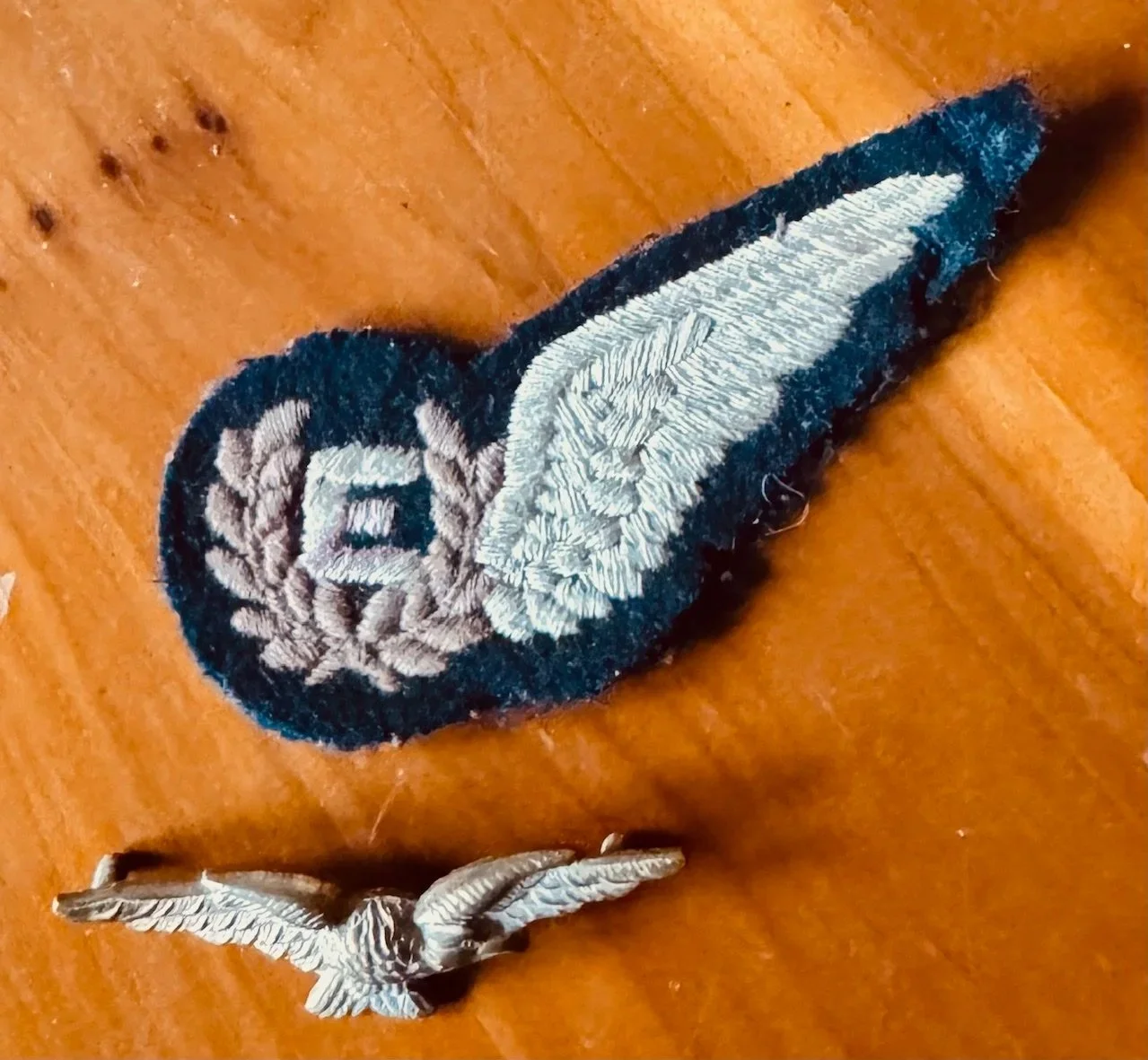
These are Uncle Harry’s Flight Engineer’s and Pathfinder Wings KW
Page 16
Harry was later promoted to the rank of Flight Sergeant.
We know this because of Mum’s lovely account, oft recalled, in meeting her brother at St James’s railway station, Cheltenham and asking him if he had anything wrong because of an ‘affected cough’! We know Mum!!
Of course, Harry was merely trying to attract his sister's attention to the Crown on his arm. Mum wondered why Harry kept winking towards his arm. Have you got something in your eye Harry? And I hold very dear mum’s description of jumping up to hug Harry for all he was worth upon seeing the Crown above the Chevrons, and mum also recalled him again rolling his eyes as if to say, “very slow but we got there in the end!” and giggling.
And as this is only for the family, this reminds me of another instance. Mum walked with Harry to the railway station (where Waitrose now stands) and just as Harry was about to board the train, ‘I slipped half a crown in his hand with a ‘mum’s the word our Harry’. And Harry was so grateful.’ [1]
I include these personal notes because this is a document written entirely for the family, so that we, as a family, can understand what an uncle, great uncle and indeed great-great uncle had to achieve, and then to do in battle, in order to become a flight engineer. In this regard, I think of what your Grandsons Jack and Finn are achieving on the Rugby pitch and Sam on the football pitch. The adjective ‘fearless’ comes to mind, and of course in Jack’s case, he is indeed an Engineer!
Page 17
Chapter XI
Flight Engineers and Flying Training
A very important aspect of the role of the flight engineer was the ability to assist with flying the aircraft in emergency situations. Flight Engineers received sufficient flying training that proved crucial in many instances when the pilot had bcome incapacitated.
As my notes and research indicate, the flight engineer “could act as a reserve pilot in an emergency”; he also sat beside the pilot, assisting him particularly during critical phases such as take-off. We know that it took considerable physical strength to ease any of the four-engined heavy bombers into the air and clear the boundary in time without mishap.
Training included exercises for managing aircraft with compromised systems, for we learn this from Sergeant Jay’s service, when three-engine landings were conducted, and we discover via the International Bomber Command Centre (IBCC) that this training proved crucial in Robert Jay’s case when his aircraft lost an engine to flak during a daylight raid on Hamm, Nord-Rein Westfalen, Germany on 27 March 1945.[2]
The RAF also used simulator facilities to provide simulated flight environment for practising piloting skills. The flight simulator is not a modern concept.
This limited but crucial flying capability made the flight engineer an important backup to the pilot, potentially enabling aircraft and crew survival in emergency situations when the pilot had been wounded, sometimes fatally, but the aircraft remaining flyable.
Everything centred upon Bomber Command and its highly attuned Flight Engineers Course. Everything radiated outwards from RAF Bomber Command. Aircrew from the RAF, the Royal Canadian Air Force, the Royal Australian Air Force, the Royal New Zealand Air Force and the South African Air Force superbly combined their resources.
We had many air forces throughout the Empire and Commonwealth (as then referred to), and this enabled the Royal Air Force to mount the air offensive during 1939-1941 that, under Sir Arthur Harris, which evolved into the Strategic Air Offensive against Nazi Germany in early 1942 whilst the British and Commonwealth Armies were rebuilding following Dunkirk, and which clearly Adolf Hitler had not thought was possible.
It meant that when London was bombed in 1940, the RAF was able to carry out retaliatory raids upon the still-lit city of Berlin and to call Herman Goering’s boast to account and much to the shock, yes shock, of Berliners safe in the knowledge, they believed, that they had conquered and were masters of all of Europe.
It meant that the German civilian population raped by Nazi propaganda over seven years (1933-1939) suddenly became aware that they too were coming under what would become endless ferocious bombardment. And the already established Strategic Air Offensive gathered ever increasing momentum with the entry of America into the war after Pearl Harbor.[3]
Page 18
Chapter XII
Conclusion
Writing and researching RAF 51 has been demanding, undertaken solely for the benefit of our Family (all branches) before I depart.
Dad’s brother Kenneth Ernest Webb was a Sergeant-Pilot on the Handley page Halifax Mk V and was killed in action over Germany in 16-17 April 1943.
Mum’s brother Harry Alfred Marshall was a Flight Engineer Pathfinder Flight Sergeant and was killed in action over Germany on 16-17 January 1945.
I have never, until now, fully understood the role of the flight engineer. However, this paper is sound testimony to the colossal evolution in RAF Bomber Command’s approach to crewing up four-engined heavy bombers during the Second World War.
For wartime purposes, taking the bold decision to assign basic second-pilot capabilities to a technically specialised crew member, demonstrates to me the RAF at its best; taking in its stride the technical management of increasingly complex aircraft, and the operational effectiveness demanded of all of its bomber crews. Please see the Appendix for more detailed information regarding RAF Policy which was very much in the vanguard of international aviation leaving far behind its contemporaries whether Allied or Axis.
I was amazed when I read the comprehensive training programme undertaken at RAF St Athan, Wales. It was like going down memory lane. The structure, the administrative layout of the directive with which my own service is very familiar. Here, flight engineers with advanced technical knowledge of aircraft systems combined with practical operational skills were being moulded, and then returned to their squadrons for operational service in the fiercest battle conditions.
“The flight engineer is effectively the bridge between ground maintenance on the one Part and flight operations on the other Part, and which contributed beyond measure to the operational capability of RAF Bomber Command throughout 1942-1945.”
Page 19
Harry was also a Pathfinder. These were the elite of the Royal Air Force.
It was the task of the Pathfinder Force to fly ahead of the Main Force, locate the target, and then mark the target. This was highly complicated and extremely dangerous.
Markers - akin to today’s fireworks displays - were dropped at varying heights, enabling the Main Force to calculate where the lethal payloads would be released. In newsreel footage we see showers of lights over a target descending, oh so gracefully, downward. Different colours marked different heights. They were doing this in the fiercest heat of battle. I have seen for myself the gigantic Flak Towers – die Flaktürme – in Berlin and Hamburg. The enemy defences were highly sophisticated and the main reason why the fatalities in Bomber Command by the war’s end stood at 53,573.
Adolf Hitler was so fearful of the RAF Pathfinders that crews were forbidden to wear the Pathfinder wings on operations. And upon capture, aircrew identified as Pathfinders were executed. Wartime records confirm that this final act was only after information might be extricated. It is for this reason that I am relieved that the end came as it did. And in time the infamous directive encompassed all aircrew personnel.
Carol, Ness, my sources and citations will be added later. For now, I can say that we have at last, a very clear picture of both of our uncles.
Page 20
Chapter XIII
A Final Quiet Moment
15 January 1945
Eighty-One years ago tonight ~ 15 January 2026 ~ Harry spent his last night in Quarters at RAF Gransden Lodge. The horrendity of war very apparent, the enemy indeed fighting to the very end. Already five months have passed since the liberation of Paris; yet the war grows fiercest as the enemy is backed into its corner.
In the morning Harry will attend the specialist operations briefing. Every member of aircrew attended their respective briefings, pilots, flight engineers, navigators, bomb aimers, wireless operators, air gunners. Then every full crew would assemble for the final briefing overseen by the Station Commander. It is this final briefing that we often see in the Pathe newsreels and BBC newsreels.
Monday, 16 April, 17:30 hours
On a cold, very dark wet night, last week’s snow at last beginning to thaw[4] as the crew are driven to their Avro Lancaster Mk III PB402 LQ-M awaiting them, pristine again, battle damage repaired, all systems operating, directly due to the tireless work and specialisms of PB 402’s Ground Crew Unit.
A conversation takes place between our Uncle with his opposite number the Ground Engineer Officer (GEO), a joint inspection follows, Harry would be invited to sign-off the GEO’s checklist. I’m quite sure of the genuine friendship between these men. I’m equally sure of the activity by all of the Ground Crew doing their utmost, quietly, efficiently, to facilitate their aircrew successfully boarding and settling in to their stations. The Ground Crew know that boarding is both a tense and intense internal moment for every flyer. There is a sense, unspoken, of great respect in the cold night air. It is equally so for the ground crews. Many ground crews knew that this was a final parting but praying to whoever that it wouldn’t be.
Our uncle would no doubt – if we have Mum or their brother Frank to go by – have said something quite pleasant to his opposite number, leaving the GEO knowing full well he’d done everything possible to ensure safe flight, as Harry climbed up into PB402, and the GEO would have picked up quite easily Harry’s appreciation for this.
The much respected pilot and captain, Flight Lieutenant Leslie Payne RCAF, would have already been aboard and now climbs back down to do his final checks with the GEO.
Les is meticulous. He walks round again, doubles back, and this is what the GEO most likes.
‘Skipper’ is not one to take chances or leave any stone unturned. Only when he is completely satisfied will he sign off, and Ground Engineering Officers never rush their Skippers in this procedure.
Questions are answered forthrightly and with gentility. They know they’re letting go of their baby into the hands of seven guys who will, God willing, bring Her back safely to them eight hours from now.
It cannot be explained, but I know from countless conversations over fifty years, that an aircraft is the personal private property of her Ground Crew. Air Crews are their tenants.
Skipper signs off. Again, gentle words, Canadian humour, and genuine thanks, a smile, and he’s back up inside and the door is closed firmly behind him. He hears the ratchet engage the lock. He clambers over the centre frame, past Harry who is working on the wall of switches in his cubbyhole behind the pilot’s bulkhead. Les slides into the cockpit. Start-up commences. Harry now moves forward to the cockpit.
Harry will lift and lower from the starboard stowage the small seat to the right of the pilot. Firmly in place, he glances downward to the quiet glow of the Navigator’s lamp across the small table.
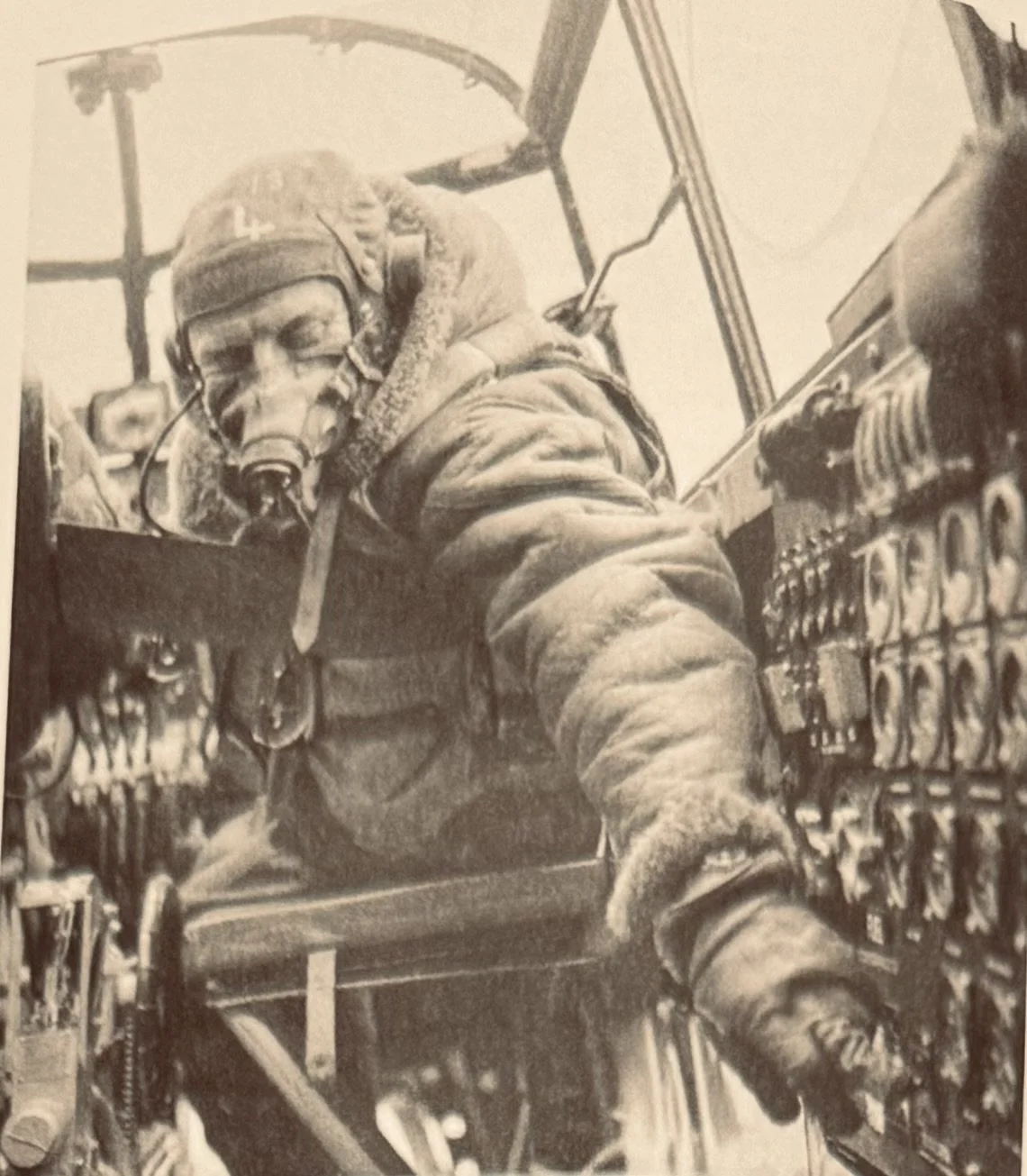
The Flight Engineer now takes his position alongside the pilot in the seat he has unfolded from the starboard mainframe. Behind him, are his controls to the engines. The compactness of the cockpit is easily seen when one looks to the left of the image and can easily see the right arm of the pilot, the back support of the folding seat clipping into the right edge of the pilot’s seat. This image is by courtesy of the Imperial War Museum IWM Avro Lancaster Flight Engineer CH 12289 and to whom all rights are reserved. KW is a fully subscribed member to the IWM.
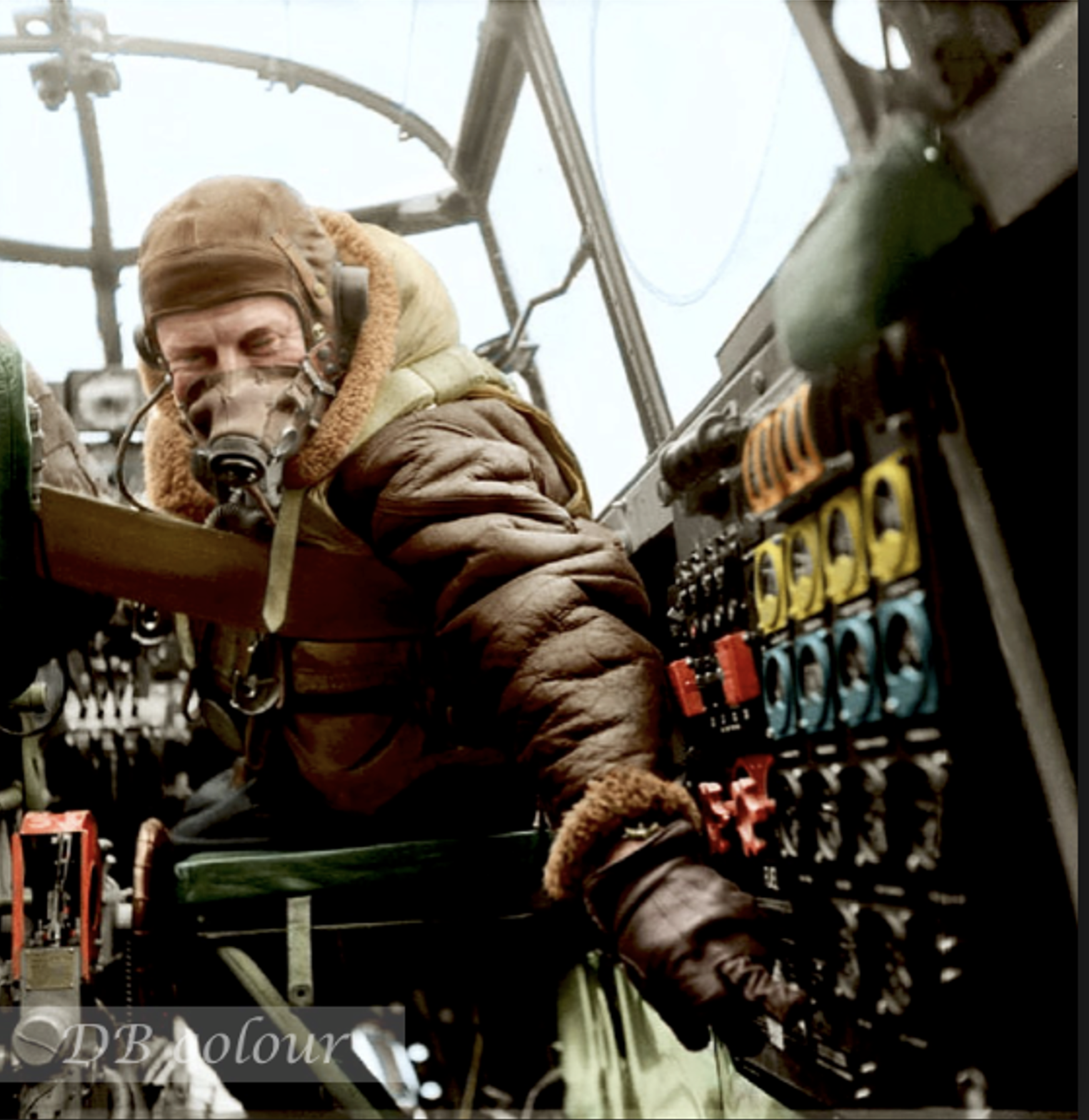
This colourised version of the IWM photograph by DB Colour ~ and to whom all rights are reserved © DN Colour ~ gives us a much greater undertsanding of Harry’s work. The extensive record held with the International Bomber Command Centre (IBCC) City of Lincoln, confirms that the Flight Engineer is Fg Off James Gordon Bennet ‘Lucky Jim’ Burnside, ending his service in 1946 in the rank of Flight Lieutenant.
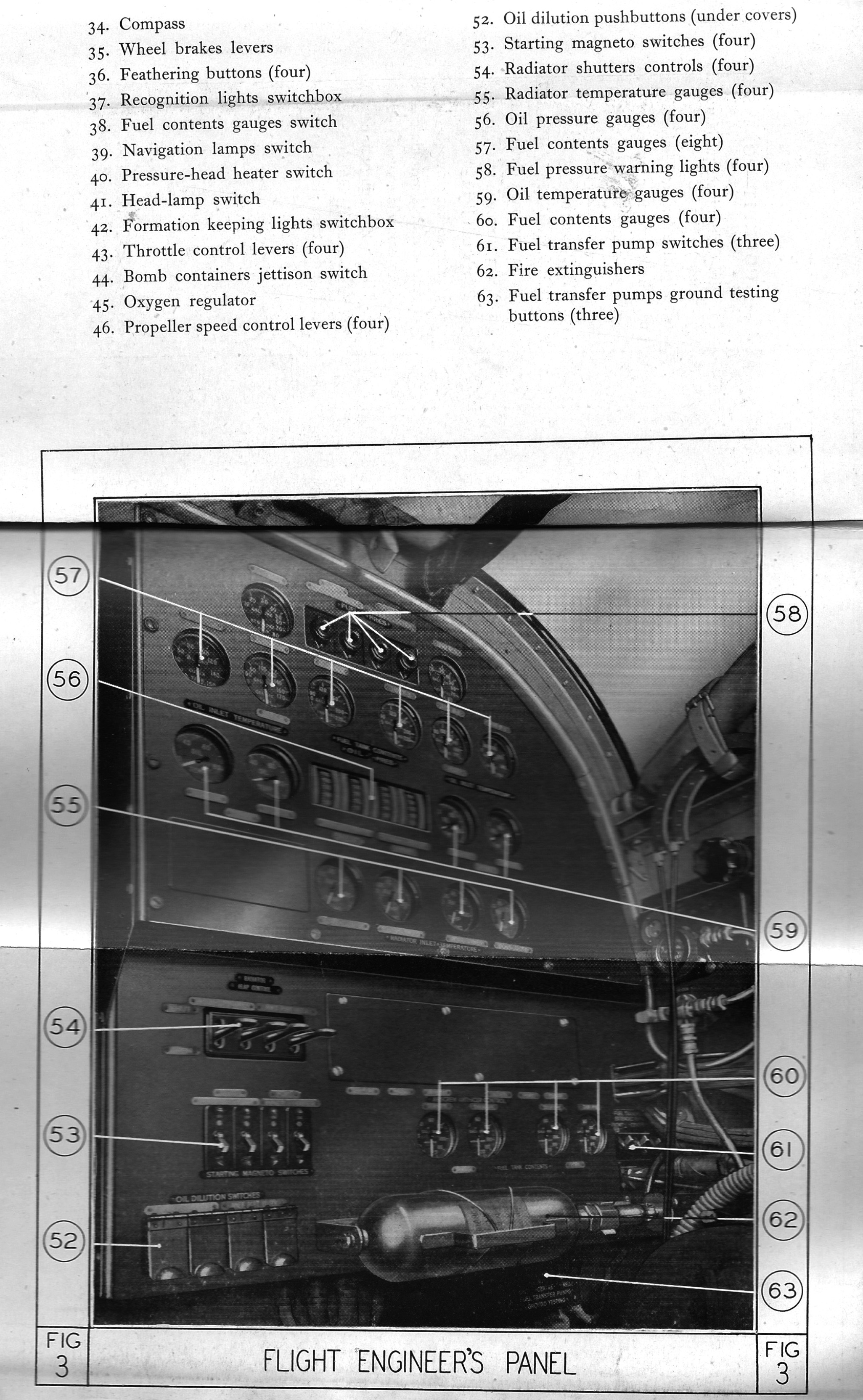
This panel is not the same as in the photograph. Just behind the pilot is a small stand up cubby hole. With his back to the pilot (separated by an armour plated bulkhead) the flight engineer would also be monitoring the aircraft’s systems in front of him. The flight engineer is crucial to every member of the crew. He is the engineer, and will often be able to temporily repair malfunctions that might be in the heat of battle ~ the gun turrets suddenly locking when under attack, the wireless operator, navigator and bomb aimer all also using highly sophisticated ‘state of the art’ equipment, much of it ‘top secret’. KW
[1] Purchasing Power: While it might seem like a small amount today, in the 1940s and 1950s, a half crown held significant, practical spending power. It could buy a decent meal, several pints at a pub, or, in some contexts, two portions of fish and chips. Inflation Adjustment: Because the British pound has lost over 98% of its value since 1944, a 2s 6d coin from 1944 would have a purchasing power equivalent to several pounds in modern currency. Several is generally considered to mean between £3 and £7. That would have been quite a sum for Mum in 1944.
[2] International Bomber Command Centre, Lincoln
[3] The Empire of Japan attacked Pearl Harbor on Sunday 7 December 1941, with President F D Roosevelt announcing America’s declaration of war on 8 December 1941. The declaration was against Japan, not Germany at this moment. Then Adolf Hitler played his hand and declared war on America. Churchill now had exactly what he needed. FDR agreed that Germany had to be defeated first. This takes on heightened significance when Ukraine will, on 22 February 2026 enter its fifth year of intense war waged by Russia. KW
[4] as mentioned by Harry to Grandad in his last letter, agreeing with his dad that he did not like snow and mud KW
Page 21
The bomb aimer and wireless operator are in take-off positions. Gunners are secure in their turrets. Harry has subconsciously noted the sound of the turrets revolving, a mental note that thus far, all seems in order. Very shortly Skipper will speak on the intercom to each of his crew. Formal, pleasant, his voice gentle but clearly that of a seasoned commander of men about to go into pitched battle.
The first contact, the outer port engine grimaces, then whirls into life.
Harry is listening to the revolutions, all is well, a silent nod, their only contact now their eyes. Skipper engages the inner port engine. The same.
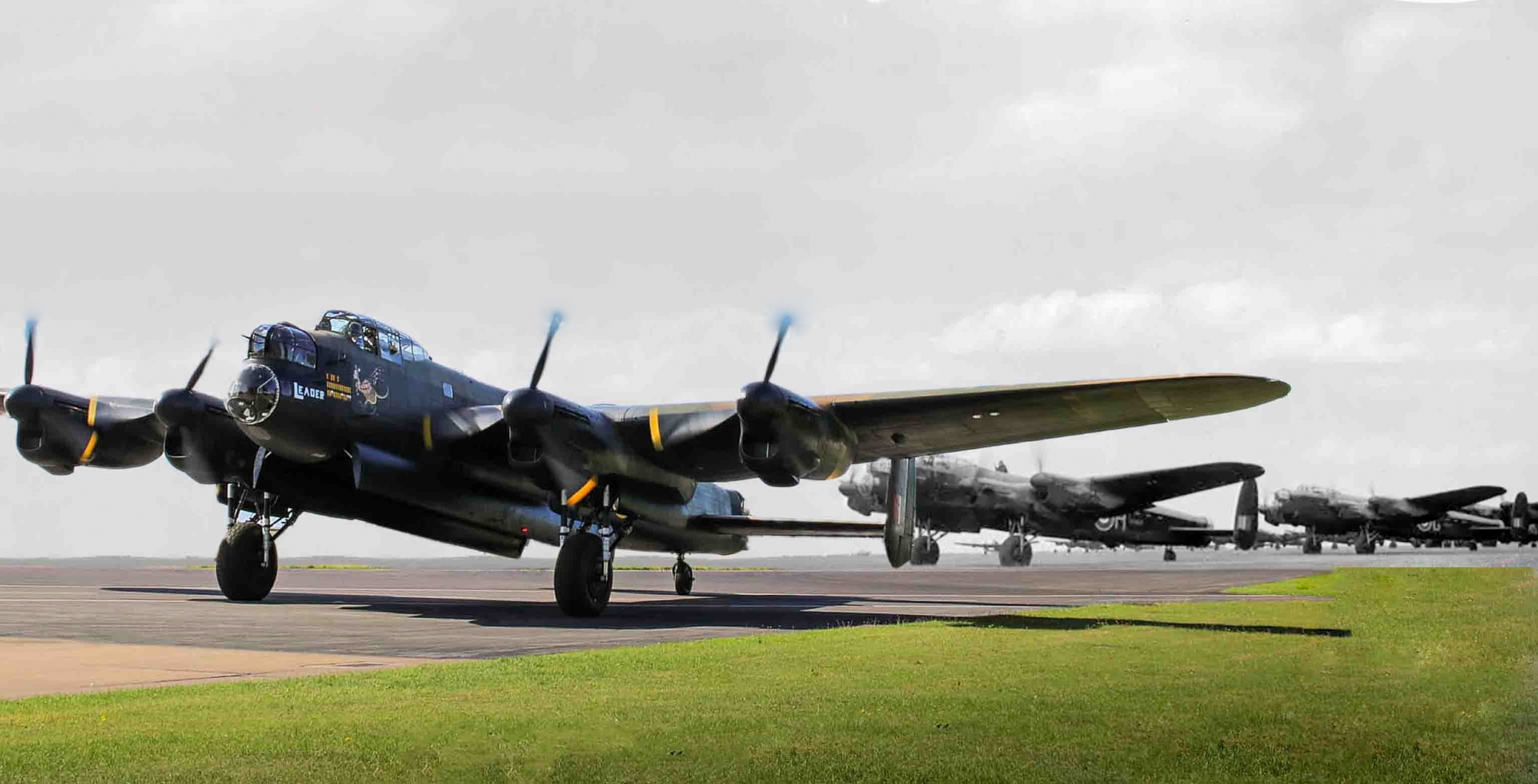
Soon, all four engines are straining to be unleashed, members of ground crew are in place, a hand signal ‘chocks away’ and the throttles are eased forward to begin the long snaking line of taxiing Lancaster Bombers. Operation Zeitz has commenced.
Avro Lancasters -Pathfinders at RAF Coningsby, Lincolnshire, 1944 taxiing for take-off.PNG
Page 22
As Lancasters leave the runway, below, in darkness, in quietly lit parlours across Cambridgeshire, blackout curtains forbid emission of light, a couple wonder about their son. They have no idea where he is serving. A paratrooper, dad surmises often, that must therefore mean their son is somewhere in Europe, and no news is good news.
In reply to his unspoken commentary, Mum nods, It’s a heavy one tonight. God help them all on the receiving end.[1]
At 18:13 hours PB402 LQ-M leaves the runway.[2]
The parlour now is far, far behind PB402 LQ-M.
At 17:19 a near perfect scenario had also acted out at RAF Croft in the county above Lincolnshire, in North Yorkshire as Lancaster Mk X KB850 WL-O heaves into the night, also on Operation Zeitz, the captain Flight Lieutenant Kiehl Bauch RCAF and his Flight Engineer Flight Sergeant Turner RCAF.[3]
[1] Mum would tell me often, even as a boy, that the family would say this hearing the aircraft gathering overhead. Think of this gathering from 12 Counties as 700 or more aircraft gathered from 31 Squadrons across 25 RAF Stations.
[2] W R Chorley Bomber Command Losses 1945 Volume 9
[3] In the WR Chorley Bomber Command Losses 1945, Mr Chorley observes ‘that it is possible that Flight Sergeant Turner RCAF was an Englishman serving with the RCAF; certainly, he had married Margaret Kathleen Turner of Church Stretton, and it seems likely from evidence in the CWGC cemetery register that his parents, too, lived in the same area’. I am indebted to Mr William Chorley for this information in the definitive Bomber Command Losses of the Second World War. KW
Page 23
PB402 LQ-M and KB850 WL-O fly towards their target, the Braunkohle-Benzin Synthetic Oil-Plant located at Zeitz, near Leipzig in what today is the Saxony-Anhalt Region of Germany.
Aircraft faced countless dangers on operations whether by night or day. Numerous aircraft were lost by bombs being released from above them. It simply was not always possible for aircraft to fly and at the same time give higher formations clearance to release their payloads.
Another danger suffered by hundreds of aircraft on night and day operations were mid-air collisions.
This was the fate of PB402 LQ-M and KB850 WL-O on this night. The collision, according to German eyewitness reports, was of a huge explosion in the sky. PB402 LQ-M came down in woodland in Pfaffenhausen.[1][2]
All fourteen crew were lost. PB402 came down in woodland. The Luftwaffe Crash Report suggests that one of the crew had been found not far from the site, as they had followed the blooded footprints in the snow. And so far as I can tell, it is possible that PB402 was still outbound, as Harry’s death is presumed to have occurred on 16 January 1945.
Page 24
Closing Note
We live in the most dangerous times in 81 years. We do not know the outcome, but it seems to me that it is time for me to close my work on aviation matters.
I do, however, have a sense of achievement that has eluded me for many years, namely, reporting extensively on what our uncle, Harry Alfred Marshall, had achieved in his short time.
Family history always felt lopsided because we knew so much about Ken, but so little about Harry.
Now the scales balance perfectly.
Carol, Ness, I know that this is of past events. I take the wider picture. Archival research brings me face to face with the reality of our ancestors. It also enables us to recognise past calamities, be alert to repetition, and hopefully bring to us all reform without, as they saying goes, throwing the baby out with the bathwater. It enables us to always use our vote wisely.
“State of the Art” is not a 21st Century or 20th Century awareness. It is a concept existing since Time immemorial.
I thank you for reading this. It means much to me. Ken xx
[1] The WR Chorley Bomber Command Losses 1945 carries an additional note: there are at least four locations in Germany named Pfaffenhausen but in respect of this aircraft, it is believed the place so named is on the road between Krumbach and Mindelheim.
[2] When Rita (in the Rheinland Pfalz) realised this, I received this note… I lived near [this] Pfaffenhausen in Augsburg for five years.
Kenneth .T. Webb
Flight Lieutenant RAF VR Rtd
16 January 2026
All Rights Reserved
Gloucestershire and Liverpool
© 2026 Kenneth Thomas Webb
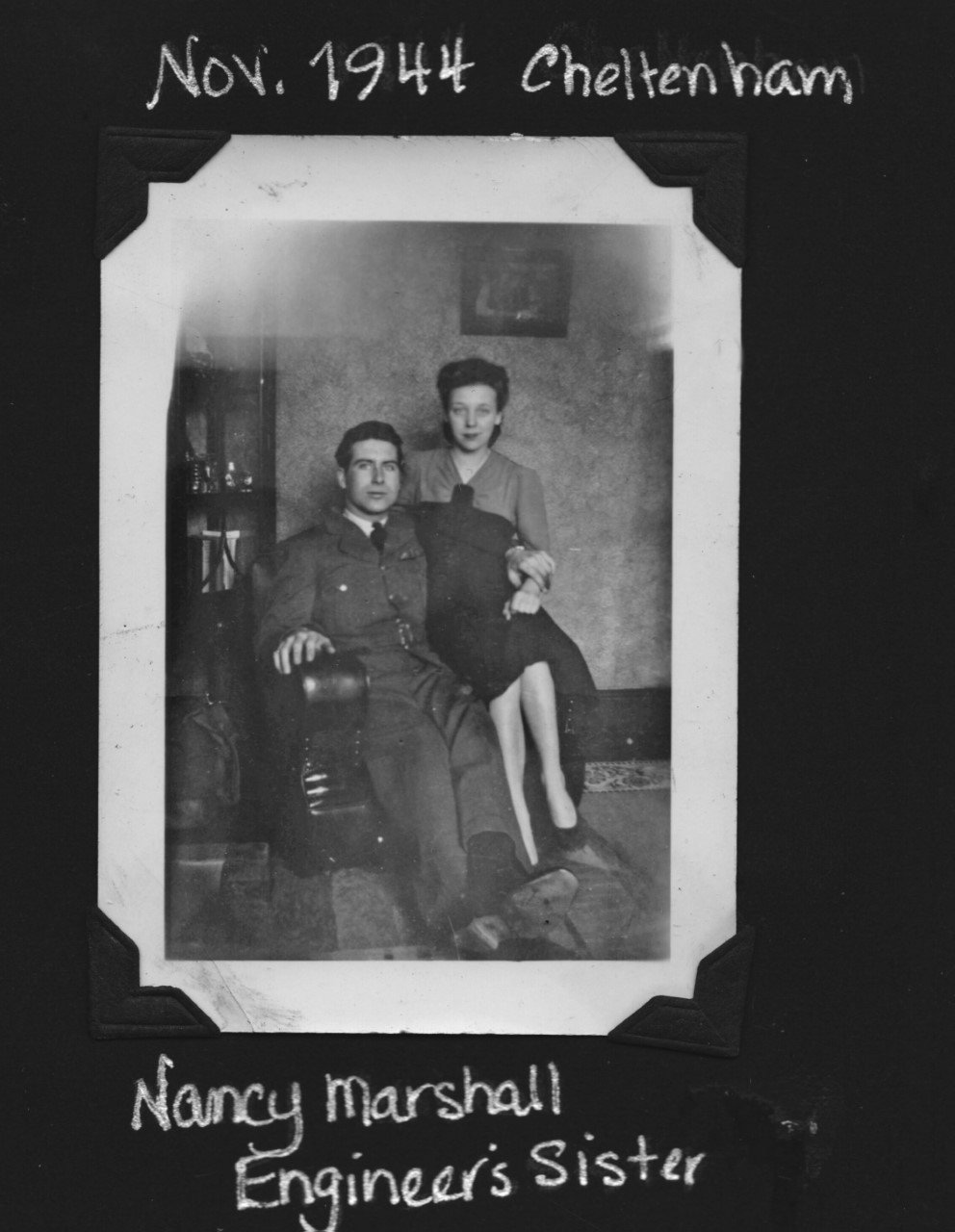
November 1944, Cheltenham
My Mother, Nancy Webb née Marshall with Flt Lt Leslie Payne RCAF.
The glass cabinet now stands as a presentation cabinet and is around circa 1898 or earlier, originally standing at Vine Cottage Cheltenham, the earlier family home of Mum.
Vine Cottage reaches back three generations prior to 1944 to the Marshall, Bowles and Hope Branches of the maternal family tree.
KTW
Flight Sergeant Harry Alfred Marshall RAF 1337884
(1923-1945)
Pathfinder
This portrait would have been prior to posting to 405 (City of Vancouver) Squadron RCAF
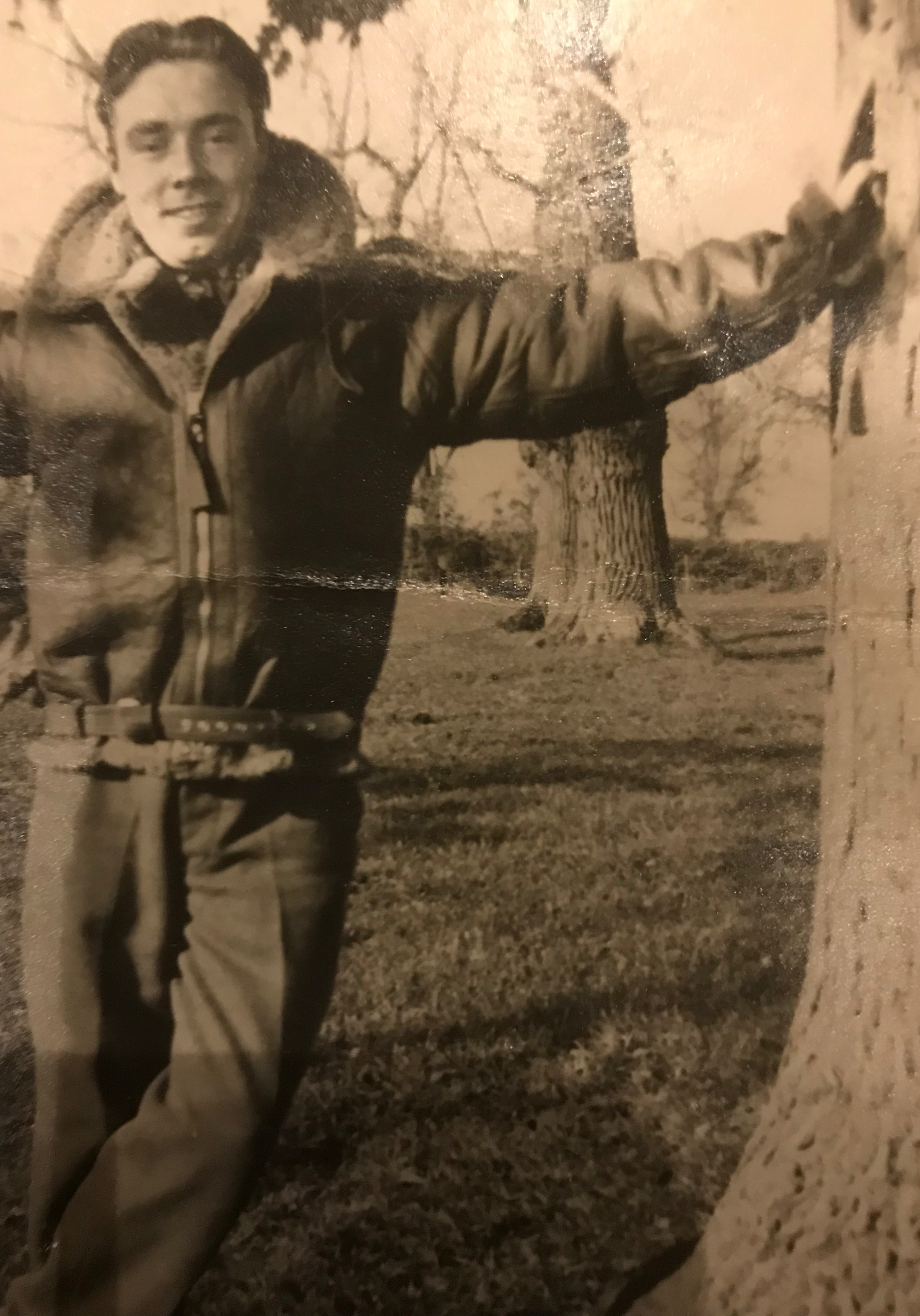
Aye! You’re right there, our kidder!
Last photograph in November 1944.
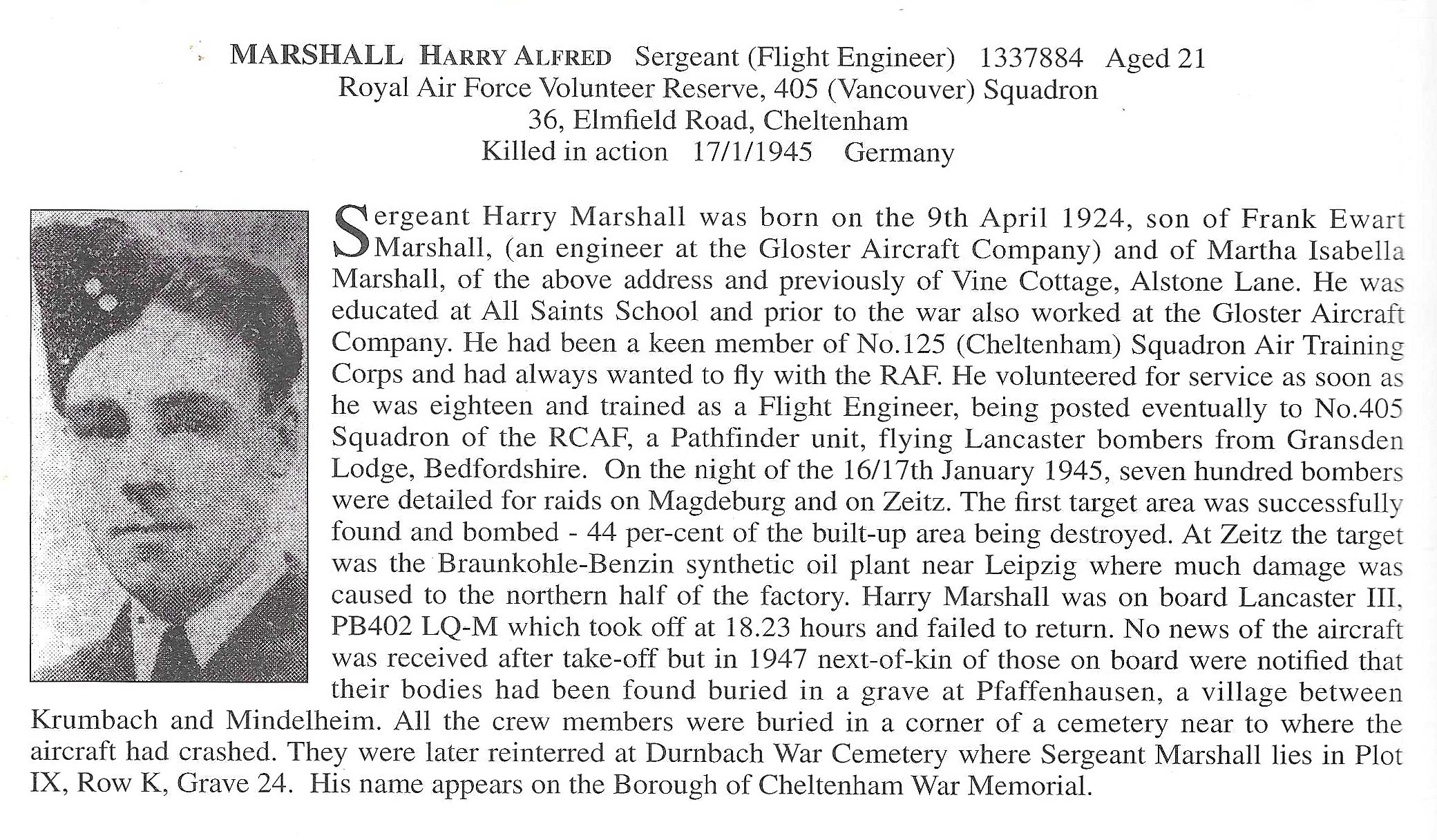
Entry on page 272 Cheltenham Roll of Honour published in 2000 by Graham Sacker and Joe Deveraux
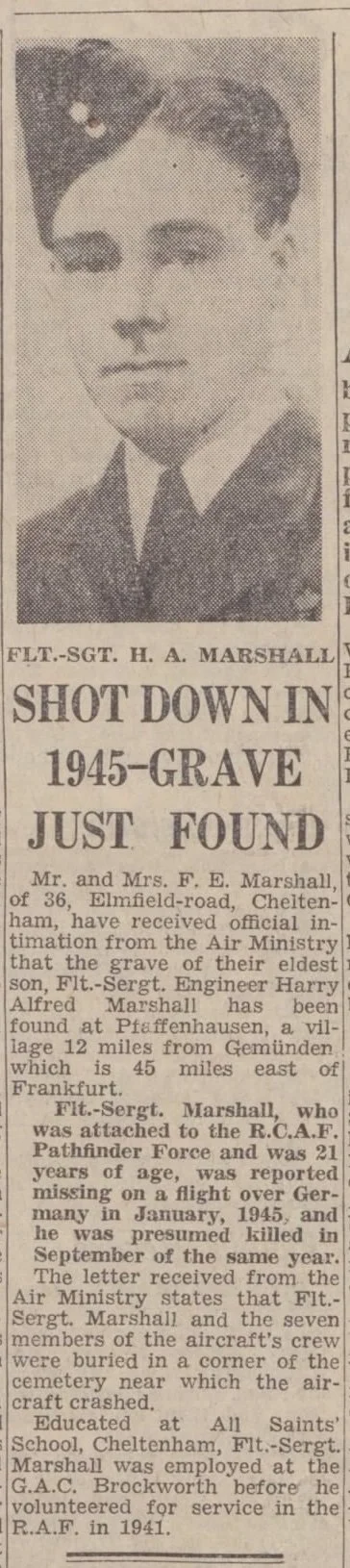
Found in 1947
This Tribute appeared in the Gloucestershire Echo on Wednesday 17 September 1947, the full page being the next plate. This is the original cutting from the family archive.
The full page is by courtesy of Newspapers com with whom I maintain a full annual subscription via Ancestry com.
The headline presumes that the Crew were shot down and we had no reason to think otherwise. Seventy years later, we learned of the mid-air collision.
KTW
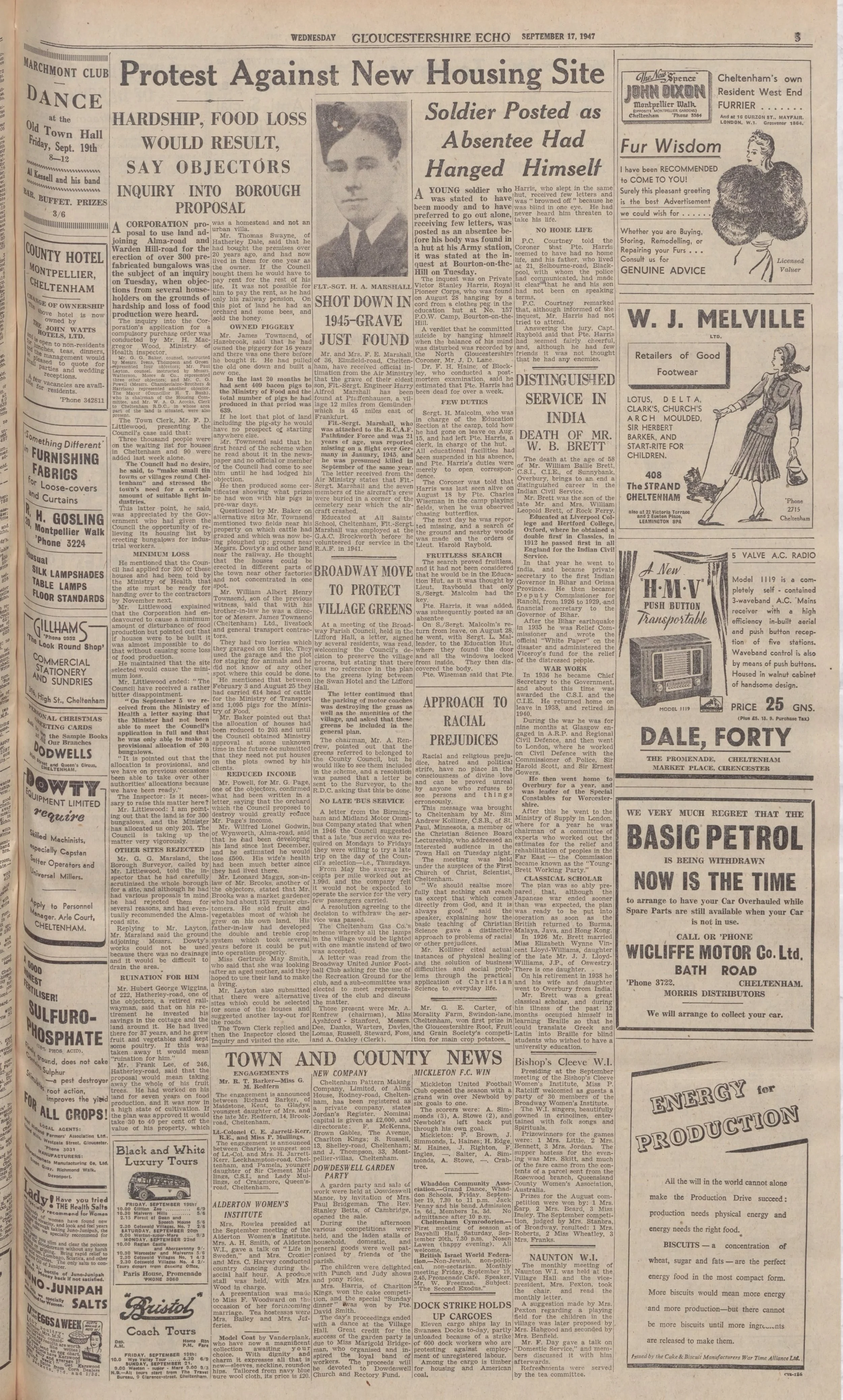
Gloucestershire Echo
Wednesday 17 September 1947 page 3.
The page reflects the aftermath of the Second World War in many ways.
The immediate post war period reflects the inevitable consequences of what, today, we fully recognise as Post Traumatic Stress Disorder.
We see, too, a report on racial prejudice and I’m reminded of my mother’s rebuke by American GIs at the Town Hall Dance for daring to dance with ‘one of them’. I have reported elsewhere the outcome and Cheltenham and the RAF making it abundantly clear on that night… this is Great Britain. It is not America.
In July 1945, American Armed Forces attempted to set up a colour bar in the towns adjacents to their bases. They were given their marching orders.
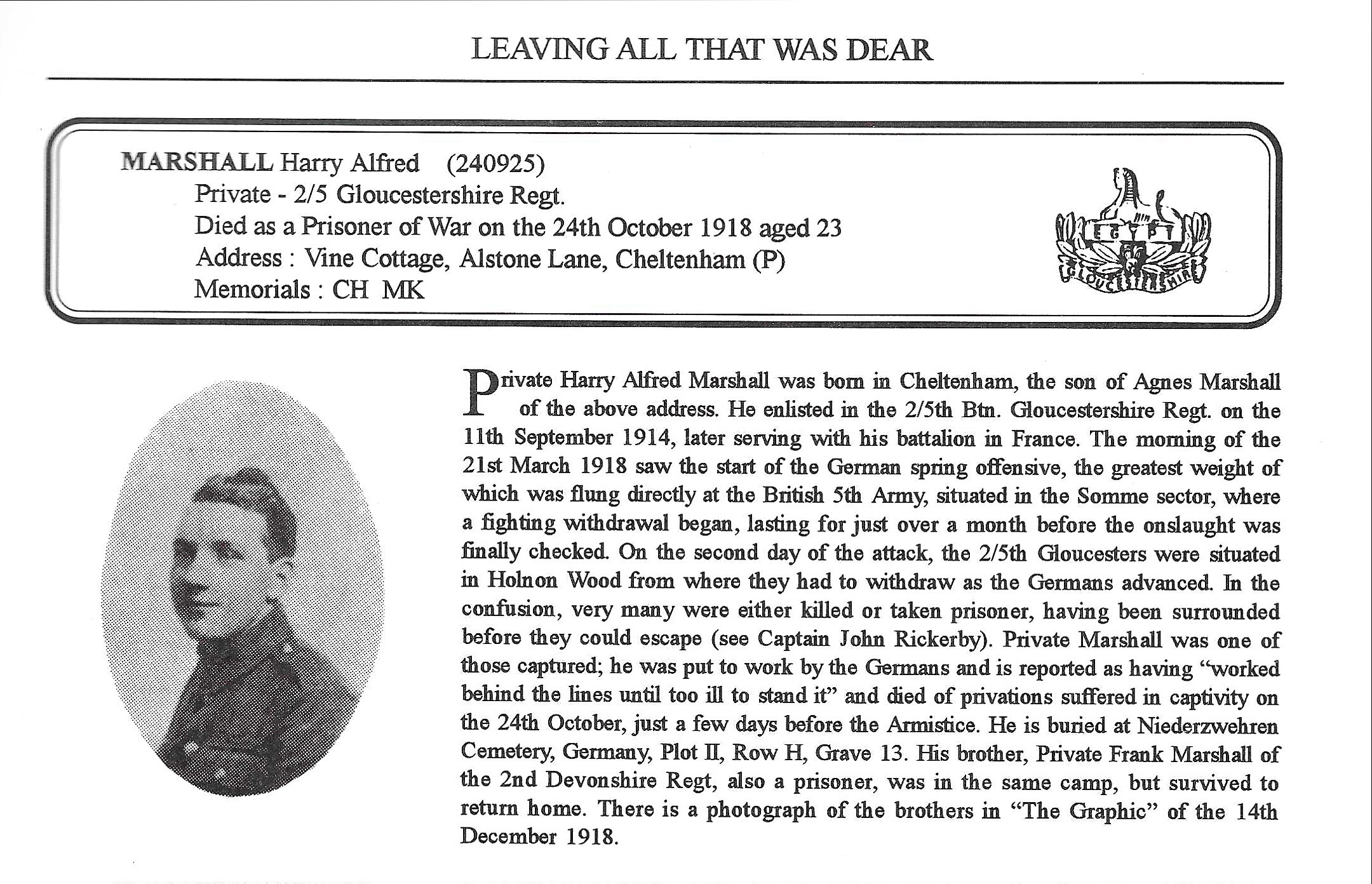
It is right to include herein our Great Uncle Harry Alfred Marshall after whom our Uncle is named.
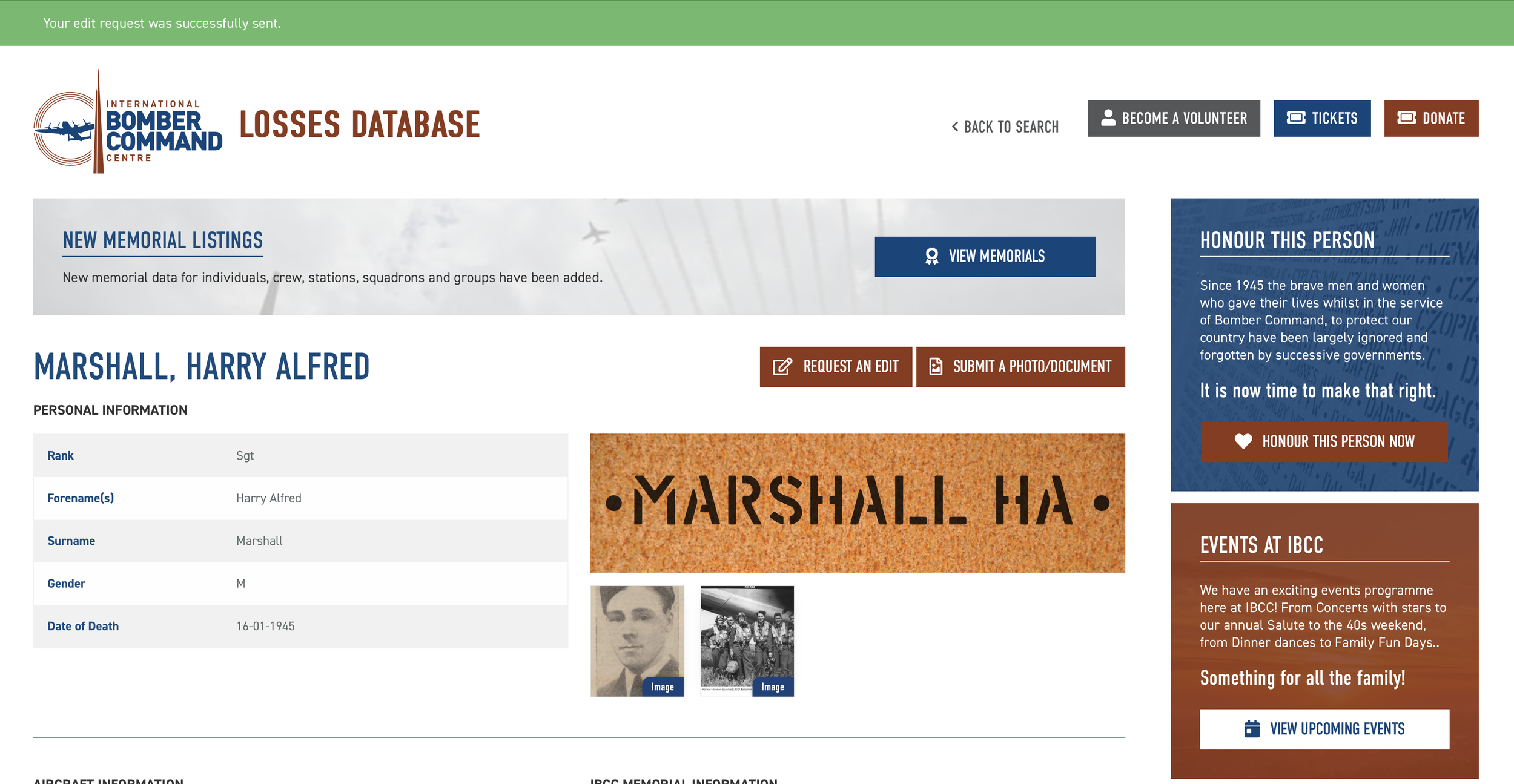

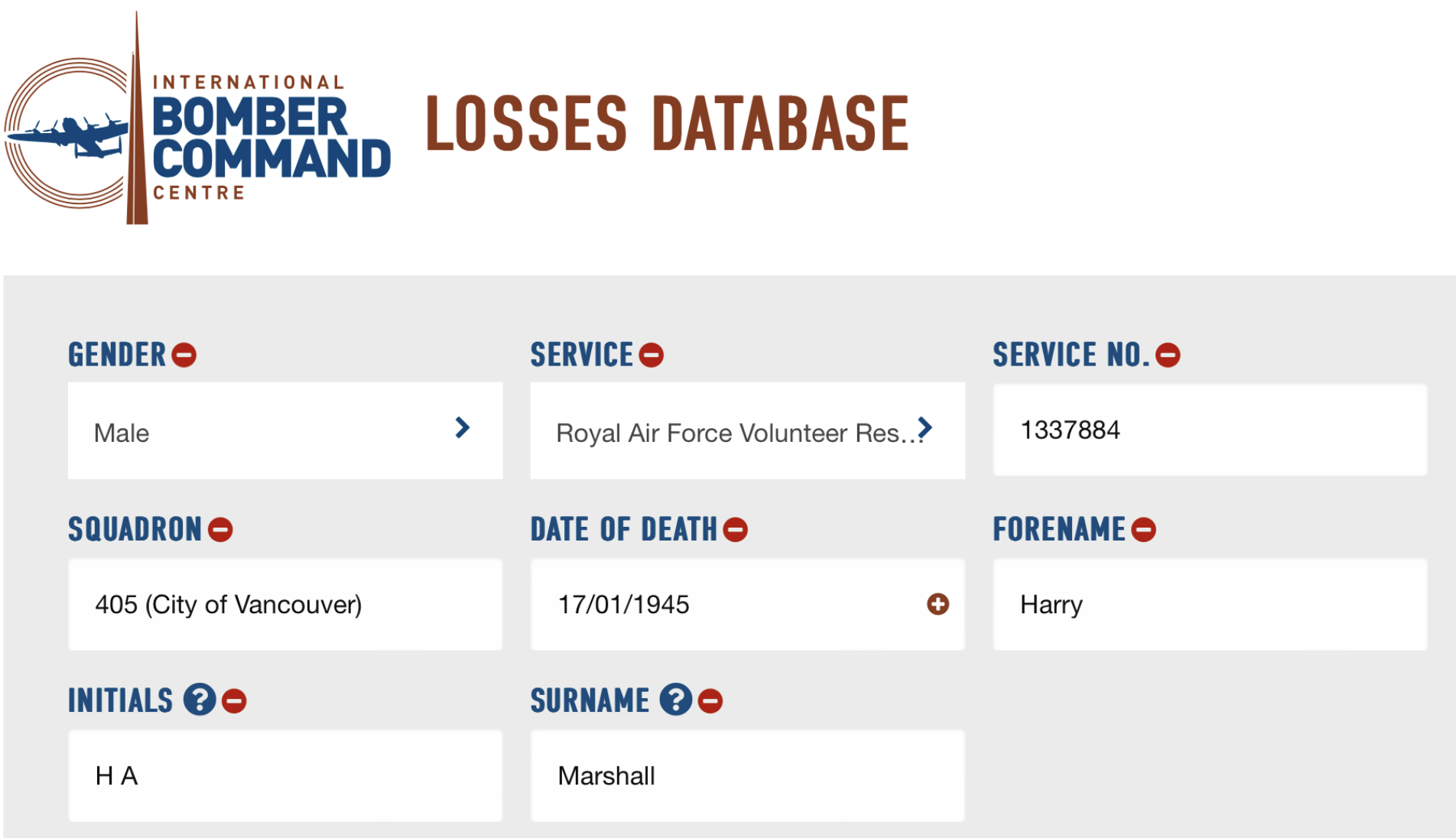
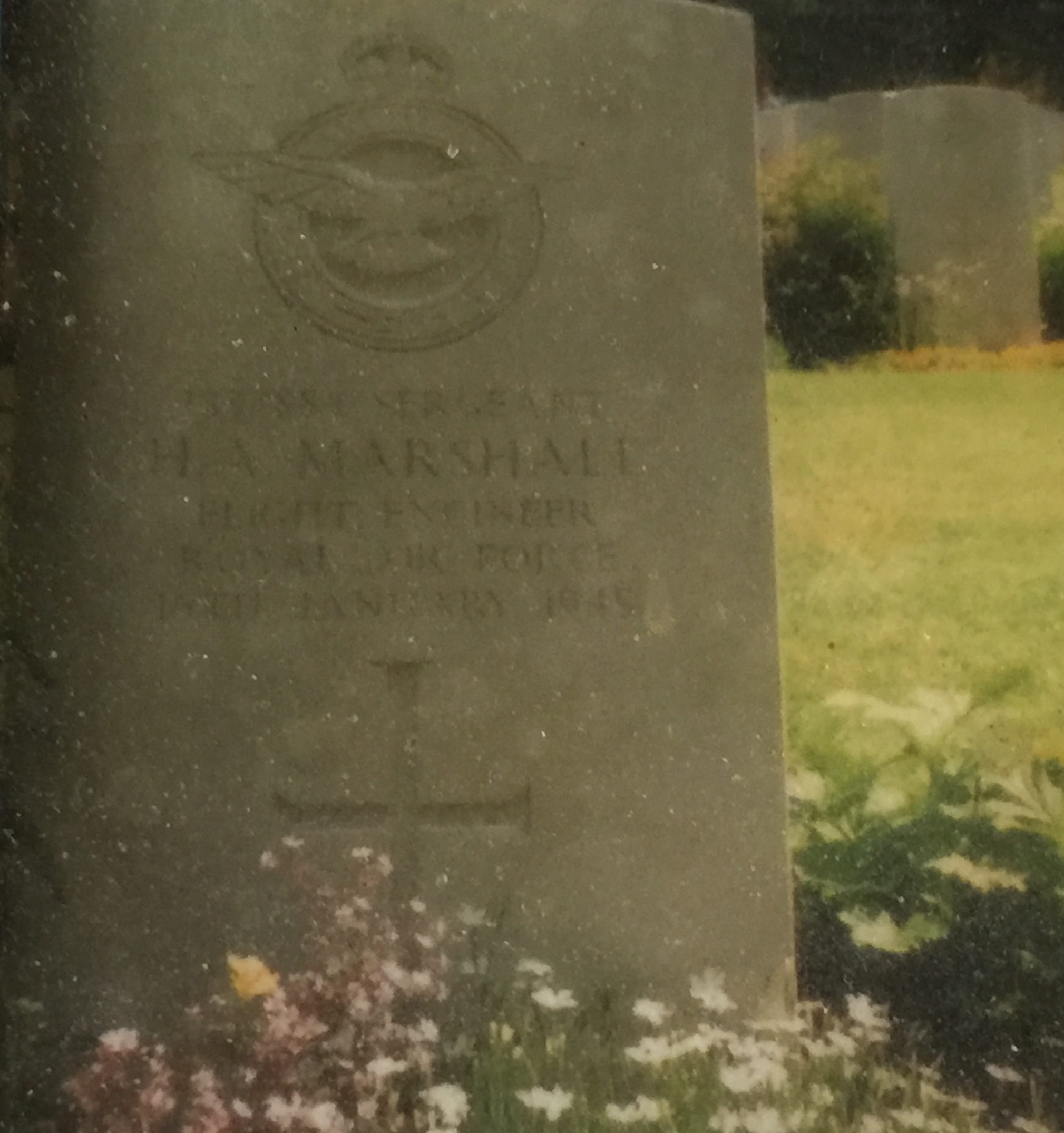
Photograph taken by Mrs Nancy Webb at Durnbach, CWGC, Germany in 2001

I love this ~ for we see Grandma at Grandma’s best
Life does recover, Life goes on
Oh, and who’s that behind Rog?!
And who’s that next to Carol?
Ah, Guy! Roger’s eldest of “We Three” Guy, Roger, Ben
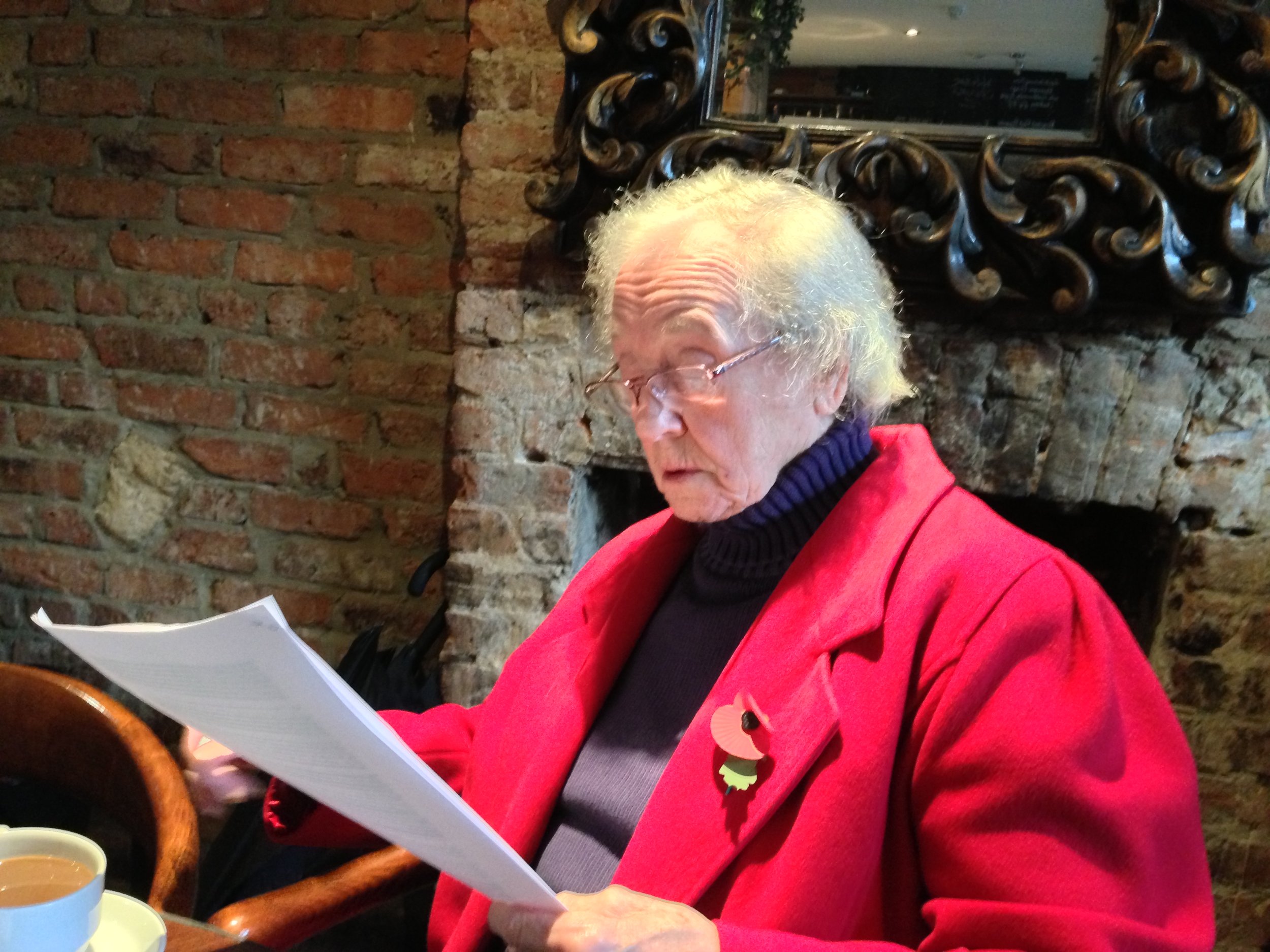
Mum (Mrs Nancy Webb) reading the Crash Report at Morans, Bath Road, Leckhampton 8 November 2013
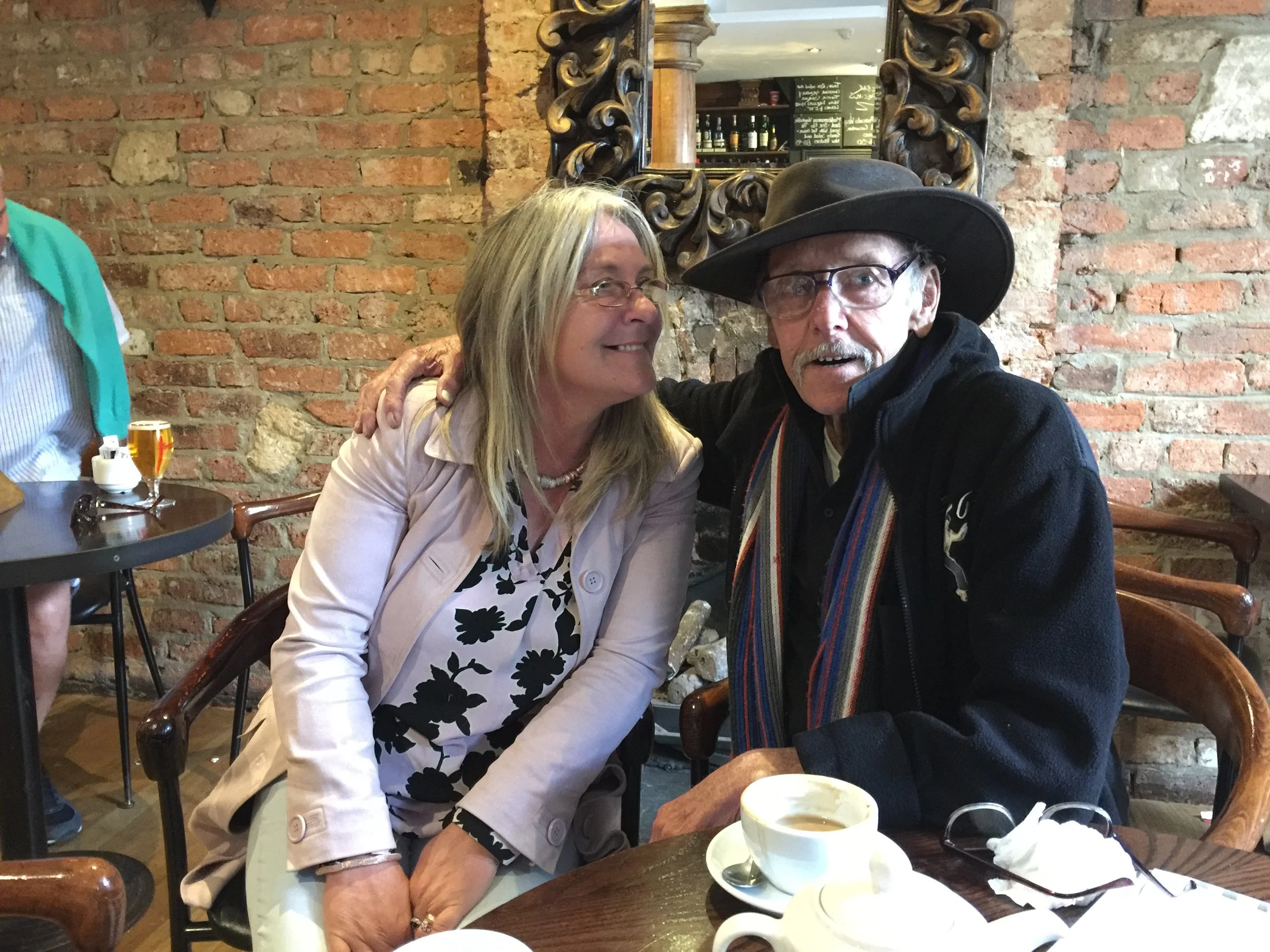
Uncle Frank seated at the same table with Bridgette (Eldest Daughter) on 14 July 2017
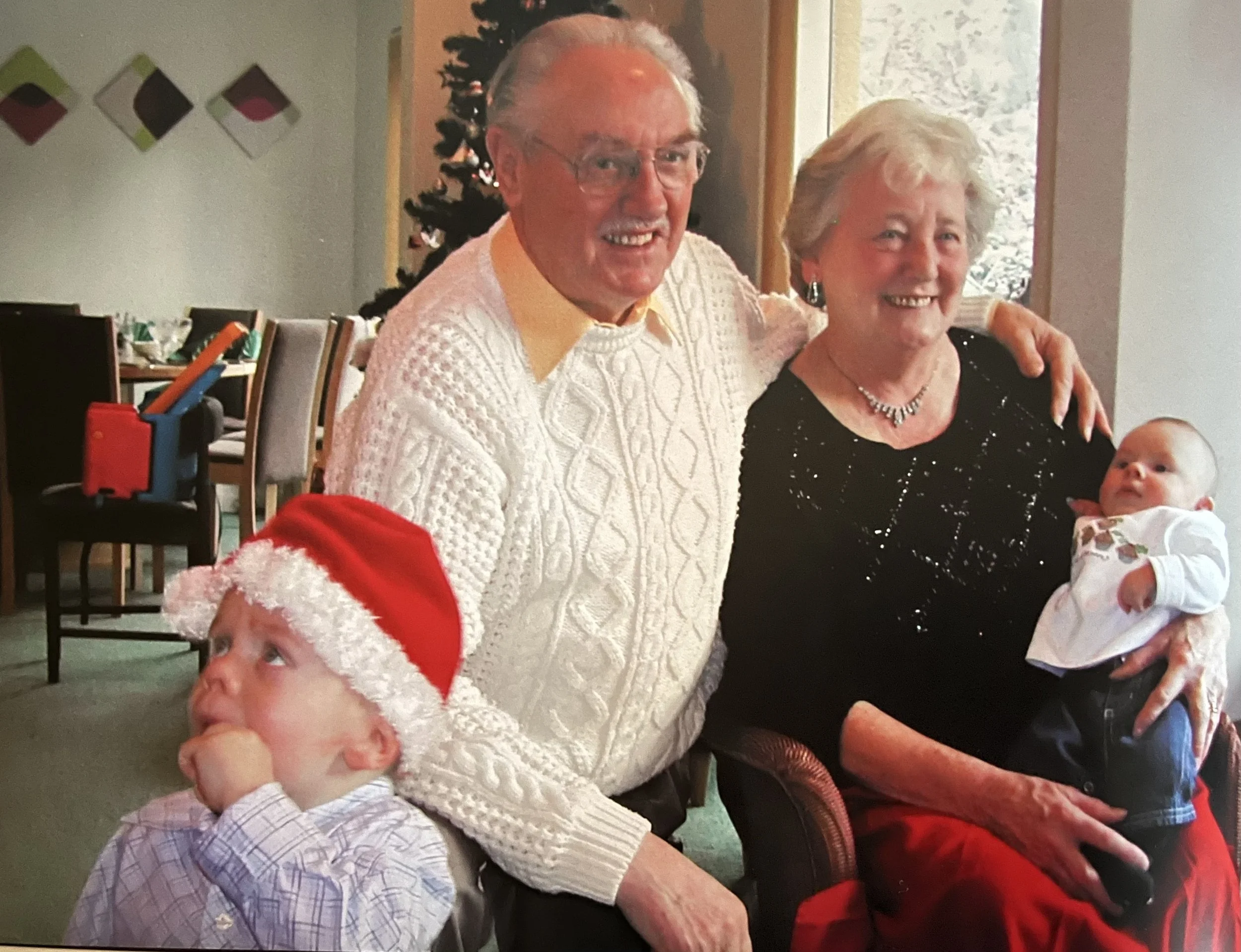
Mum, Dad, Sam, Jack ~ Bredon
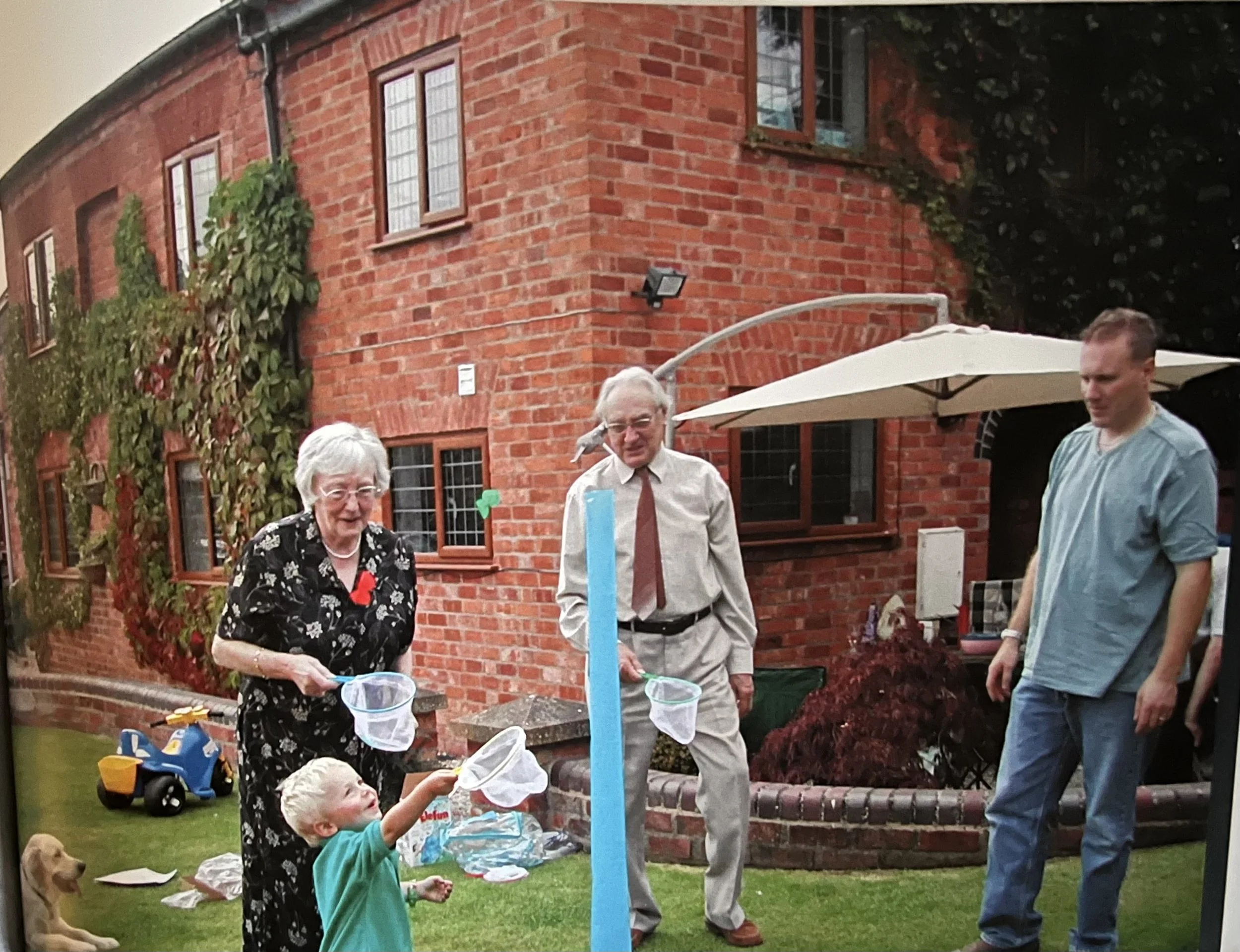
Mum, Dad, Chris, Jack and Amber
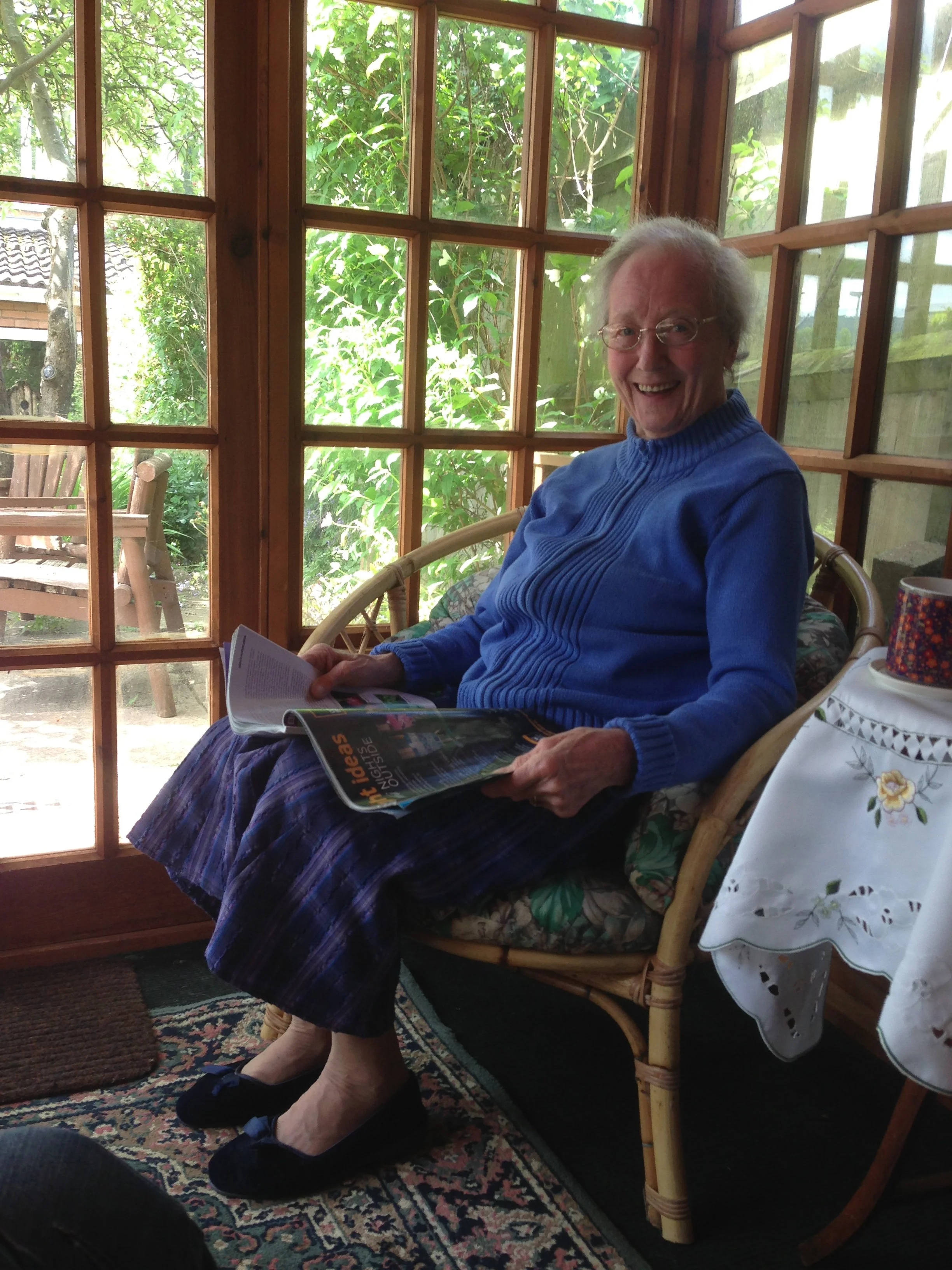
Always a laugh ~ The Summerhouse, Pittville Mount Park
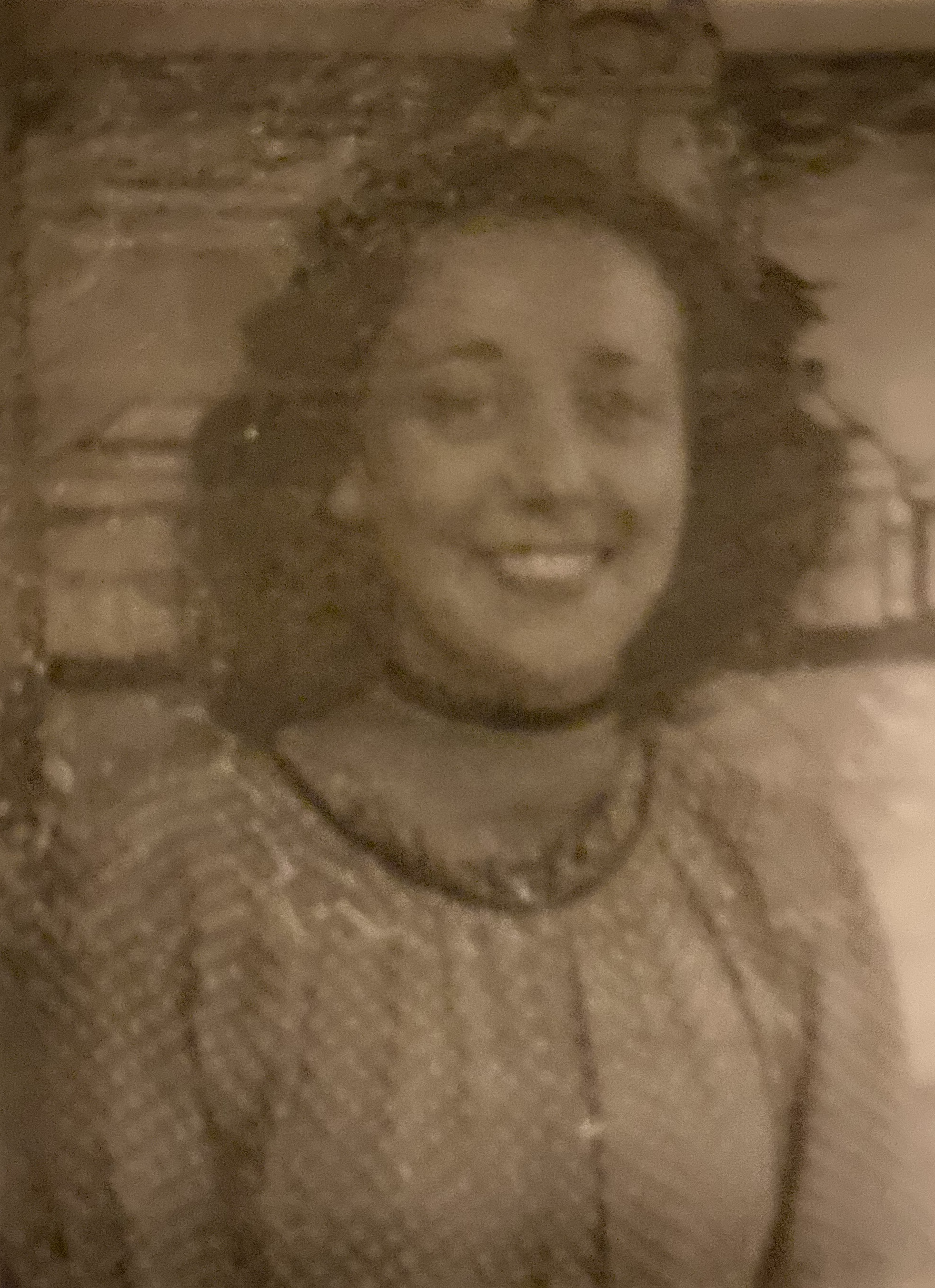
Mum ~ Mrs Nancy Webb née Marshall cica 1949-1950 Harry’s Sister and most stalwart defender across 89 years.
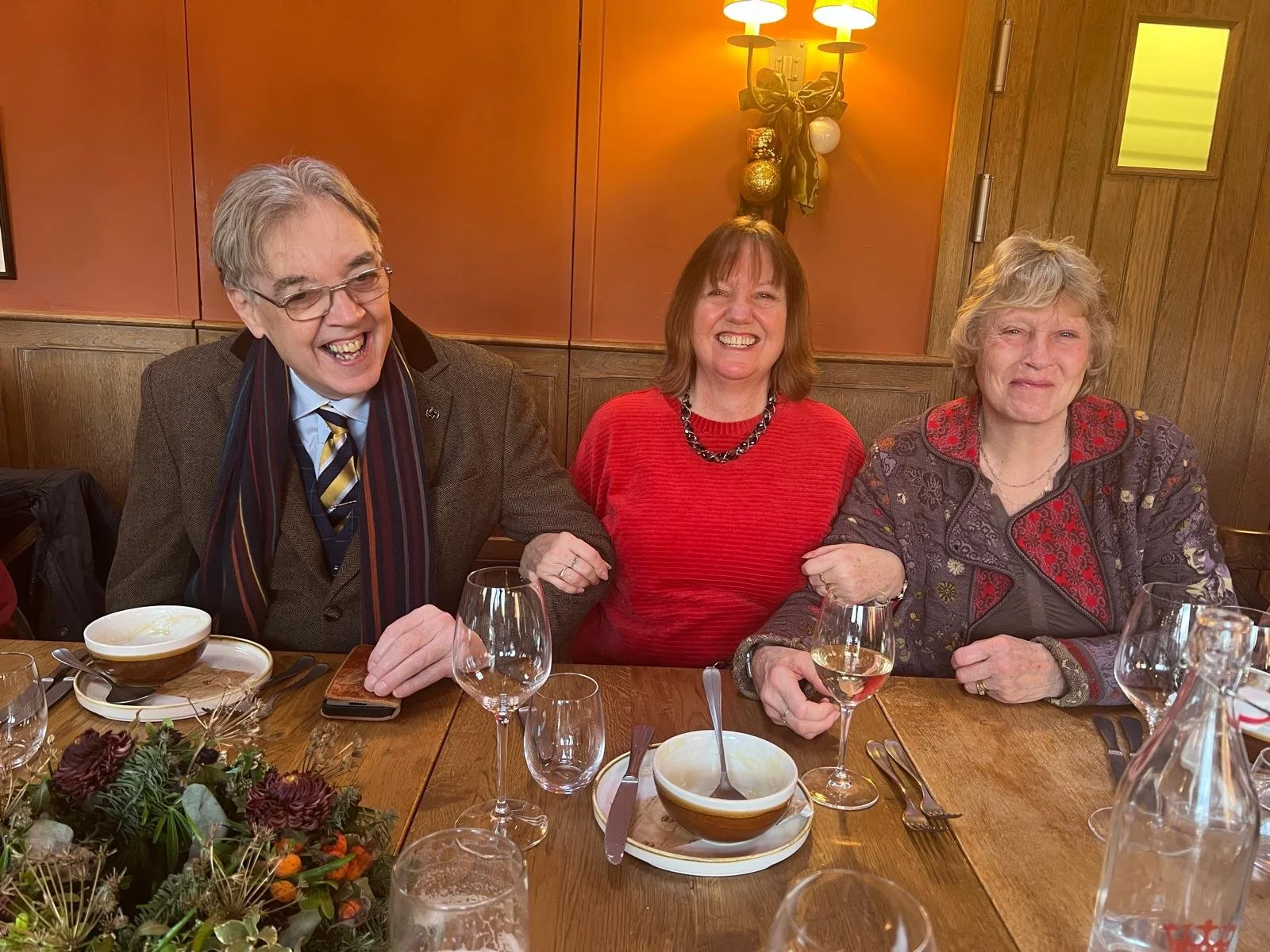
We Three
Right to Left
Carol Vanessa Ken
“We Three” ~ Carol, Vanessa and Ken. Life Goes On ~ Life is Good.
Marlborough
December 2025
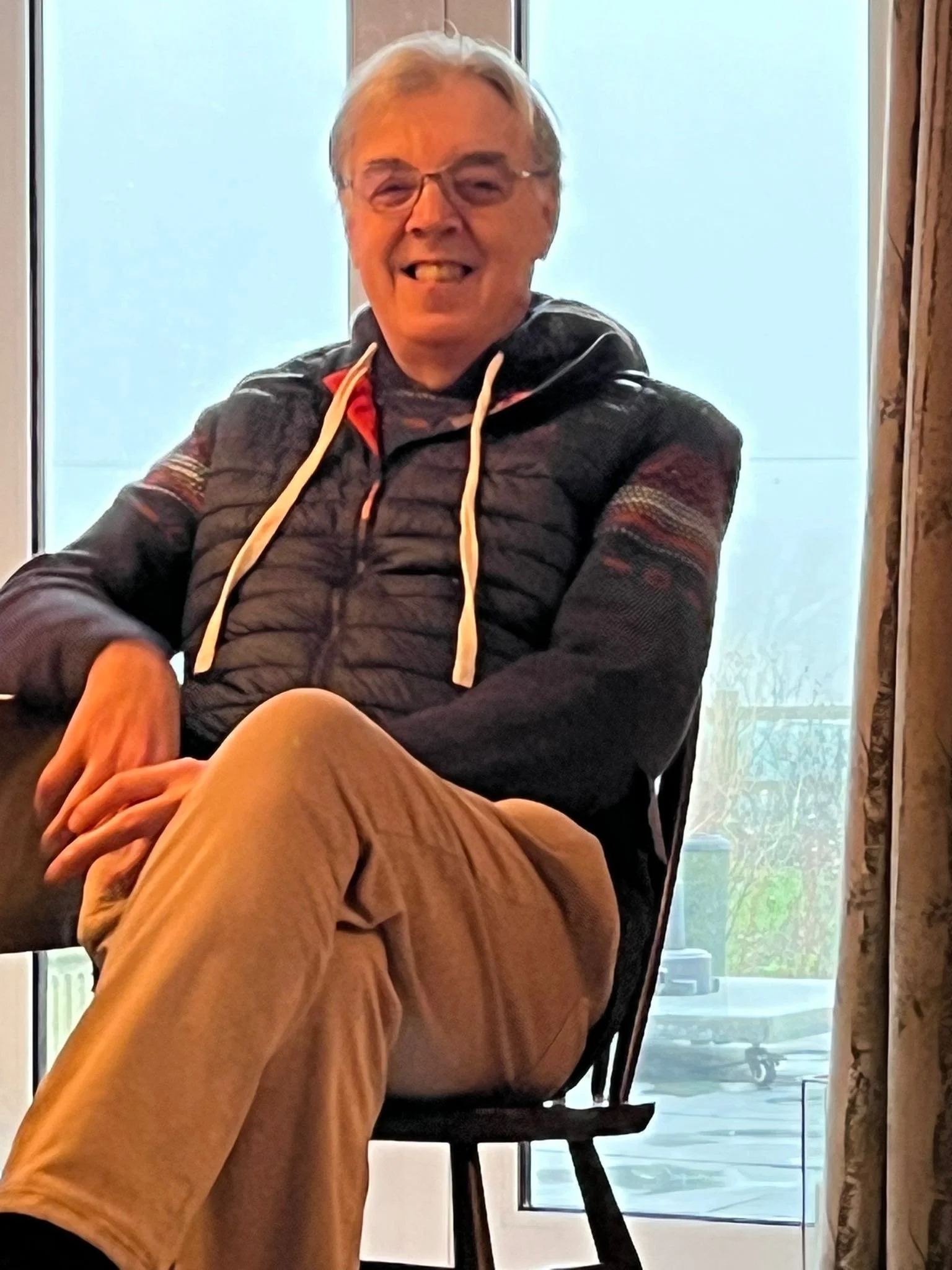
Relaxing with the Family Christmas Day 2024

1985 ~ A Different Century, a Different Era, a Different Life