William Marshall 1796 ~ Land Surveyor ~ An Introduction
Gloucestershire
The Rural Economy of Glostershire
by
William Marshall
18th Century
in the
29th Year
of the
Reign of King George III
1760~1811

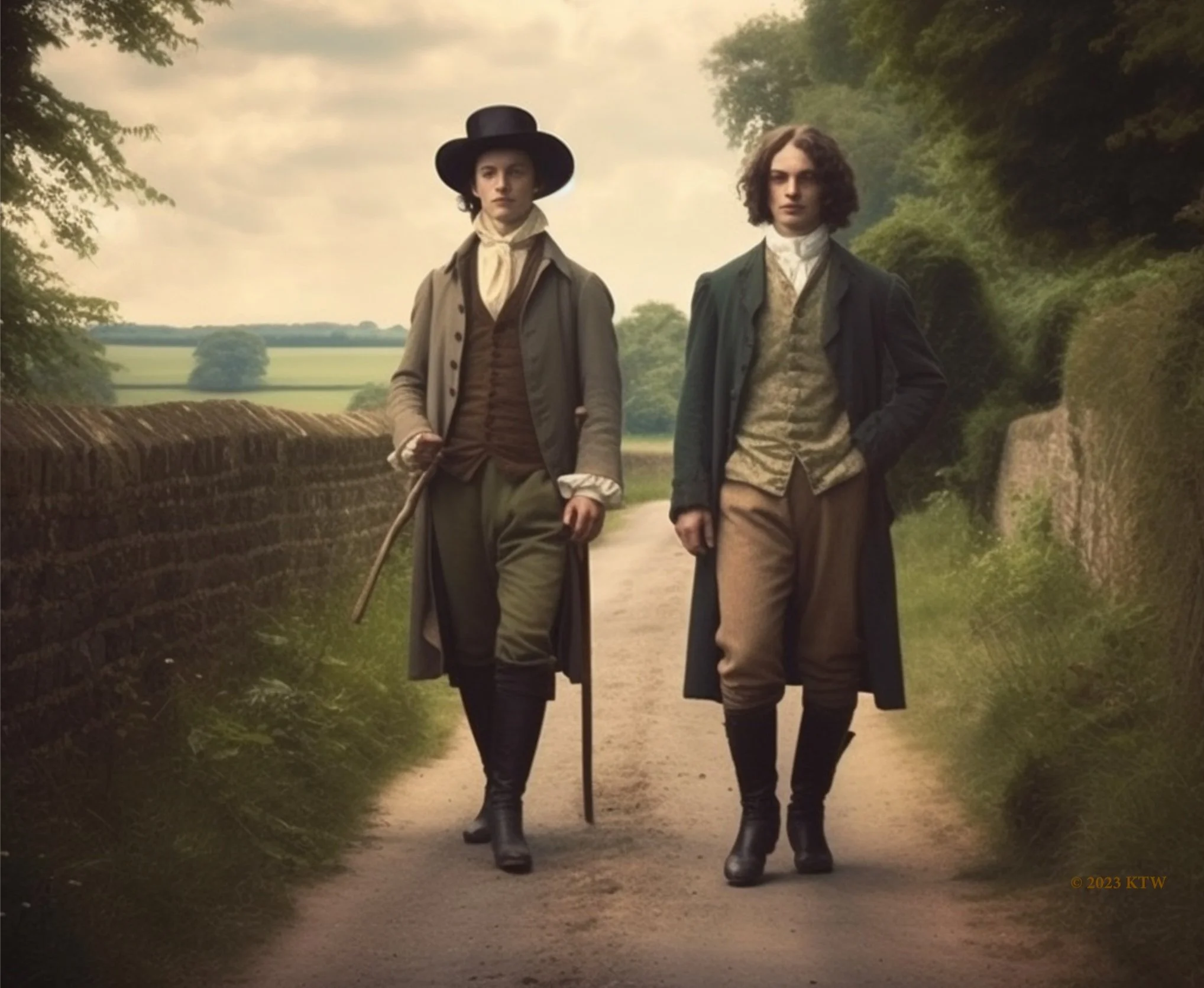
In the mind’s eye ~ a depiction, perhaps, of William Marshall as he undertakes his Examination of the Rural Economy of Gloucestershire in 1789. One imagines the surveyor walking with a colleague along Bushcombe Lane on Nottingham Hill just above Winchcomb in the North Cotswolds.
WILLIAM MARSHALL
During the reign of George III
An Introduction
“I emphasise that the author’s name, William Marshall, does not mean that there is any ancestral link.
None at all.
I only include this note because this also forms part of Windsor Street Days (Second Edition) 2025.”
William Marshall was a surveyor of land whose work, emanating from his practice in the county of Surrey, undertook a series of very detailed surveys on horseback during the latter part of the 18th century. His published works include:
The Rural Economy of Norfolk
The Rural Economy of Yorkshire
The Rural Economy of Glostershire
The Rural Economy of the Midland Counties
The Rural Economy of the West of England
The Rural Economy of the Southern Counties
This is my first detailed study of the Agricultural Revolution of the 17th and 18th centuries.
Then followed the Industrial Revolution of the 19th and 20th Centuries. This, in turn, gave rise to the fifth British Empire, the largest empire in recorded history. Empires rise and fall. The British Empire fell but not in quite the usual way. By 1948 it had metamorphosed into the British Commonwealth. Students of historyk will recall the interchanegable use of those two terms, none more so than when Churchill used this conjunction in his we shall never surrender speech when he uttered that opening line…
What General Weygand has called the Battle of France, … is over… … … I expect that the Battle of Britain is about to begin.
When I first heard that speech on an LP vinyl in the 1960s as a teenager, I remember even then, my throat catching. Hearing his voice descend with each of the first nine words, then a brief pause that seemed akin to a cliff edge with all the terror that comes with being on that edge, then a slight relief in the next two words, but followed by an even longer descent of silence, and then those final eleven words, each word the next step down that long stone stairway away from the edge but into what we knew might be oblivion.
I remember sitting for quite a long time. So this is what Mum and Dad and Grandma and Grandad Webb and Grandma and Grandad Marshall and Aunt Bette and Uncle Arthur and Uncle Ken and Uncle Harry heard, the last two not returning.
And then hearing Churchill refer to something that I could never comprehend before teenage but which I was very aware of…
… the British Empire and its Commonswealths struck a chord. I remember my history teacher, Miss Martin, explaining to me that ‘commonwealth’ was singular, and reminded me that I would do well to make a mental note that Churchill had a lisp, and to always give latitude.
And yes, within a very short period of time the British Commonwealth changed its name to the Commonwealth of Nations. At the outset it was eight nations, today this Commonwealth is fifty-six voluntary nations, and increasing.
I
First published in 1796, I have Volume One entitled The Rural Economy of Glostershire, a facsimile edition published by Alan Sutton Publishing Limited of 17a Brunswick Road Gloucester GL1 1HG in 1979, 190 years later.
The book before me is antiquarian, a Limited Edition of 200 Sets. The two volumes are facsimile reprints of the 1796 edition. My copy of Volume One is Set No. 40.
The facsimile is printed in Great Britain by Redwood Burn of Trowbridge and Esher.
How strange… 1979 is, for me, a few seconds away, a minute at most.
In my ninth year in the Gloucestershire Constabulary I was on the cusp of posting to the Stow-on-the-Wold Rural Subdivision and about to be promoted to substantive sergeant after successful periods in Cheltenham as an acting patrol sergeant and as acting station sergeant ~ the latter being very, very operational. My next stop was the Inspector and Inspectors expected, quite rightly, that the station sergeant would make the majority of the practical and executive decisions, referring only to the Inspector when a matter or incident needed to be referred to senior command.
Of course, 1980 saw the return of epilepsy with a vengeance. Overnight, literally, I was posted back to Cheltenham in October 1980 and further seizures on duty on Christmas morning signed off the inevitable. I must be medically discharged in January 1981. Losing my Constable’s Warrant Card was, to use Churchill’s words my own ‘grim and grevious hour.’
When William Marshall was conducting his Surveys of England in the 1780s-1790s, the Fourth British Empire was metamorphosing into its fifth and final evolution.
II
I was born in Cheltenham, Gloucestershire, following fourteen very important years 2003-2017 in Liverpool, having qualified at Worcester College in 1987, I practised law in the City of Gloucester a stone’s throw away from Brunswick Road, as well as Cheltenham, Bristol, Oxford, Beaconsfield in Buckinghamshire, Folkestone and Dover, Kent and thence Merseyside and finally in Preston and Blackpool, Lancashire, retiring from the legal profession in 2011.
I emphasise that the author’s name, William Marshall, does not mean that there is any ancestral link. None at all. I only include this note because this also forms part of Windsor Street Days (Second Edition) 2025.
The agricultural revolution is especially important for me to understand because when I study family ancestry I find that in Southern Britain my ancestors worked on the land. Likewise, in Northumbria, my northern ancestors were skilled Miners in the Pit Collieries, and which continued well into the mid-twentieth century, my maternal grandmother’s brothers Thomas and William Hope (and their fathers before them), Thomas Hope becoming a Pit Manager.
With the Industrial Revolution in the 19th century, the Marshall branch of the family moved into the skilled towns trades and became master bricklayers, and then progressing to steam locomotives. In the 1920s, my grandfather Frank Ewart Marshall was a fireman on the footplate of the famous Cheltenham Flyer, and his name appears on the Commemoration Plaque that now stands on the site of what used to be the Swindon Rail Network in Wiltshire.

II
In the First Edition of Windsor Street Days, I have drawn upon William Marshall‘s work when I discovered that my great-great-great-grandfather was in charge of cattle, and which William Marshall describes in his section concerning the important role of the Herdsman. But I never studied in detail the volume until now.
I’m delighted to have this, as it opens up whole new areas of family life over many hundreds of years.
William Marshall gives a beautiful description of Gloucestershire and I would like to think that somehow, this gentleman’s spirit might be aware that his work written in the 18th century, is being read and enjoyed in the 21st century, and also bringing great delight and enlightenment to a Glostershire man born and bred.
EXTRACT by William Marshall
Pages 5 ~ 6
A Preparatory Note
(British English 18th Century)
I have disengaged Grammarly to protect the original style of writing, spellings and to accurately report William Marshall’s style and method of writing in his 1789-1796 manuscripts and notebooks.
For example, the town of Winchcombe in Gloucestershire is also correctly spelt in the Author’s Treatise as Winchcomb. This gave me the answer to a question that arose in the 1970s as a young police constable. My beat included the very long Winchcombe Street that ran from the High Street in Cheltenham in a very straight line to Pittville Gates. Yet half way along, the street sign - a very old one - declared I was now walking in Winchcomb Street.
I leave you to imagine the game a good solicitor would play in trying to trip me up with the incorrect spelling, thereby placing his client away from the scene from where he had been arrested.
Glostershire might well be styled the seat of picturesque beauty. It is equally a subjective study for the painter and rural artist; not in the outline only, but in the detail: the Stroudwater hills, and the banks of the Wye, are full of secluded beauty.
It is this lower extremity of the Southern Vale which falls within the district I have chosen for my present STATION.
Not an account of its beauty; but by reason of its situation, with respect to the other stations I have fixed in; its richness; and the various productions it affords.
Had it not been singularly characterized by natural ornament, I should not have detained the reader a moment on so unprofitable a subject.
But the eye must be dim and the heart be numbed, which can be insensible to the rural beauty of Glostershire.
Author Note
The Gloucestershire Constabulary’s archival records report that to remove the problem for visitors, Gloucestershire would be shortened from four to three syllables as visitors did not always realise that the letters U C E are silent. It is, however, important to note that William Marshall presented his treatise a century and a half before.
4 November 2025
All Rights Reserved
Gloucestershire and Liverpool
© 2025 Kenneth Thomas Webb
Digital Artwork is by KTW IBM unless otherwise credited.
The photograph of the Cheltenham Flyer is taken from the Internet and I have not been able to find its source.
Therefore, should anyone know where I might find this source, I will of course immediately apply the photographer’s / owner’s accreditation.
The reign of King George III of the House of Hannover was, until that time, one of the longest reigns ~ 51 years ~ in British History.
The reign of Elizabeth I (1158~1603) was 45 years, the reign of Queen Victoria Empress of India (1837-1901) was 64 years and of course, the longest reigning Monarch in British history.
is Her Late Majesty Queen Elizabeth II of the House of Windsor.
(1952-2022) 70 years.
First written 13 March 2025
Ken Webb is a writer and proofreader. His website, kennwebb.com, showcases his work as a writer, blogger and podcaster, resting on his successive careers as a police officer, progressing to a junior lawyer in succession and trusts as a Fellow of the Institute of Legal Executives, a retired officer with the Royal Air Force Volunteer Reserve, and latterly, for three years, the owner and editor of two lifestyle magazines in Liverpool.
He also just handed over a successful two year chairmanship in Gloucestershire with Cheltenham Regency Probus.
Pandemic aside, he spends his time equally between his city, Liverpool, and the county of his birth, Gloucestershire.
In this fast-paced present age, proof-reading is essential. And this skill also occasionally leads to copy-editing writers’ manuscripts for submission to publishers and also student and post graduate dissertations.