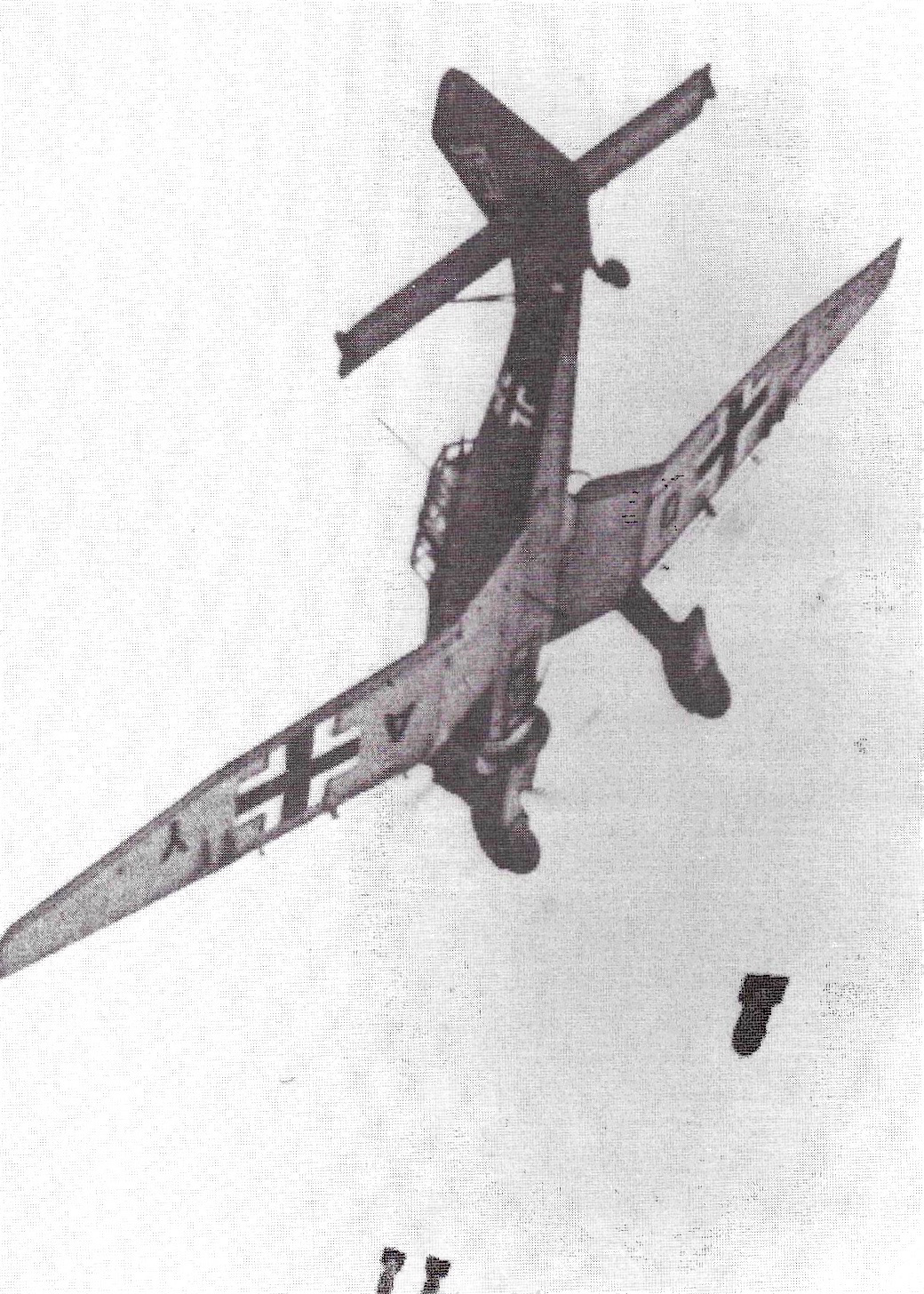
Eight Days in May
Book Review
Eight Days in May
by the People of Liverpool
(through Lord Derby) 1941
Thursday 1 May 1941
The title of this series ~ Eight Days in May ~ refers specifically to 1–8 May 1941, in the City of Liverpool, Bootle, Birkenhead and Merseyside.
In 2026 we see the devastation of:
The War in Ukraine
The Israel Gaza War
The US Israel Iran War
We see the devastation being caused by the Russian missile strikes on the civilian population, cities, towns and capital, Kyiv, right across Ukraine.
Likewise, Gaza flattened.
Likewise, American and Israel air offensives on Iran and Lebenon.
These are the equivalent of the World War II air raids that subjugated and crushed what had earlier become Occupied Europe.
What befell the City of Liverpool, over eight days, was kept from the British People for fear that it would undermine morale.
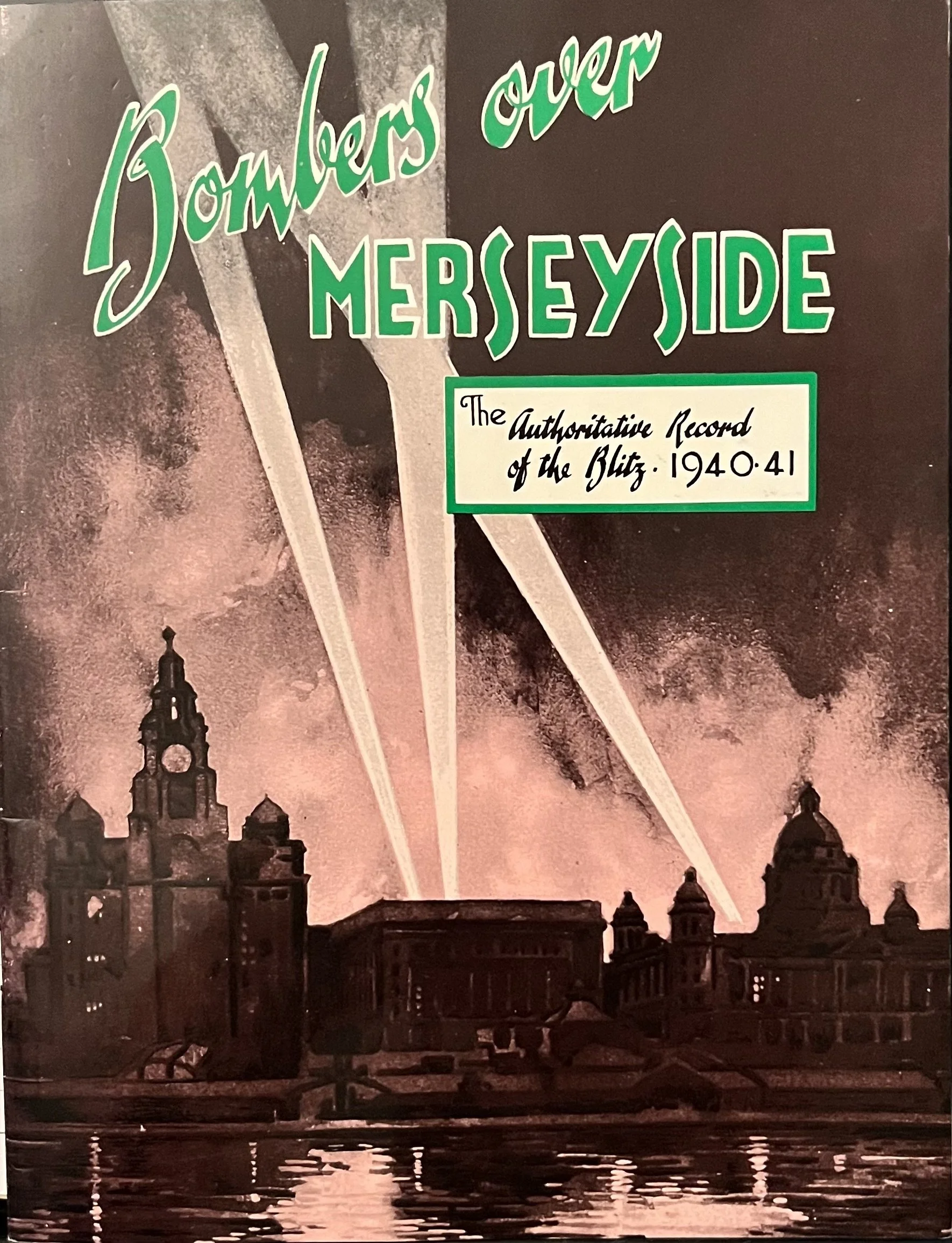
Fortunately, the people of Liverpool have a tendency to make their voices heard, and this came in the form of a little booklet entitled “Bombers over Merseyside” and published by the Liverpool Daily Post and Echo Limited in 1943 and whose foreword is written by the Right Honourable, the Earl of Derby. It is, therefore, a contemporaneous note.
Lord Derby’s Foreword:
“I am delighted to think that the authentic story of the bombing of Merseyside is being published, because I feel it is a step in the right direction, in placing on permanent record, the triumph and bravery with which the people of Merseyside answered the brutal call on their courage and steadfastness.
In addition, I am convinced that even now what took place here is not generally known and full credit has not therefore been given to the way in which the whole of this area stood up to its testing.
I believe that with the publication of this book, the country will better be able to appreciate – what we who know Merseyside already, realise, – the way in which the ordeal was faced.
Nothing could have been more inspiring, and it is right that this bravery should become known more widely than it is known at the present time.
It will, I think, be sufficient for me to say that I hope this account will stand for all time as a testimony to the gallant way in which the attack was met, and be an example to all parts of the country, if they should unfortunately be subjected to a similar attack.”
Introduction
The Liverpool Blitz commenced on 9 August 1940. Regular and sustained attacks on Britain's principal Port (it was and had been for at least a century the gateway to the British Empire that covered a quarter of the globe). American Lend-Lease was in full play whereby President Roosevelt lent us his garden hose to put out the fire - with ever larger convoys making the perilous, often fatal, transatlantic crossings.
The air raids were not opportune. They were powerful, deliberate and consistent.
Photography clearly shows that there was, at best, loose strategic targeting. In short, Liverpool was subjected to carpet-bombing. The term infrastructure was relatively unused in 1941.
Today, many presume it means intangible objects such as power stations and network, but not people. Grow up!
The People of Ukraine will very quickly disabuse this cosy, “Walt Disney” view of life in war.
Infrastructure includes people.
If infrastructure is the target, then the people who maintain that infrastructure are part of that so-called legitimate target. Those living within the target area are collateral. Putin’s Russia refuses to give warning.
Israel gives warning to thousands of people to immediate vacate the target area of Beirut now, last year the target areas of Gaza. But where do the people go?
Just as we are watching across Ukraine Gaza and now Iran and the entire Gulf Region, so we saw in 1940-1941.
If the thirteen-mile stretch of docklands need to be targeted, military strategy did not factor in those people. The Allies did exactly the same in Phase I of the Strategic Air Offensive (SAO) by the RAF 1941-1942, and in SAO Phase II 1942-1945 by the RAF and the USAAF , the RAF bombing by night and Americans bombing by day. This night and day policy rested upon America’s B17 Flying Fortresses being able to fly higher than Royal Air Force heavy bombers viz the Short Sterling, the Handley Page Halifax and the Avro Lancaster.
For the people on the ground it mean round the clock bombing.
This is why it is essential that the Russian people, 142 million, minus the thousands of Russians killed in Ukraine since 24 February 2022, need to come to their senses, and fast.
Likewise Americans in 2026.
They seem not to understand that should the unthinkable happen, and they fully engage NATO Forces, it would mean total war. And, yet again, all because of one man’s flirtation with vanity ~ how I want to be seen in history.
I therefore break precedent and begin this review with a short story.
We are in Berlin on 29 April 1941, not far from Gatow, a Luftwaffe air base (and where I held a short commandant posting with the RAF VR in 1990. That was quite a year. It was also one helluva year to have around a hundred 21-year-old cadets of the Air Training Corps who’d all worked darned hard to earn this chance to visit one of the most beautiful cities in Europe. I certainly earned my keep during those 14 days, (but because I, too, was still a young chap, I could speak with them in a way that older officers often couldn’t. I was lucky).
We now zoom back across the decades to the evening of Tuesday 29 April 1941 ~ Dienstag, 29 Apri. 1941.
Short Story
A Chill Scenario in Berlin
Senior Luftwaffe Command, gathered around the plotting table, a large map of Britain, even larger maps of Liverpool in both German and English.
At least twenty people, all in uniform, mid to high-rank are working with intensity.
On each side of the map room is a stenographer, a man and a woman. They are proud. Young. In uniform. They are inside the heart of operations against the enemy, selected because they had both mastered in excess of 220 words per minute. They are members of the Nazi Party. Both have met the Fuhrer when appointed to their posts in Herr Reichsmarschall Hermann Göring’s Command. Both had witnessed the Fuhrer’s rage when the Reichsmarschall’s boast was turned upon him, as the first bombs did indeed fall on their Capital, Berlin, on the night of 25 August 1940, nine months ago now, even as the Battle of Britain raged and was by no means decided. It had shocked them. They had been led to believe that they were out of range of enemy bombers. They had no blackout, they had no curfew, other than for der Untermenschen, for not even Berlin was yet completely Judenrhein.
The overweight Reichsmarschall has just left, ordering his staff to implement der Führers Direktiv.
The officer tasked to implement the Direktiv and to flatten Liverpool stood quietly, a former Luftwaffe pilot, like Göring, now taking in the coastal outline and the city outline of the various maps, and the portfolio of reconnaissance photographs taken during the last twenty-four hours. Beside him, stood Major Ernst Angerer, a Wehrmacht staff officer. Junior staff officers listened and watched on as the general discussed with him the maps before them.
General: The people are at work when we strike?
Major: Yes.
General: Fair enough. They know the risk.
Major: Yes. But they work in shifts. That is why we take out these areas, too. (A wide sweep of his hand directed the pencil like a conductor’s baton emphasising a trill with pint point accuracy).
General: The photographs show me lines of housing, street upon street, so here are where they live? These are the family homes?
Major: Yes.
General: But I can't attack women and children.
Major: Why not? (Instantly there was a shuffling across the room, the stenographers noted the pregnant pause.
Major Angerer kicked himself but it was a knee jerk reply after what he had seen in Poland in the first month of the war eighteen months earlier. He recalled then that no such distinction had held any of them back). It was his career’s defining point. He saw no reason to hold back now.
General: It's unethical Major! These are the British. They are the same as us.
Leutnant Artur Axmann, caught up in the moment, almost ahead in his stenography, shuddered, as he realised he had just typed what had not been said but had been his own private thinking process …Ich glaube nicht, dass die Briten diese Ansicht vertreten… I don’t think the British take that view. How would he erase it before the stenograph was processed? A strict rule forbade a stenographer processing their own work. That was the task of the BDM ~ Der Bund Deutscher Jungfrauen ~ the Girls’ arm of the Hitler Youth. Teenagers, they were even more fanatical than the boys. They were fast and ruthless. The Führer knew how to manipulate women and girls. All were in thrall to the Leader.
A thin trickle of sweat found its way down from his forehead, across his lip. The dim lighting where he sat enabled him to cough slightly to clear his throat, to tuck his chin into himself to absorb the drip that poised on his chin. His colleague, Fraulein Fischer, glanced at him. He ignored her eyes.
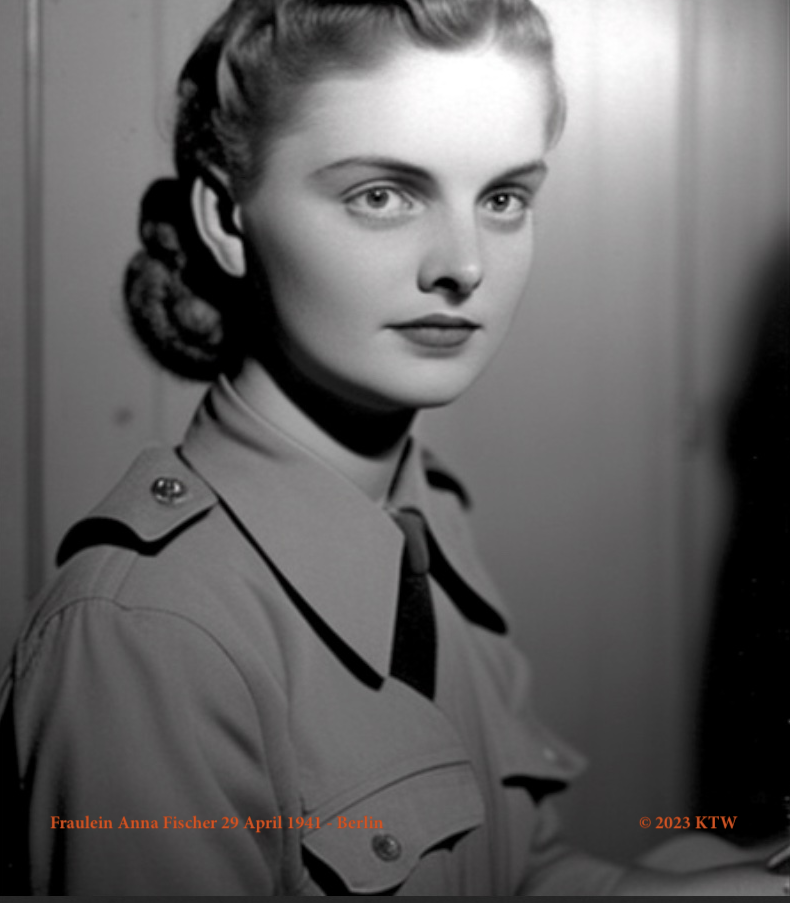
Fraulein Anna Fischer 29 April 1941 - Berlin
Fraulein Fischer, glanced at him. He ignored her eyes.

Fraulein Gisela Beck April 1941 Berlin
BDM ~ Der Bund Deutscher Jungfrauen ~ the Girls’ arm of the Hitler Youth. Teenagers, they were even more fanatical than the boys. They were fast and ruthless. The Führer knew how to manipulate women and girls. All were in thrall to the Leader.
A slight murmur amongst those gathered around the large map table.
Major Angerer pondered, waiting patiently for silence to return…
Major: Herr General there are a lot of Jews in Liverpool.
General: Really?
Major: Sir, with respect, we must remember that Liverpool is a wealthy city. Where we find wealth we find money. Where we find money we find Untermenschen. This is the thrust of Mein Kampf, Sir.
Emboldened at the general-officer-commanding’s continued silence, this impatient man pressed his advantage…
… and as you know Herr General, the Leader has issued a directve as part of Operation Sealion that, I respectfully reflect upon, is merely postponed, as to what we shall also do to Liverpool and Edinburgh… when we have occupied the country.
General: Yes. God help them. Major, I see what you are driving at, and I admire your tenacity even if it is misplaced. But remember, to whom you speak!
(He pointed with a wide sweep of his hand)…
Now, these areas here, all of it is Liverpool?
Major: The Port of Liverpool, yes sir.
The actual city of Liverpool sits on the north bank of the River Mersey and then, here, on the South bank are the shipyards at Birkenhead and Wallasey.
He picked up a long tapered Rule and tapped Ellesmere Port on the southern edge of the Wirral.
That whole area there is, General, the Wirral Principalität, with deep water on three sides.
He stepped back a pace, the heel of his riding boot clipping the polished floor… And coming back across the river, that is the Waterloo Dock, that is the Stanley Dock reputed to be the largest brick building in Europe, some say, in the world; and this, here, is the town of Bootle, almost a city in its own right.
…The tip of the Rule bounced with precision across Waterloo Dock, Stanley Dock and Bootle, almost like one of those fun dashes on a summer’s day across stepping stones with a girlfriend…
The General shot him a glance. Fingers paused and poised. The room was stifling.
General: Major. Do not say what you think I want to hear!
Angerer bristled. Junior staff hastily looked anywhere but at him. They knew the General had found his weak spot.
General: Major. Deep water? Are you quite sure of that? Because I understand that the Wirral Peninsula, as it is called in English, has vast sand beaches. That, to me, does not sound like deep water. What is more, the Mersey River is notorious for its sandbanks. In some parts, here, for example, on Waterloo Dock where the ill-fated SS Lusitania of the Great War had its moorings, keel clearance was barely the height of an average man!
The room was silent. Staff officers shuddered. Who on earth, which of them, had advised Major Angerer?
The General had made his point. he had gently and very firmly brought the young major to heel. Later, he would consider a posting. His view always had been that the air force must be independent of the army. In pre-war discussions on a good will visit to England in 1936 hosted by the Royal Air Force, they had very firmly outlined the benefits of being independent of the army and navy. Reichsmarschall Göring would have none of it, when he received their brief on their return to Gatow. Inwardly, he rolled his eyes at recall of his flight back to Germany in a Junkers JU 88, very aware that as regards RAF battle tactics he was none the wiser. He and his staff had seen an obsolete bomber force, a hopelessly obsolete fighter force of biplanes, yet when the Leader had launched his Blitzkrieg - his lightening strike - on 10 May 1940, suddenly the Luftwaffe found itself in combat with Hawker Hurricanes and Supermarine Spitfires. He gathered his thoughts afresh, tapping the edge of the map table as if watching a cockpit’s rev counter.
The air was electric.
General: Thank you. Tell me, what do these two markers indicate?
Major: These are the entry and exit points that identify the Mersey Tunnel opened in 1934, Sir. The initial operational plan is to destroy these two points on both the North and South banks. This will effecvtively cut the Port of Liverpool in two, dislocating Birkenhead and Wallasey. (Angerer allowed himself amusement). It will be like breaking in half with one hand the fuselage of a Spitfire, Sir. Liverpool will go, for good.
No one in the room knew that it had been a Spitfire
that had killed his son, Karl, over Kent
nine months earlier.
General: And these houses - you say, Jews?
Major: Yes.
Angerer knew inwardly that he had no data to confirm this aside from the addresses of a synagogue or two, but he knew that Mein Kampf was right and he also knew that if ever the General needed to show leadership, then just mention to him the Jewish Problem.
General: Carpet them. Anything else?
Major: This building here.
General: Art deco office block by the looks of it. One would almost think one was looking at our Capital Major.
Major: Sir…
A polite nod accompanied his reply. He paused.
Yes, it is in a large complex called Walker House and Horton House.
General: Why have you marked it as the major target?
Major: Intelligence confirms that the British are fighting the War in the Atlantic from there, in a bunker deep below ground.
The General pondered. He gestured, and a staff officer rolled out a German version of the Liverpool map. 1-3 Rumford Straße.
He said nothing.
He calculated.
He knew the havoc being wrought by the British Fleet on the submarine fleet commanded by Admiral Karl Dönitz.
He leaned across the board in his spotless dress uniform.
His hand was steady.
He looked around him, taking in the eyes of the entire room, including the stenographers, fingers poised again in anticipation.
His long arm swept across the map of Liverpool.
It moved like a tidal wave from the Fort Perch Lighthouse in the Estuary on the tip of New Brighton, onward inland up the river, taking in Wallasey and Birkenhead, back-tracking to Ellesmere Port, then sweeping back across the river to the Royal Liver Building, the Strand, Parliament Street up the steep hill to the partially built Anglican Cathedral, then back-tracking to Castle Street, Lord Street, Victoria Street, across the Castle, into Dale Street and across the famed Monument to Queen Victoria, Empress of India.
General:
Gentlemen. All of this goes.
Lay it to the ground.
Major, prepare the final briefing notes.
Assemble Group Commanders,
Wing Commanders and Squadron Commanders.
It is now 29 April.
The operation will be eight nights of sustained bombing and destruction of Liverpool
commencing in two days,
on 1 May.
A mass of heel clicks followed and the man was gone. All immedately rushed to their pre-allocated duties.
Leutnant Axmann prepared his stencil and within a moment he and Fraulein Fischer had BDM girls giving the Hitler salute and impatient to remove the stencils. Axmann did not know quite what to think. No one knew of his time in Liverpool before the war. Nor of his connections with a certain tiny office in London.
Major Angerer noted that when Axmann departed, he gave the military salute, not the Heil. He would keep his counsel and observe the young leutnant.
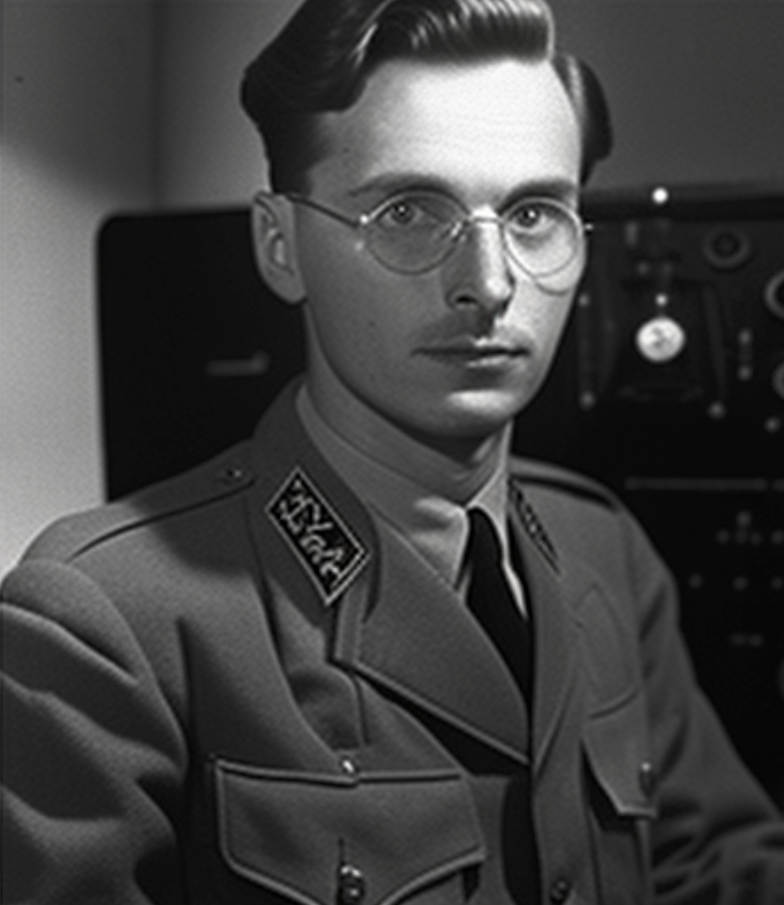
Major Ernst Angerer
Major Angerer noted that when Axmann departed, he gave the military salute, not the Heil. He would keep his counsel and observe the young leutnant.

Leutnant Artur Axmann
Axmann did not know quite what to think. No one knew of his time in Liverpool before the war. Nor of his connections with a certain tiny office in London.
By the 8 May 1941, as we shall see, the Nazi General’s impressive arm-sweep across the map table did indeed lay waste the entire city centre of Liverpool and much of the docks. He would not have foreseen that in 1944 a vast armada of warships would lie at anchor on the Mersey before suddenly departing late one night to commence the D Day Landings on 6 June 1944.
A cautionary tannoy to those who say that we should let Ukraine get on without our assistance. Those voices are few here in Britain, but the fewer the voices the more strident the shouting.
Likewise, across the Pond, the USA is once again an arsenal of democracy. If an American says it is in the spirit of Roosevelt’s garden hose leant to his neighbour to douse the fire, that is good. FDR knew full well that if he withheld the garden hose then as night follows day so would his property have then been caught in his neighbour’s out-of-control inferno.
In May 1941 my father’s brother was shortly to embark for the States to train as a Royal Air Force pilot which he achieved at Craig Field Alabama in April 1942.
America was doing everything short of actual engagement which took place following the Japanese attack on the American Fleet lying at anchor in Pearl Harbor on 7 December 1941.
When I read family accounts in the archive, the Coventry Blitz on 11-12 November 1940, the London Blitz that raged for 57 nights, the raids on Cheltenham and Gloucester, the raids on our ports, towns, cities and military installations throughout the United Kingdom, NOT just England, I find myself really beginning to sense that feeling of being totally alone.
Isolationism is the curse that clings to a democracy that is so large that it can accept that it can quite happily exist alone. Get real, America! Simply put, the USA has a role and a duty. The politics of today make the old high principles difficult to maintain. By the time the outcome of that problem is comprehended by Generation Z, these post War and post Cold War Generations will have both long gone.
That is when the cold light of day is at its most vicious.
The reader can, therefore, see that the purpose of Eight Days in May is not to lament what happened to Liverpool in 1941, but to remind us all of the crucial importance of supporting Ukraine, for if we do not, then, as Winston Churchill very succinctly and bluntly put it to the British People and to the Commonwealth and Empire…
but if we fail,
then the whole world, including the United States,
will sink into the abyss of a new dark age made more sinister,
and perhaps more protracted,
by the lights of perverted science
(June 1940).
This website is followed by 106 countries. Those words are relevant to us all even today.
1 May 2024
All Rights Reserved
LIVERPOOL
© 2024 Kenneth Thomas Webb
© 2024 Eyes to the Skies
First published 1 May 2023
Digital Artwork is by © 2024 KTW © 2024 IBM unless otherwise credited
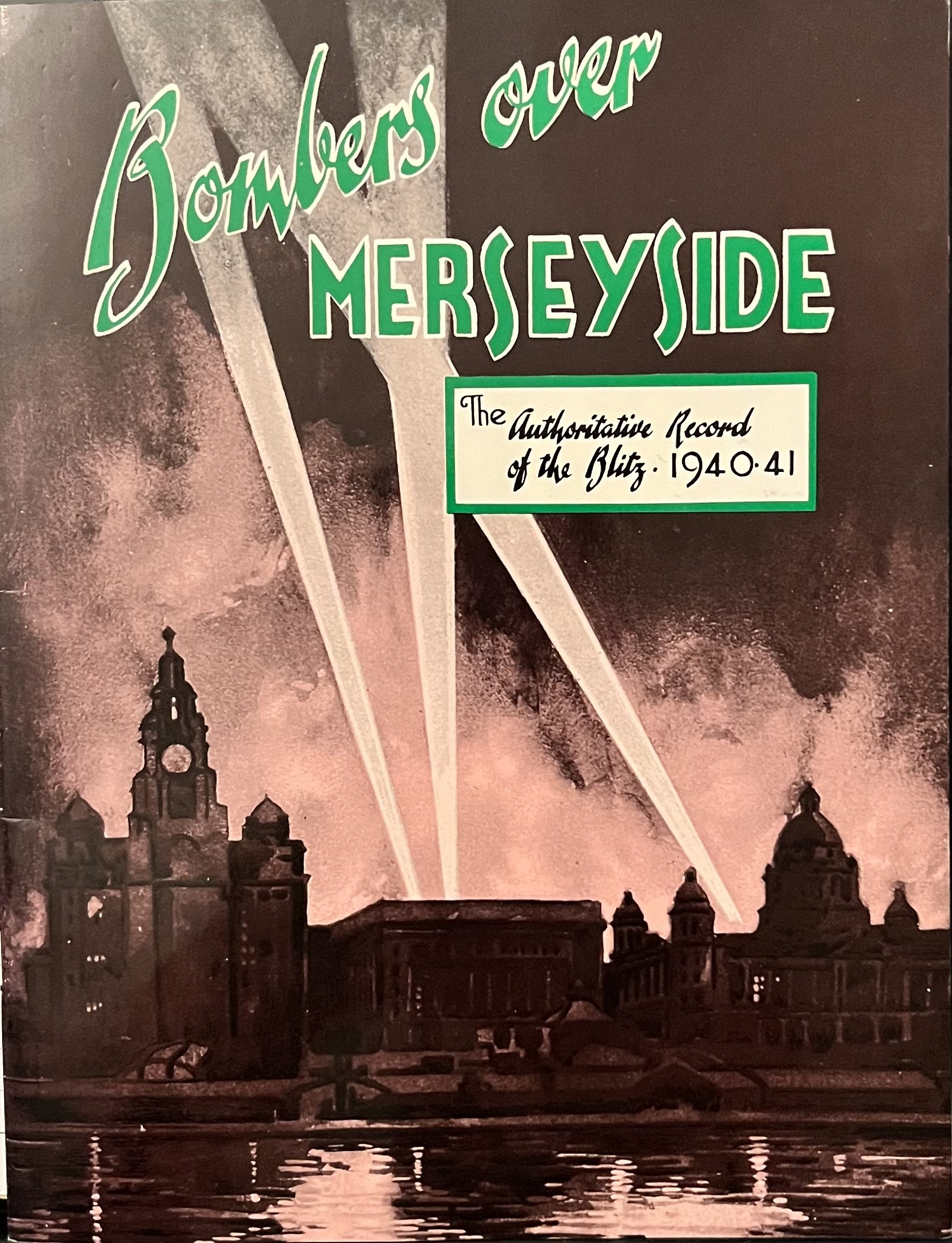
This magnificent little booklet is available worldwide. It is now less than 1 GBP or 1 Euro. What I find, is that apart from it enabling me to fully grasp what my own City went through 82 years ago, it also reminds me of what the People of Ukraine have been going through and are still going through, with ever greater intensity, in this second year of the War in Ukraine. KTW
Author Note
Merely for interest.
I took a bad fall 12 days ago which resulted in a week or so in two hospitals.
I’m now at home and quietly regathering my routine.
Lying in hospital, I decided,
You know what Ken? I know you’ve promised to publish strictly in line with the Eight Days in May.
But get real. Go at your own pace, even if it is glacial.
You are beholden to no one, no publishers or agents bang on the door.
These are great blessings.
Good god, man, you’re not even a writer or a poet.
You just faff around. Enjoy life.
And I thought, yep, that’s that!
KTW
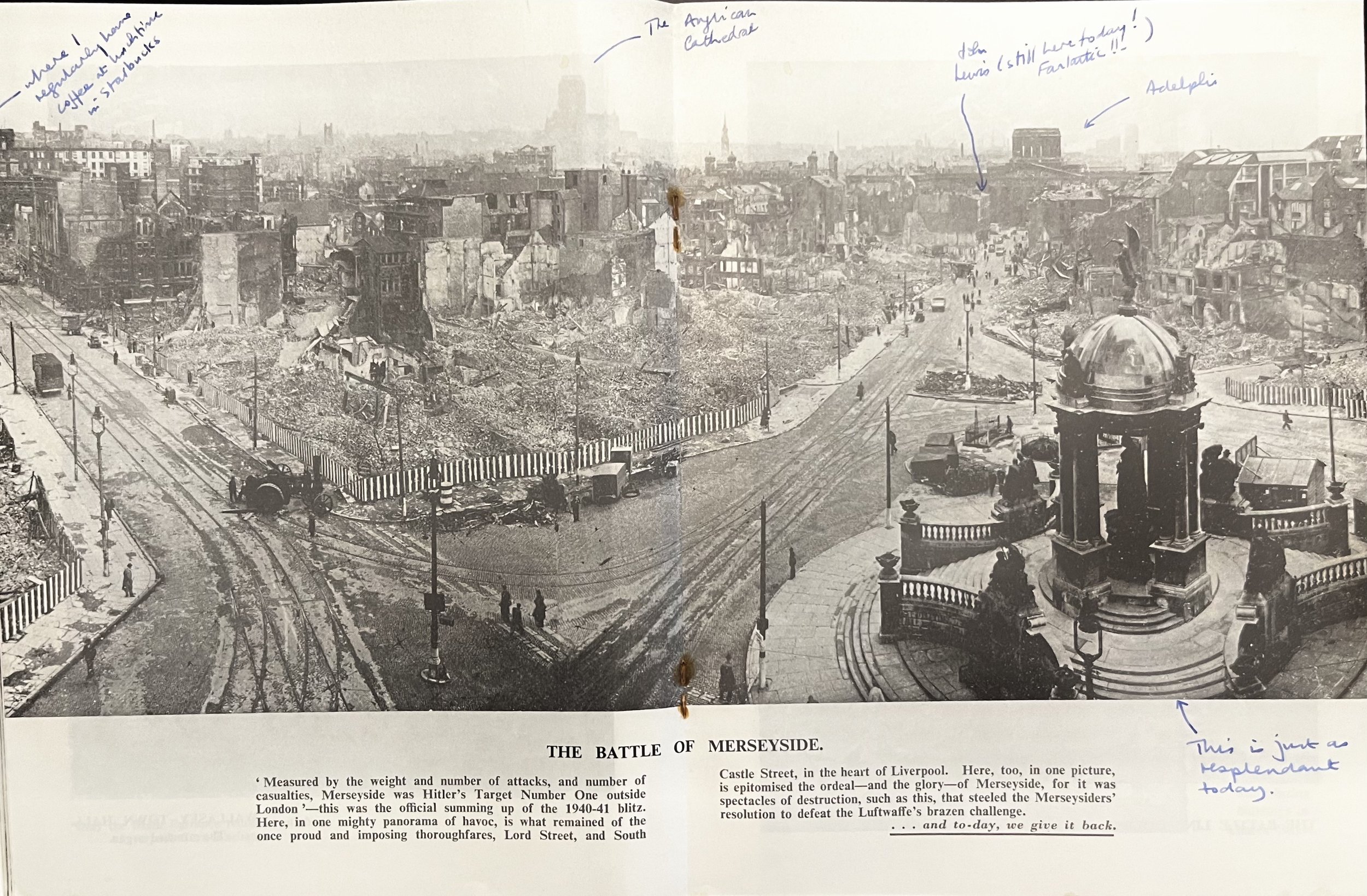
The Centre-spread of the booklet “Bombers Over the Mersey”, when I first turned the page to see this as I sat in the Albert Dock, I did indeed go cold. Where the steam tractor stands, the grand entrance to the building and the building itself was rebuilt, as too, Derby House where we see the diagonal fencing; but it is inside those doors that I did much of my writing in Liverpool. Castle Street to the left has indeed been wiped from the face of the earth. My back yard. For Waterloo Dock is just off to the left of the Lens a thousand meters. This is where I became the City Boy. The author writes of a panorama of havoc. But landmarks remain. The famous Adelphi Hotel, defiant, and thirty-five years on from this scene my father’s brother-in-law and his wife, Les and Pat Freeman, became the managers, before eventually returning to Cheltenham and eventually as Mayor and Mayoress. I remember Aunt Pat as a very tiny boy at the front garden gate. Aunt Pat would cycle by, ‘Good morning Ken,’ ‘Good morning Aunt Pat’, and vigorous waving as my aunt turned sharp right into her avenue. I must have been four. I mention this only because when we see what Vladimir Putin is doing, we know that already the People of Ukraine are seeing their future. We just have to hold on to this vision. They well get through this. They will become members of the European Union. One day, Vladimir Putin will be a blip on the time line of history. Kenneth Thomas Webb 2 May 2023
Ken Webb is a writer and proofreader. His website, kennwebb.com, showcases his work as a writer, blogger and podcaster, resting on his successive careers as a police officer, progressing to a junior lawyer in succession and trusts as a Fellow of the Institute of Legal Executives, a retired officer with the Royal Air Force Volunteer Reserve, and latterly, for three years, the owner and editor of two lifestyle magazines in Liverpool.
He also just handed over a successful two year chairmanship in Gloucestershire with Cheltenham Regency Probus.
Pandemic aside, he spends his time equally between his city, Liverpool, and the county of his birth, Gloucestershire.
In this fast-paced present age, proof-reading is essential. And this skill also occasionally leads to copy-editing writers’ manuscripts for submission to publishers and also student and post graduate dissertations.