James Henry Budd and Eliza and Budd (1851-1939 & 1948)

ELMFIELD ROAD & WINDSOR STREET DAYS
Windsor Street Days
James Henry Budd and Eliza Ann Budd
(1851-1939 & 1948)
The Passing of an Old Soldier
July 2026
Partial Family History
by
Carol Ann Vanessa Jane Kenneth Thomas
© 2026 Kenneth Thomas Webb
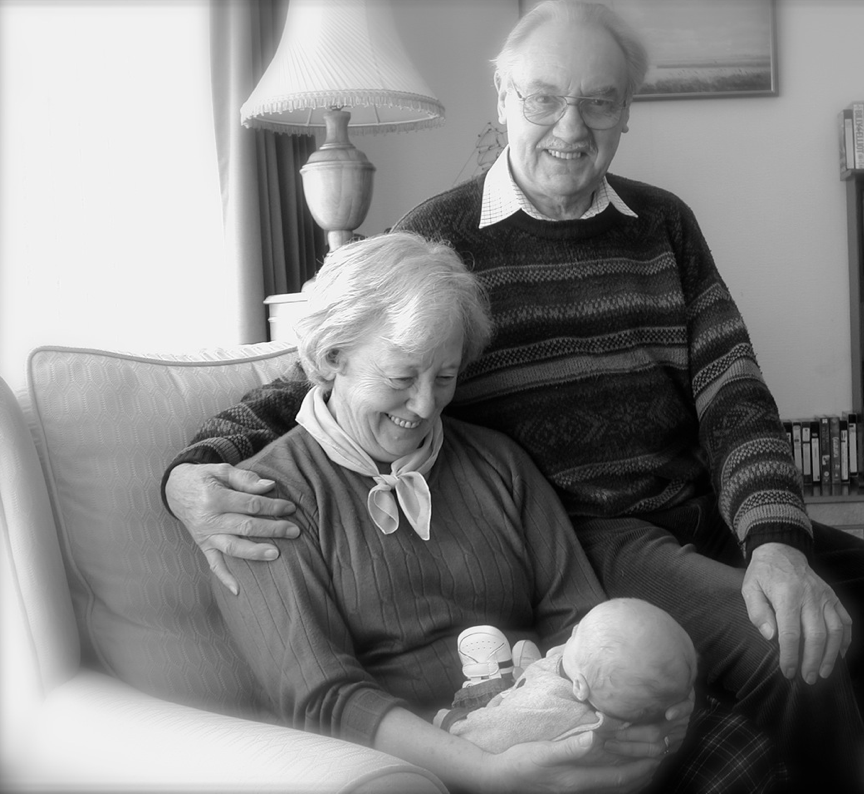
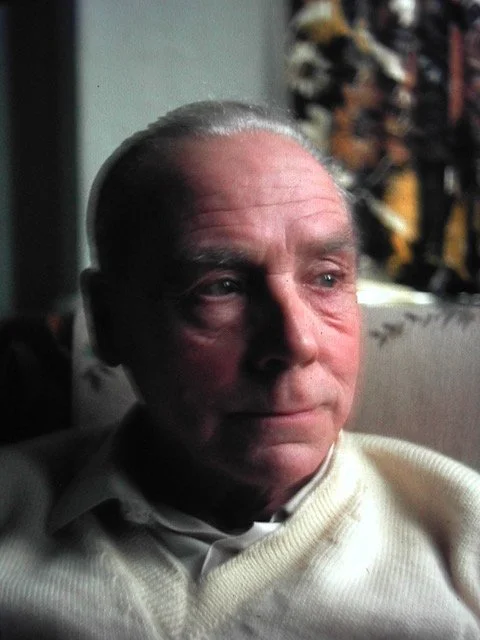
James Henry and Eliza Ann Budd at their Cottage ‘Appletree’ in Upper Boddington Northamptonshire circa 1870s. The Parents of Isabel Alice and Charlotte (Lottie) and Arthur and the grandparents of Arthur Horace James and Kenneth Ernest and Desmond Budd (Webb) and of Leslie Orriss...the Great Grandparents of Carol Ann and Kenneth Thomas and Vanessa Jane (Webb) Christopher and David Budd and also of Vanessa and Nicola Orriss. KW
Part I
James Henry Budd and Eliza Ann Budd neé Wimbush are our maternal great grandparents. James died on 17 February 1939 (87) and Eliza died on 28 April 1948 (96) respectively. Our father – Desmond Budd Webb and our grandmother Isabel Alice Webb neé Budd always referred to them as Grampy and Granny Budd when we were growing up in the 1950s.
In our childhood, their memory remained an integral part of the family and dad often referred to them along with many amusing anecdotes. When mum and dad became great grandparents to Sam, Jack and Finn, they chose to be called Granny and Grampy. Wonderful!
James's death in February 1939 naturally found Eliza living temporarily at 25 Windsor Street, Cheltenham, Eliza’s family home being a cottage in Upper Boddington Northamptonshire.
That Eliza went on to live through the Second World War and well beyond, even surviving the passing of her son Arthur in 1945, hints at her mettle and resolve. Eliza eventually came to terms with widowhood and, as dad used to tell us all, (and this is in paraphrase)…
“Izzy, Horace, I’m ready to go back home now, thank you.”
Unfortunately, there was no home to go back to. The cottage had apparently been "sold" by Eliza's younger daughter Lottie Orriss, herself a widow, following her husband – William – being killed in action in 1917 during the Great War just fourteen months after their wedding. Lottie would eventually marry Albert (Uncle Bert) Rollings. In 1939, it naturally fell to Isabel to break the news to their Mum.
I remember Dad recalling that ‘Granny’s complexion went white with shock’.
The Frisbee Factor
The Frisbee Factor Every family, without exception, deals with what in our family we call the frisbee factor. I saw this countless times in legal practice over 29 years as a probate and trusts lawyer. Our family was no exception.
Much of my life I recall our great aunt – a very determined, no-nonsense lady and businesswoman – having the unfortunate reputation of apparently ‘selling the roof of her parents home over her mother's head’ following her father's death. Yet I remember as well the wonderful conversations with Lottie, and our Great Aunt’s generosity to us all.
I believe that the cottage was tied, not freehold property of James and Eliza. Lottie was simply returning the cottage to the freehold.
Isabel (her elder sister) would have understood this, but the problem was that Lottie had forged ahead – as our great aunt tended to do in all things, and left her sister to deal with the fallout!
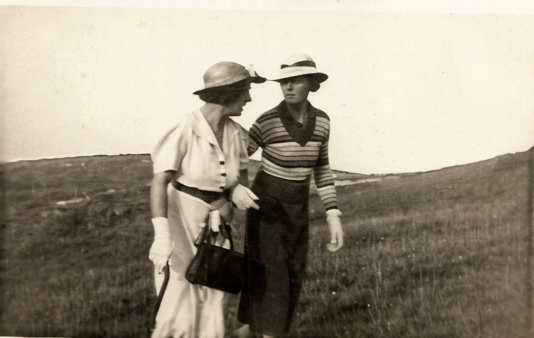
Lottie (Charlotte) and Isabel, Cleeve Hill late summer 1938
The photograph above is of Lottie and Isabel in conversation on the Escarpment of Cleeve Hill above Cheltenham around 1938. I have always loved this photograph. I first glimpsed this in my late forties and wrote about it, then lost the document and years later found it in the archive. In fact the caption reads…
"Grandma Webb (Isabel) 51 years and Great Aunt Lottie (Lottie) 49 years,
Isabel's younger sister in most earnest conversation in 1938 on the escarpment of Cleeve Hill walking towards the Rising Sun. It really catches life and movement. Still in an Age where dress hats and dress gloves were the order of the day." KW
Part II
"Family Archive" is too grand a term. Most family archives are a collection of boxes of all shapes and sizes gathered over a dozen or more decades, even centuries, each collection being transferred to the next person upon each quantum leap.
Just as historians and archivists can be taken aback at what the National Archives surprisingly reveal, on a smaller scale the same thing happens in every family.
25 Windsor Street had a mezzanine floor which meant that the staircase went up to the landing, but then another tiny staircase twisted round to the right and which took me up to Grandma and Grandad's bedroom. My Aladdin's Cave!
The newspaper article, tucked away in a small beautifully crafted wooden case that used to sit on the dressing table at 25 Winter Street - my tiny fingers delighted in lifting the lid and seeing numerous newspaper cuttings and other items that have become very special to the family. ‘Ah! I’d better close the lid and slip back out before Grandma (Isabel) finds me! I do love my Aladdin’s Cave!’
It reminds me how children have this experience in every generation, the world over. We are a very loving family and there are now seven grandchildren:
Martin ~ Chris, (my First Nephew) and then his sons Sam, Jack and Finn
Opacic ~ Suzanne and Caroline (my First Nieces) and then Theo and Max (Terry) and Daisy (Young).
There are no Webb grandchildren, so the name quietly peters out when I too take that quantum leap.
I am greatly blessed with a nephew and two nieces ~ Christopher John (Martin) and Suzanne Louise and Caroline Jayne (Opacic) twins. So when I add their children to the list above, in addition to my first nephew Chris, and first nieces Suzie and Caroline I have quite a family. I’m immensely proud of this, and see no difference between my own position and the fact that these nine nephews and nieces are also nine grandchildren.
I say this because there is a tendency in every family to not always grasp how uncles and aunts feel. They are a step removed, yes.
I'm talking now of the thousands of families I have encountered in legal practice, and the countless times I've had to use my diplomatic skills and tact when dealing with the thorny subject of testamentary decisions in a will or a trust which are suddenly set in stone when that quantum leap is taken, and which are not always benignly accepted by the beneficiaries. This is not a criticism.
It is an observation born of a lifetime from many different angles and with thousands of perspectives, most of which my own family are unaware that I take these perspectives very seriously. But I also often wonder to myself… what would you have been like as a father, Ken? A husband? That is when I acknowledge that there are so many more perspectives that, quite simply, I can never be aware of. Being aware of this conundrum is sufficient to keep me on track and to learn from my sisters Carol and Vanessa (Ness).
Because of what I am, I have always naturally stayed in the background. It is safer. Crucial because of what Nature decided I am to be. I’m quite happy with that. It is lonely, yes. But that is both down to me and the increasingly hostile world in which we all live and not to my family. I do not tell them what is happening in other countries and in parts of ours, too. I do discuss these things with Andrew, a lay minister and Darren (Daz) in Lancashire. We do know what is going on.
Chris follows in the footsteps of Horace, his great grandfather with a passionate interest in motorcars. Indeed, this is the case with Vanessa’s family too, with Ness’s husband Steve and son-in-law Jason both owning classic motor cars and regularly attending events up and down the country. This, likewise, reflects identical interest by our father and uncle - Des and Arthur Webb - with the regular attendance at the Prescot Hill Trials in Gloucestershire, and Des taking up motorcycle scrambling in the 1960s.
The Equestrian Root
Horsemanship now enters into the story and this has great relevance for me.
I rely upon Chris for making sure that I have really lovely motorcars to drive, and I rely upon memories. Memories are subjective, a single memory will have as many perspectives as the clock if we imagine twelve people having the same memory of an event or a person.
One priceless memory is with my former girlfriend Meriel when Chris was about 12 or 13. Chris had learned to ride, and Meriel invited Chris to accompany us on the Worcestershire Rides. The Rides are very similar to the Gloucestershire Gallops on the Cleeve Hill Escarpment.
Chris rode alongside me to my left, and Meriel was 4-5 yards (3.6-4.5 metres) to my right. It was a beautiful sunny day. Even now, I remember the breeze on our faces. We took our lead from Meriel. Into the walk, from walk into sitting trot, then into rising trot, quietly gathering up the reins, allowing our horses to settle – as they were excited as we were because they knew a gallop was ahead of them. Meriel and I had done this many times. I remember the chuckle from Chris. Chris, of course, loves speed and challenge.
Meriel then suggested a slow canter, and we rolled very gently into this from the rising trot. We started to speed up as we prepared to go into fast canter. I remember the sound of the hooves. The hooves of three horses is quite something, especially when being in the midst rather than a spectator looking from the safety of the barrier on a racecourse. And we were riding Hunters. Mine and Meriel’s were a little above 17 hands, Chris’s at 15 hands, not a small horse by any means.
I remember Meriel laughing, and both of us are leaning forward, Meriel loved speed and challenge as well. I do too. We were now at fast pace just moments away from the full gallop and I remember saying to Chris ‘bring your head down to the side of the neck, Chris’. I do not know whether Chris said ‘wow’ as I am not sure whether that term was in use in those days. But I remember his pleasure and laughter and excitement!
Easing the reins forward so that my gloved hands were just touching the base of the mane; the signal to my Hunter that we were both about to fast gallop. And gallop, we all did! It was wonderful!
And even more so because my nephew was riding with me alongside!
When I was alone on the Cleeve Hill gallops, I would often imagine Horace Webb – our Grandad – riding alongside me in his Great War uniform and spurs. I’d imagine Grandad giving me very similar instructions – and to always keep the heel slightly lower than the toe – the mark good horsemanship.
The Worcestershire Rides are long, and in time, all of us now at full gallop, I could see Chris’s Mum and Dad and the golden retrievers. Sometimes, the mind is a camera. It captures a moment and stores it forever. I remember all of us. I remember the three of us gradually easing into the fast, then slow canter, then rising, then sitting trot, and finally, as meriel and I always did at the walk, we’d let the reins very loose, and we would just saunter. I recall the power. I recall hearing our horses breathe, I recall the shivers of delight my own mount gave that would sinew and connect. I remember the laughter and chatter. An unforgettable day in family life, and as clear today as if but yesterday.
As I say, wonderful memories.
Let us therefore go back to 1939 when the family have gathered at the funeral of James, and now take into account his achievements – much of which has remained concealed in that tiny wooden box – for eighty-seven years.
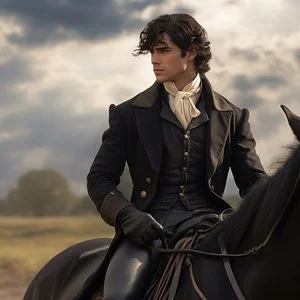
That final moment as we contemplate our Gallop on Cleeve Hill, Cotswold Escarpment
Digital Artwork by KTW IBM created in 2023
Part III
James Henry Budd
(1851-1939)
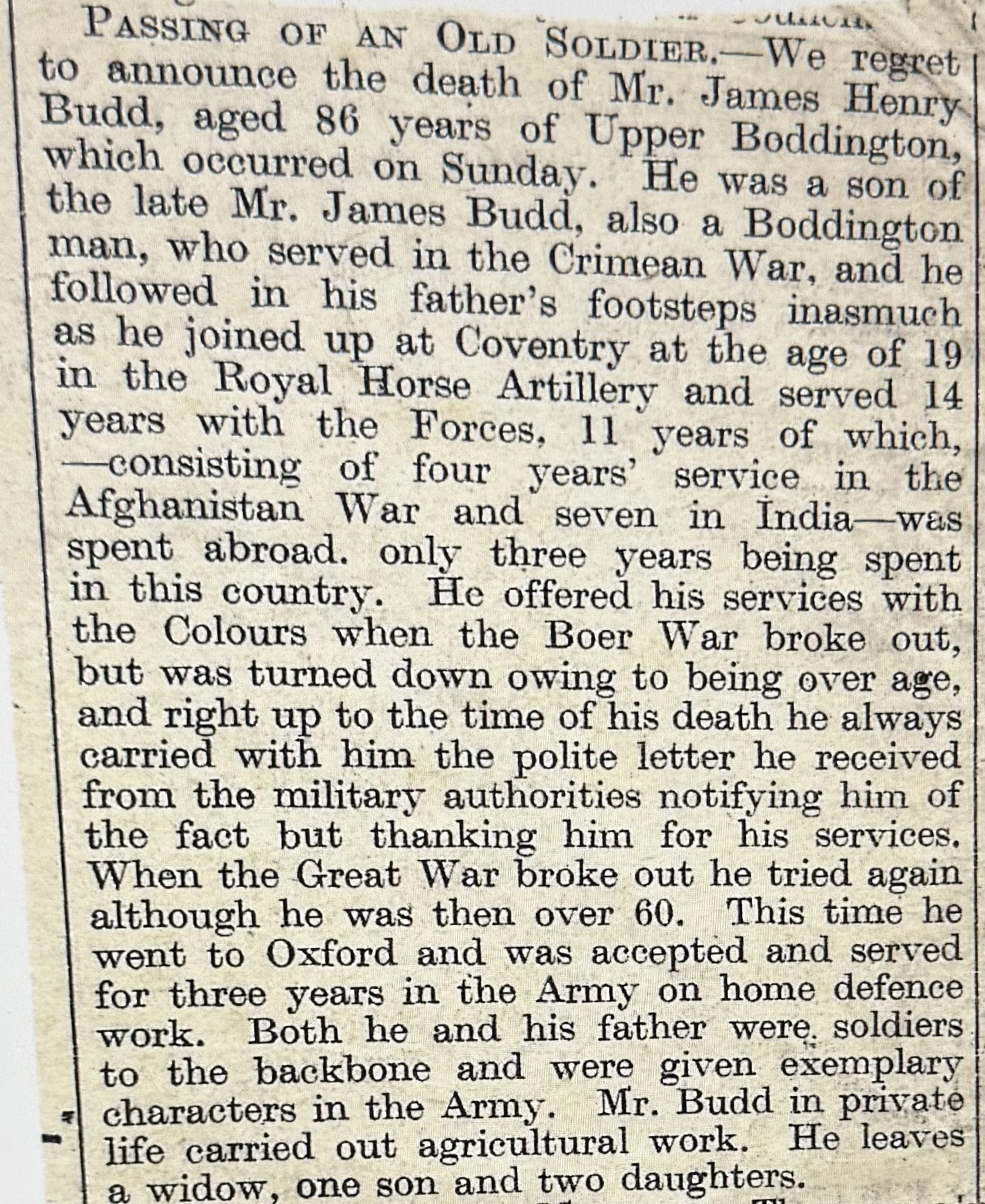
PASSING OF AN OLD SOLDIER
RATHER THAN concentrating upon departure, I visit the year of birth because both James and Eliza were born in 1851. What was going on in the Great Britain and in the wider world? Were there great achievements? Were there wars? Was life as hectic in 1851 as it is in 2026? Yes, to all.
Victoria R was Queen, the grandmother three times removed of King Charles III.
The King is descended from Queen Victoria through both of his parents:
Queen Elizabeth II, descended from Victoria's eldest son, King Edward VII, while his father,
Prince Philip, descended from Victoria's second daughter, Princess Alice.
That is quite a deep web of Royal Ancestry. It draws a very direct line from the King to Queen Victoria Empress of India (1876).
As a teenager my history project was to relate the Great Exhibition 1951 to the Great Exhibition 1851. That our great grandparents were both born in 1851, had I realised, would definitely have earned extra marks in what I clearly remember being a most enjoyable school project. Haha!
Thus, in 1851 we had the Great Exhibition of the Works of Industry of All Nations – its official title – in Hyde Park London.
The centrepiece was The Crystal Palace showcasing manufacturing, arts, and resources from Great Britain and the Empire to over six million visitors – a phenomenal number at that time.
What else happened in 1851?
Well, the list is endless, so I restrict myself to a further nine. What is abundantly clear is the position that the United Kingdom of Great Britain and Ireland (as it then was) and the British Empire held in the world.
In 1851 the British Empire was the world’s superpower, and in 1851 at the very heart of this nation was the Industrial Revolution. It was also the largest empire in recorded history. And there is another telling point. When empires fall they do so through defeat or decay and a combination thereof.
Oddly, the British Empire went through a metamorphosis. In his wartime speeches, Winston Churchill frequently referred to The British Commonwealth and its Empire and equally The British Empire and its Commonwealth.
The granting of independence to India in 1947 set in stone the dissolution of the British Empire.
For a time, from 1948, it was referred to as the British Commonwealth comprising eight nations. This commonwealth moved swiftly, changing its title by removing ‘British’ and then becoming the present Commonwealth of Nations. In 2026, the Commonwealth comprises fifty-six independent nation states.
1. First America's Cup - the US yacht America beat British racing vessels around the Isle of Wight. The victory secured the Royal Yacht Squadron’s 100 Guinea Cup, and thereby establishing the oldest trophy in International sport.
2. UK Census 1851.
3. Foundation of Owens College - now the extremely important Victorian University of Manchester.
4. Victoria separates from New South Wales in Australia.
5. Abolition of the infamous Window Tax.
6. The Arsenic Act 1851 - to combat accidental and malicious poisonings.
7. Submarine Telegraph Cable laid across the English Channel.
8. The Australian Gold Rush.
9. Cape Frontier War.
In 1851 our family was just two years away from the outbreak of the Crimean War (1854-1856) when the Ottoman Empire declared war on Russia, and our great-great grandfather (also James - James’s father in law) served in that War.
The news this week, July 2026, sees Crimea very much at war because of Russia’s illegal annexation of Crimea from Ukraine in 2014. If only the world had not looked the other way! Had our reaction been to challenge, Russia might have thought twice about its illegal invasion of Ukraine in 2022, a war now in its fifth year. Pause a moment… That is longer than the First World War!
“We make progress and for every two steps forward we take three steps back ~ such is the tragedy of human nature.”
This newspaper report gives us a wonderful insight into the southern based element of our family 180 years ago.
(Our Northern based Family covering the same period is in ancient Northumbria, and whereas our Mum (Nancy) was born in South Shields and did not move south until eight years of age, Mum’s grand-daughter and son-in-law Caroline and Jack are on tuther side of the Tyne in North Shields along wth her great-great Grand daughter Daisy Arabella).
We learn so much about the man who "we three" remember being referred to by Dad as ‘Grampy and Granny Budd’.
There is no need for me to transcribe the newspaper cutting as it is quite readable.
I do make the following observations for interest:
A : The Crimean war (1854-1856) fought by Great Britain against Turkey as an ally of Russia resulted in the infamous Charge Of The Light Brigade. What a peculiar war! The wives of officers travelled with them ‘on expedition’, bargaining with each other, often with hostility, for the right to occupy the best seats to ‘watch’ battles.
How extraordinary, that the spectacle of Roman Britain lingered on, for in Britain we have between 15 and 18 Roman sites that were Colosseums, the Chester Roman Amphitheatre being the largest military amphitheatre that could hold up to twelve thousand spectators, where animals and people were baited to death on the end of chains, and gladiators fought to the death; all public entertainment to spectators who, archaeology now discovers, were eating chicken drumsticks!
It beggars belief that in 1851 their descendants would be arguing vehemently that they were the most upstanding members of the Christian community and the Church ~ all denominations. They would also have rigorously prosecuted the biblical nonsense that some nations were ‘blessed by God’ and some were also ‘blessed’ to be slave nations. By then, of course, Slavery had been abolished throughout the British Empire (The Slavery Abolition Act 1833 granted Royal Assent by Queen Victoria on 28 August 1833) but that did not change the minds of many who had insisted upon literal interpretation of scripture and still fervently believed in heaven, hell, purgatory and damnation. They accepted the fictional account of these four elements composed by Dante Alighieri’s Divine Comedy in the Fourteenth Century. For the next millennium the poem was the basis for numerous artistic depictions.
One questions how on earth the church did not counter these depictions. Rather, the poem and the resultant paintings strengthened their literal interpretation of religious texts. By such means are the people held in check, controlled, living by fear, buying their pathway through the wilderness to paradise.
In 2026 I still come across British people, on the fringe, with such views. As always, human nature never changes, it never improves.
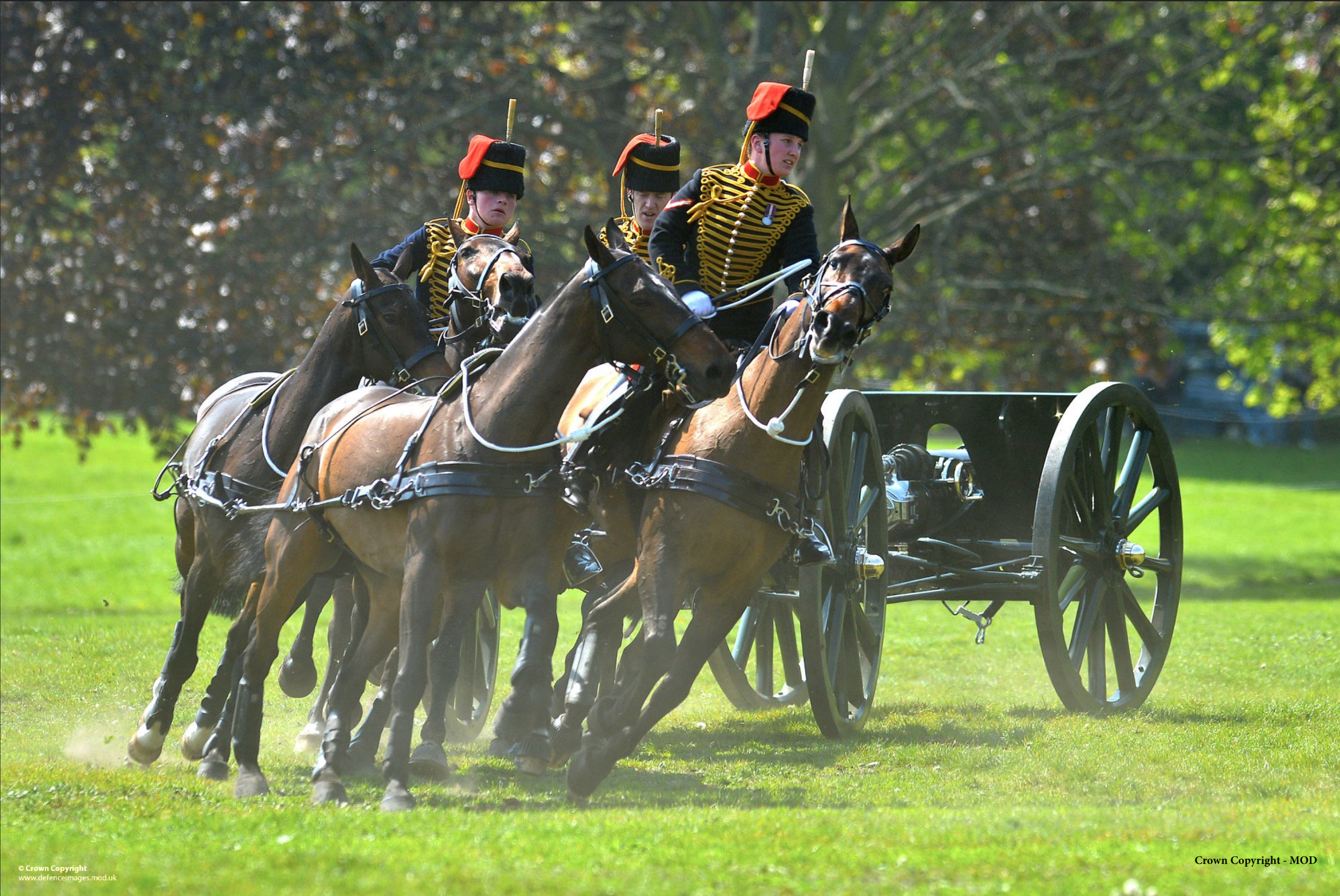
B : The spectacle of watching armies fight to the death, of cavalry charges, of horse drawn artillery, gives us as a family a very new perspective when we see the Royal Horse Artillery (RHA) every year at Trooping The Colour on Horse Guards and in Hyde Park to mark the King’s Official Birthday.
This is important to us as a family as James (and his father-in-law before him circa 1843) joined the Royal Horse Artillery aged 19 years in 1870. Let us keep this in mind whenever we see the RHA from hereon.

The King’s Troop Royal Horse Artillery
The Dress Uniform today is unchanged from the time that both James and our G-G Grandfather (James’s father-in-law) would have worn.
We see incredible horsemanship and the management and wielding of artillery, and as we can see, Troopers are both men and women. KW



C : The newspaper cutting confirms that it was James's father-in-law (Isabel’s paternal grandfather) who had served in the Crimean War in the Royal Horse Artillery.
D : It explains the macabre framed prints of the Crimean War in the lounge and hall at 25 Windsor Street. At the time, my sisters and I could not understand the reason for the display. Clearly, I now realise, they had come from Boddington when Eliza moved to Windsor Street in 1939, and this was an age when it was still fashionable to display battle scenes. What amazes me is that they remained in place throughout the Second World War and until 1966 when Des and Arthur quietly closed the door of 25 Windsor Street and upon many lifetimes.
E : We learn that James served in the Afghanistan War for four years. I remember learning about this at school, that we were defeated because we had to withdraw because we could not overcome the nomadic tribesmen. In 1967, none of us foresaw Afghanistan as the bleeding wound on the buttocks of humanity. In 2026 with the totalitarian religious regime, women and girls are very firmly thrown back by a thousand years to life as it was circa the eleventh century CE.
F : We learn also that when serving with the Indian Army, James had a high reputation for his ability as a ‘breaker of horse’.
G : That term is misleading. Language evolves. Today ‘breaker’ means ‘tamer and trainer’. That sits more easily with me. At school in religious education, we were reminded of Psalm 32:9 Do not be like the horse or mule, which have no understanding; they must be controlled with bit and bridle to make them come to you. Physically strong, mentally dumb. I never liked that, and inwardly I could be quite rebellious. When I learned to ride at the age of 21, I liked it even less. As a horseman I certainly repudiate that.
H : There is nothing dumb about a horse. There is nothing dumb about animals. The Animal Kingdom is way ahead of the human species, and not so arrogant as to presume a certain position. That arrogance only attaches to human beings.
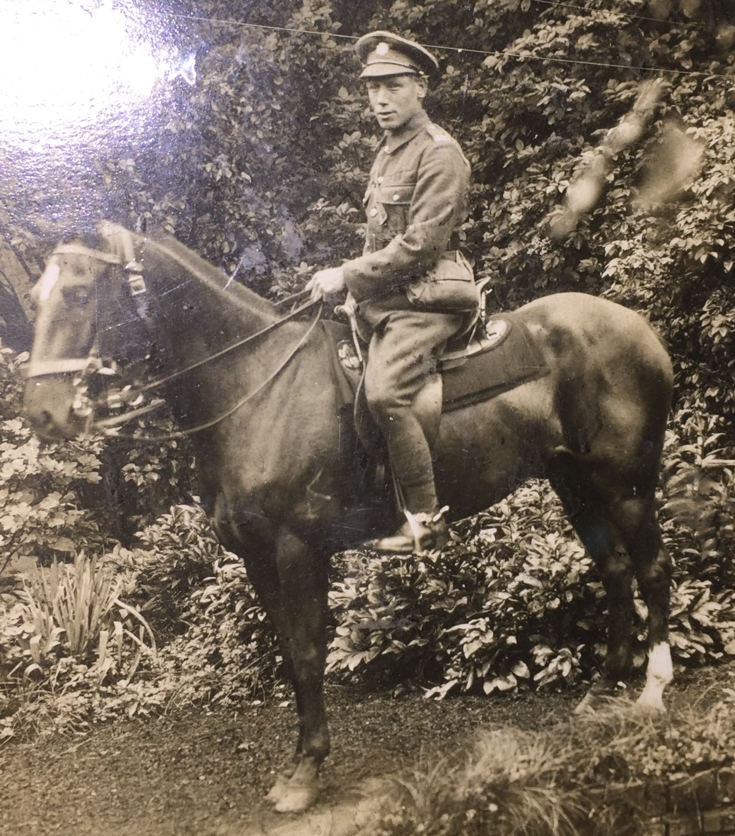
Pte Horace Albert James Webb - Western Front 1916
This image of our Grandfather captivated me from my earliest age. I knew our Great Grandfather had been highly regarded as a ‘breaker of horse’ in the Indian Army but only now have I discovered that both our great grandfather and great-great grandfather served in the Royal Horse Artillery. KW
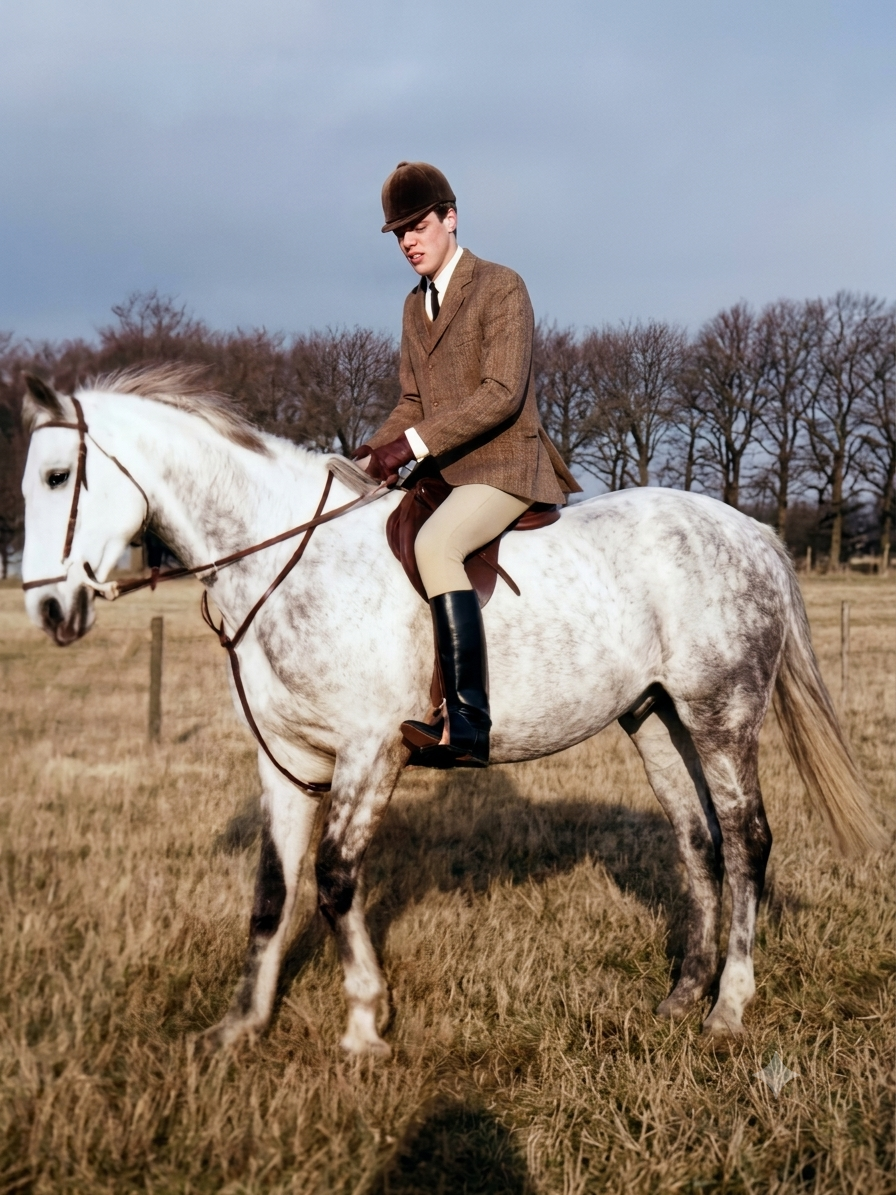
La Roche
Aggs Hill en route to Cleeve Common
and the Gallops on
the Cotswold Escarpment 1973.
What a privilege to ride
such a beautiful Mare ~ La Roche,
and more affectionately known
as Rocka. KW
© 1973 Kenneth Thomas Webb
I am very aware that all of our our pets in our family – Golden Retrievers, Labradors, Vizlers, Terriers, Sheep Dogs and German Shepherds – know of things that I cannot comprehend, and whilst I may be able to read them in small measure, they read me with an ability that surpasses understanding.
I : We learned that James volunteered for further military service in the First Boar War (1880-1881) (aged 29) and the Second Board War (1899-1902) (aged 41). Goodness knows what Eliza had to say about that! James did not serve and I like to think in my rebellious way that Eliza served notice! If you’re going to serve Jim, then you serve here, in this County, and that’s an end of the matter. Now make yourself useful. Apples in the orchard need collecting!
J : Thus, we learn that James again volunteered for military service in The Great War in 1914 although by now he was 63 years old. The interesting thing here is that the archive reports that James assisted in the administration of a local German prisoner of war Camp. Once I have located the article, I will update this. At the moment, I leave it as a family reference note.
Part IV
1921 Census
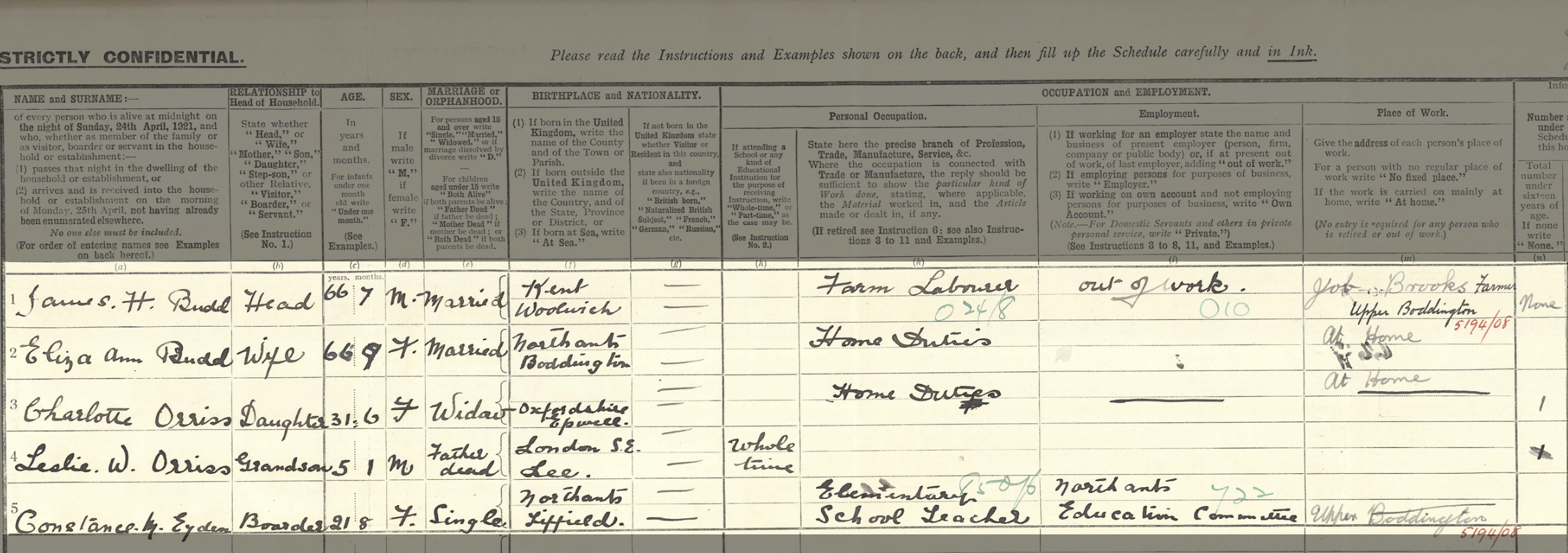
CENSUS 1921 James and Eliza Budd Upper Boddington, Northamptonshire (South)
The 1921 Census records five entries for our great grandparents residing at Upper Boddington Northamptonshire.
James is 66 years and is recorded as being born in Woolwich, Kent. James is a family labourer, but at the time of the census is officially annotated as being out of work. I would imagine the reason is because James relies upon seasonal work. For it also records that he works at Brook Farm in Upper Boddington, which therefore reinforces this presumption.
Eliza is als 66 years and born in Boddington Northamptonshire, and currently a housewife (home duties).
We find Lottie referred to as Charlotte Orriss, their daughter aged 31 years, being a widow, and living at home (home duties). Lottie is shown as being born in Eppwell in Oxfordshire, a quiet, picturesque village in North Oxfordshire, about six miles west of Banbury.
The census also shows us that Lottie’s son Leslie Orriss lives with the family aged five years, and the census confirms the death of Leslie's father, William, and that he had been born in London, South East Lee.
Part IV-I
The Reality
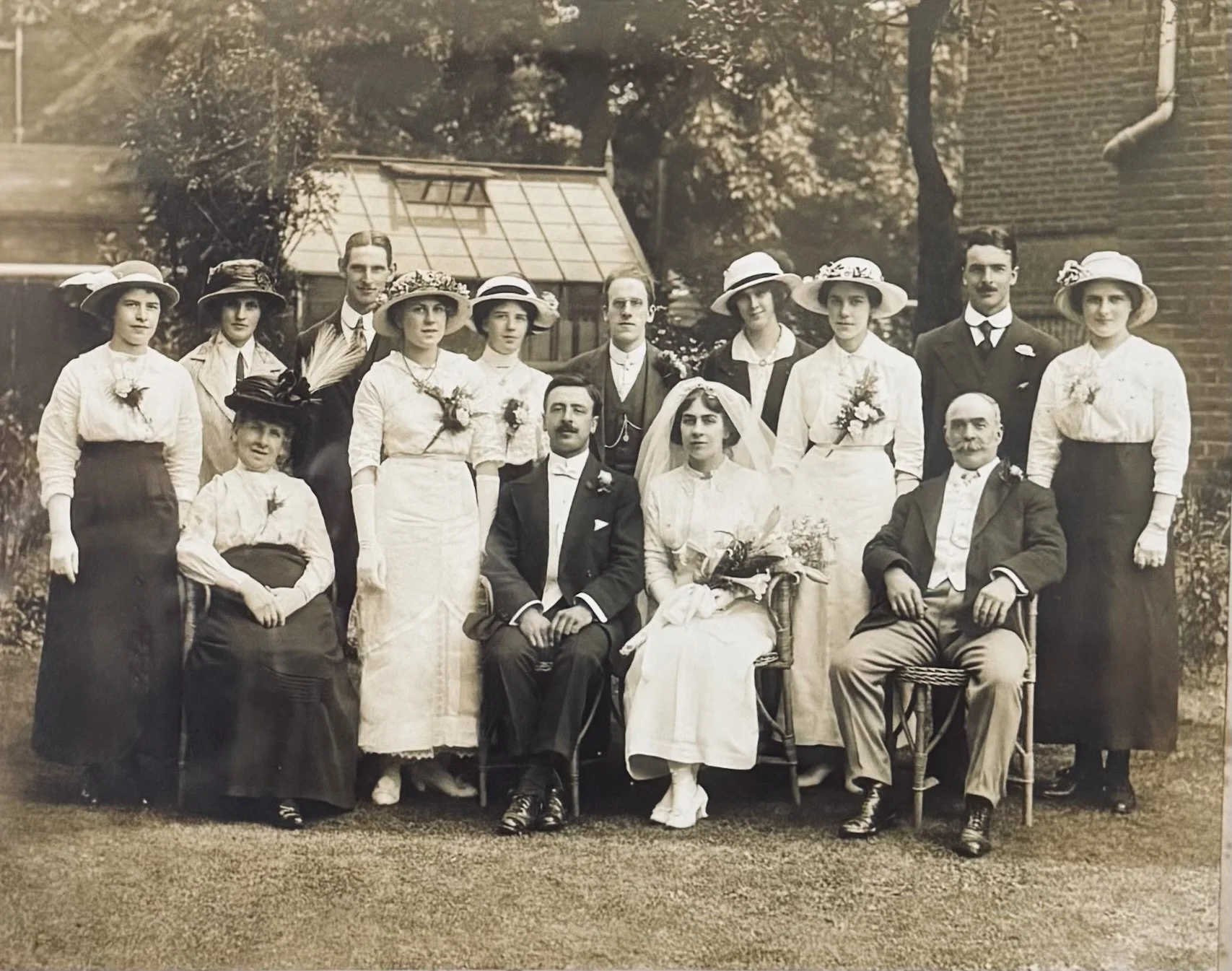
Charlotte and William on their Wedding Day in 1914 with the Groom’s Family. This is taken from a large original framed portrait in the archive. Unfortunately, I do not have a similar portrait of the Bride’s Family. KW
In their all-too-brief marriage, Charlotte and William had one son, Leslie, who went on to serve in the Second World War, and became a renowned Artist, and a quite loveable character. He, Desmond and Arthur had a warm relationship, and a wonderful wit. It was quite amusing to be in the room with all three, and Leslie had a wonderfully comical side to him, and I certainly remember how he could take off his mother. Leslie was great fun; he lived a very full and fulfilling life. And both mother and son achieved achieved the honour of receiving The Queen’s Telegram.
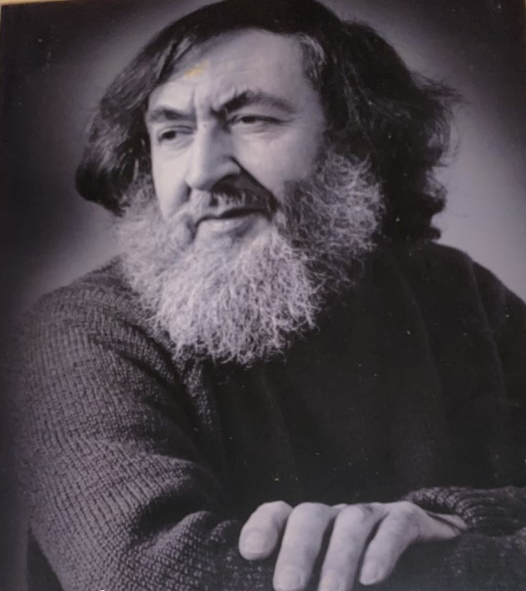
Leslie Orriss
This official portrait is frame-mounted in the family gallery at my home. KW
Leslie Orriss was a notable artist, teacher, and painter based in Cookham and Reading, and latterly Maidenhead. He is best known for being a dedicated educator rather than an exhibitor. While there are no prominent records of Leslie exhibiting his own work at the Royal Academy, his legacy at the RA most certainly lives on through his successful students, one of whom is the acclaimed watercolourist Alison Musker (RWS), and who studied under Leslie Orriss, regularly exhibiting at the Royal Academy.
I remember the many drawings that Aunt Lottie would occasionally show the family when visiting Leamington Spa and in later years when Lottie visited us in Cheltenham Spa. In particular, I recall the quite incredible depictions of the human form, muscular technology, whether of a person or an animal. These works became very important within the medical profession and I recall talking about this to Aunt Lottie on a visit to us in Pittville Cheltenham.
I was a young constable at the time and also newly commissioned into the RAF Volunteer Reserve, and Aunt Lottie loved conversation.
Talking of Leslie’s work, I clearly remember Aunt Lottie’s gentle smile, the smile that always forewarned that one was about to be quietly corrected… Ah, yes, Ken. Leslie’s work is vitally important for the medical profession as his incredible attention to detail means that these are extremely important illustrations for medical publications and journals. Never forget this, Dear!
No , I won’t Aunt Lottie. Thank you.
Wonderful memories.
Part IV-II
This Part is Dedicated to Carol’s and Roger’s Grandson
Finn Taylor Martin
Rifleman William Orriss and Charlotte Orriss neé Budd
King’s Royal Rife Corps
The Great War 1914-1918
When a Shroud is Gently Lifted After 109 Years
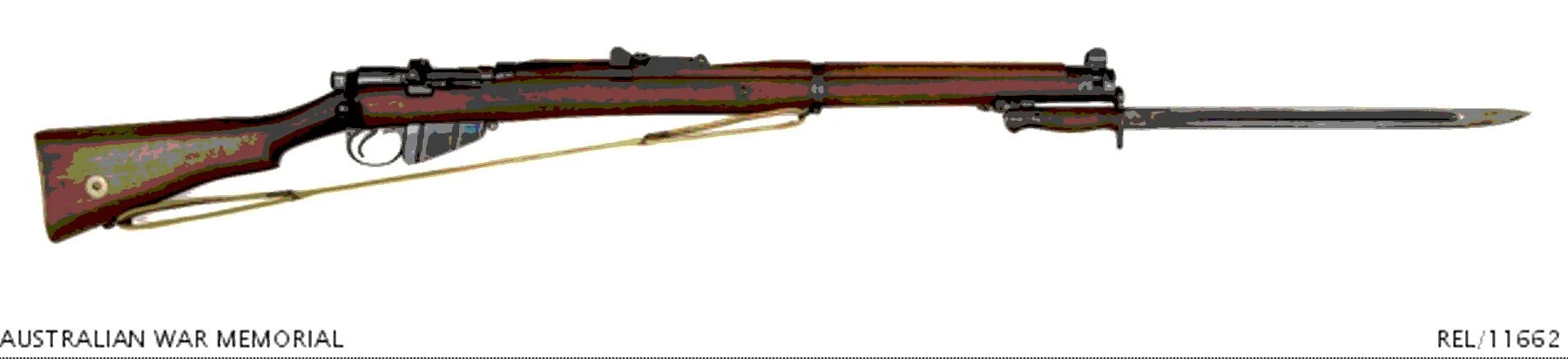
This image by courtesy of the REL/11662 Australian War Memorial I have respectfully placed here, as the War Diary clearly shows that the 21st Battalion of the King’s Royal Rifle Corps fought a fierce engagement alongside the Australian Army. And also by tribute to John (Edgar) and John’s Wife Susan (Mark) KW
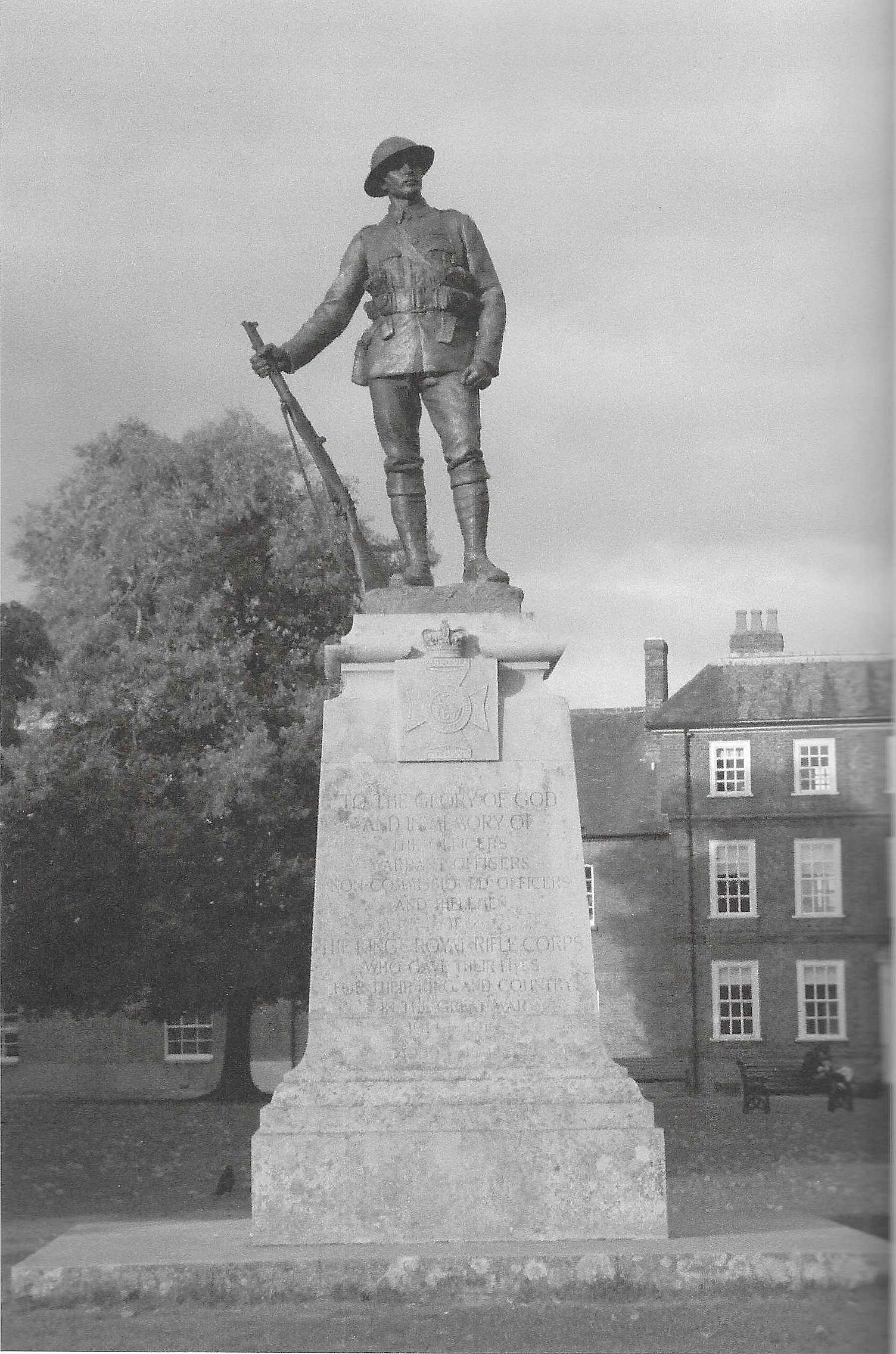
This splendid image of the 1922 Memorial to the Kings Royal Rifle Corps is by kind permission of Penny Legg in her delightful study ‘Winchester You Can See’ ~ first published in 2011 and reprinted in 2026 by The History Press 97 St. George’s Place Cheltenham, Gloucestershire.
Winchester is the Capital of Wessex within which lies the County of Hampshire. It is the seat of Alfred the Great and where he was crowned. On 25 December 1066 William the Conqueror was crowned in Westminster Abbey as King William I. In establishing his legitimate claim to rule as Monarch, William I chose to be recrowned at Easter 1067 in Winchester Cathedral. By so doing, the Monarch also underlined the national importance of Winchester Cathedral and which remains to this day. In the English Civil War it suffered very considerable damage by the Parliamentarian forces, but the People and the Cathedral successful rode that tumultuous storm.
It is also important to explain here the origin of the Kings Royal Rifle Corps (KRRC).
In the grounds of Winchester Cathedral stands a Bronze Memorial erected in 1922 to honour the Kings Royal Rifle Corps also known as the Riflemen Yeomanry.
This statue, just five years after the Battle of Passchendaele (Third Ypres) is a splendid example of the uniform that our ancestor William would have worn.
The Corps was originally raised in colonial America in 1756 where it was at the forefront during the American War of Independence, and after continued active service during the Napoleonic Wars.
Winchester is very much part of our family history, and it is important to note Winchester’s history in training the Rifle Battalions of the KRRC, giving thought also to the cost in lives, as eleven thousand of its members fell in the First World War.
*
The dedication to Carol and Roger’s youngest Grandson Finn is a very important part of our family’s story. Finn has wit, is determined, and already captain on the Rugby field. It is wonderful to hear that Meg and Chris are yet again on the side line cheering both Finn and Jack on. They are young men making their mark, as too their eldest brother Sam, and it always is a delight to see all three, to observe the banter with their Dad. It also connects to a conversation Finn and I had when the Film 1917 was first released by Neal Street Productions and DreamWorks Pictures alongside other production companies such as Amblin Partners in December 2019.
It is right to include here Aunt Lottie’s circumstances, because it reminds me of the abject horror of war in which millions of families all over the world undergo in every war, both then and today, an all sides.
Rifleman William Orriss R39239 KRRC
Rifleman William Orriss was serving with the 21st Battalion of the King’s Royal Rifle Corps (also known as the Yeoman Rifles) when he was killed in a fierce engagement in the Third Battle of Ypres - known to us as the Battle of Passchendaele.
This specific action is also known as the Battle of the Menin Road Ridge fought between 20–25 September 1917 on the Ypres Salient, West Flanders, Belgium.
During this attack, the British Second Army under General Herbert Plumer launched a successful and heavily coordinated offensive along the Gheluvelt Plateau. It was, however, a notoriously costly operation with over 20,000 casualties suffered by British Empire forces in just the opening days of this Battle.
Field Marshal Herbert Plumer (1857–1932) also 1st Viscount Plumer - as he later became - was a highly respected senior British Army officer best known for commanding the Second Army on the Western Front, and famously winning the Battle of Messines.
We therefore see from the Battalion War Diary (BWD) that Charlotte’s husband William was among the 4,630 killed in action on the opening day of this Offensive.
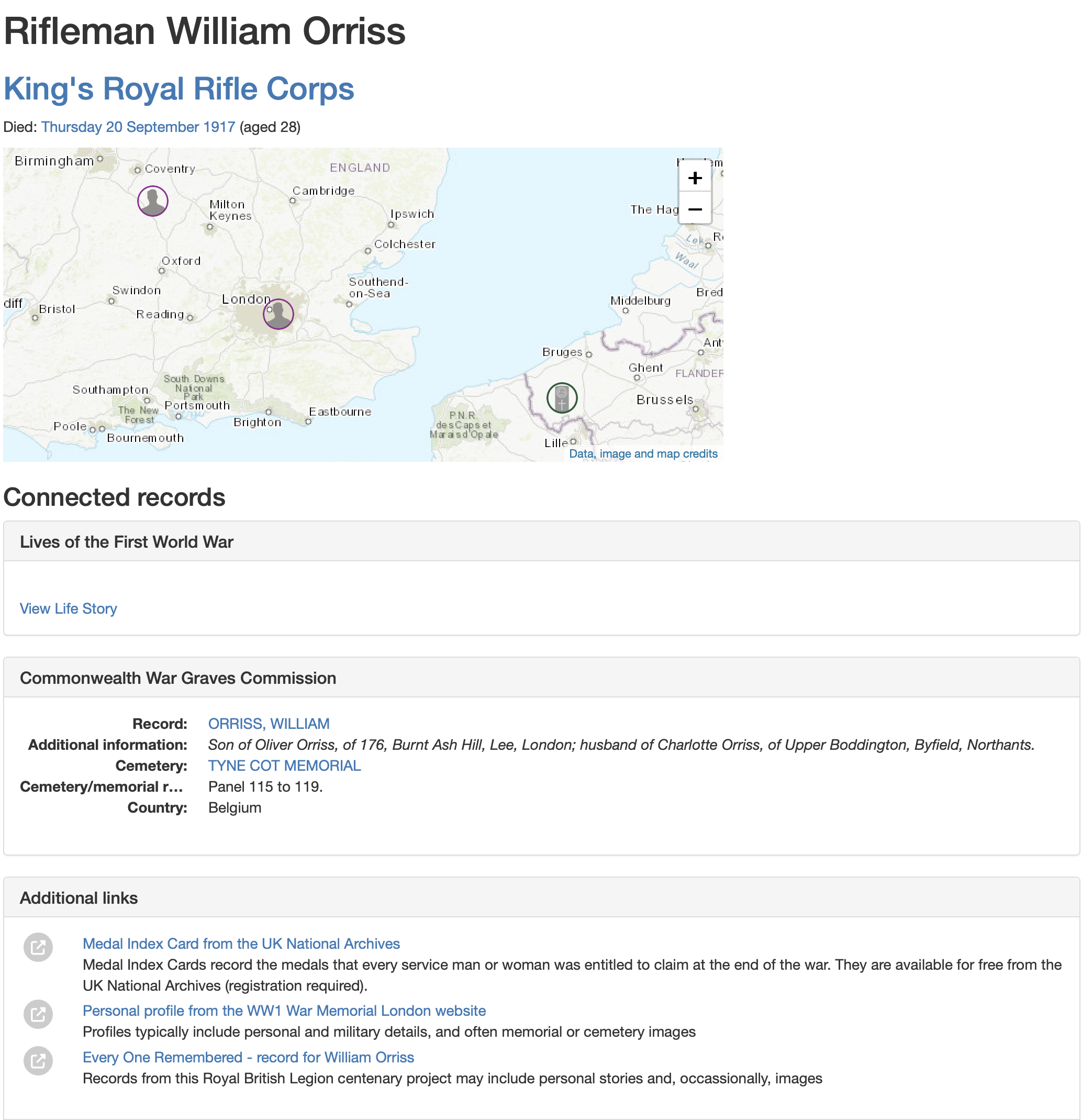
In further research into the British Army Archives we find that William has no known grave, and because his body was never recovered, Rifleman William Orriss is officially commemorated on the Tyne Cot Memorial in Belgium.
This took me aback. All of us will be aware of the famous Menin Gate Memorial that we see every November during The Armistice. That Memorial has the same status.
Let us now always remember the importance of the Tyne Cot Memorial and the Menin Gate Memorial when we observe King Charles III laying the Wreath at The Cenotaph in London Whitehall because all are intertwined. These two Memorials are perfectly encapsulated by The Tomb of the Unknown Warrior in Westminster Abbey. This is the one Tomb over which it is absolutely forbidden to walk, and which we see so often in the Procession and Recession on State Occasions when, no matter the rank and status, the column moves to the side and around. There is no record of the identity of this Warrior.
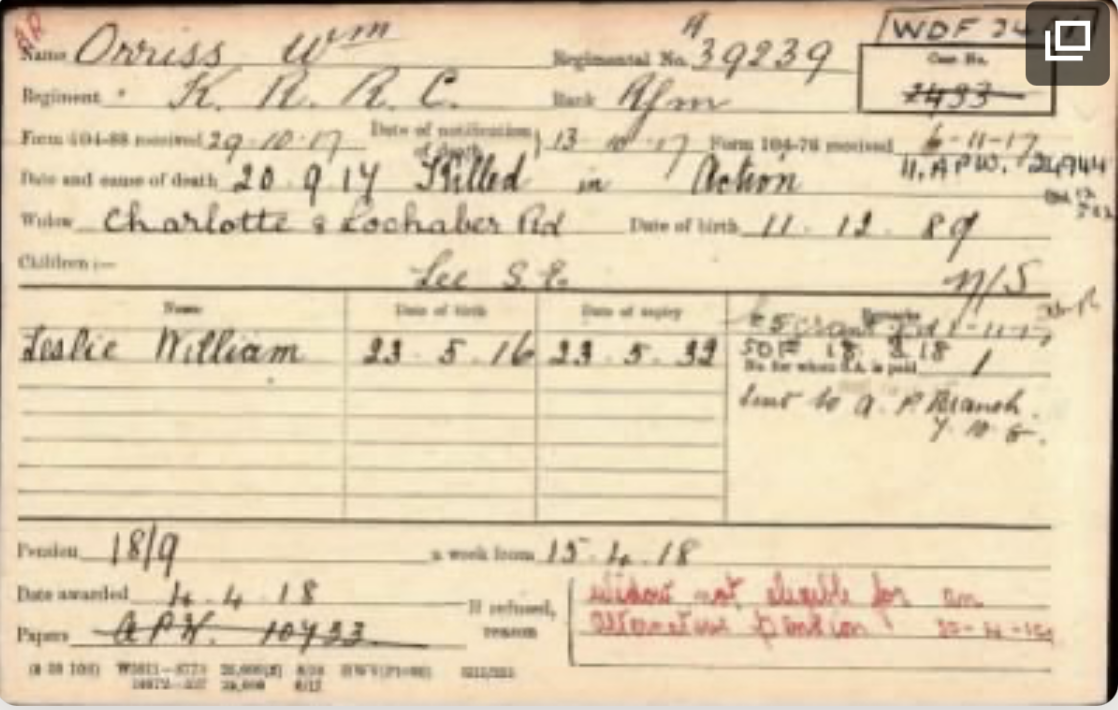
It is indeed sad to read the annotation that Charlotte is a ‘Widow not eligible for an alternated Pension’.But one has to consider the practicality as well. KW

Final Entry - Entry No. 3 for Rifleman William Orriss with reference to Charlotte in column 15 of the Battalion Ledger. KW
William’s Army Service Number is R/39239. The “R” prefix was used by the King’s Royal Rifle Corps (KRRC) to note a New Army enlistment, also known as Kitchener’s Army. The KRRC is also known in 1917 by its ancient title Yeoman Rifles. Some might recall from history lessons the famous wartime poster “Your Country Needs You” depicting Field Marshal Lord Kitchener pointing directly at you, the reader.
Military Archive research independently confirms that because William has no known grave, he is officially commemorated on the Tyne Cot Memorial in Belgium as Rifleman William Orriss. Flt Lt John Edgar RAFVR Rtd, as a former field range officer, will most certainly attest that becoming a Rifleman was not an easy task. And I recall in my own service that John was one of the finest range officers - both indoor and upon open terrain - with whom I had the privilege to serve. It was not unknown for me to be corrected politely and firmly when undertaking field practice on the range under John’s command - the price being to stand a round of drinks in the mess that evening!
Should, perchance, any of the family be visiting Belgium, our ancestor and great uncle can be found on Panel 115 to 119 and the Memorial stands near the town of Zonnebeke. Please do so. William owes our thanks. It is also good to remember family sacrifices in these very dangerous times, the most dangerous since the Second World War, now surpassing even the 1962 Cuban Missile Crisis.
The ultimate price paid that gives me and our family our freedom today in 2026 is quietly reflected; a reflection paid by millions of families in the cause of freedom and democracy and which today both in the USA and in Germany is under very serious threat. In America we look on with horror that a regime is now in place that has every mark of Fascism. In Germany, we see the vociferous minority demanding to recreate the former East Germany. Even in the United Kingdom we have fascism masquerading as reform. Their manifesto is chilling.
The Price Paid
Rifleman William Orriss killed in action 20 September 1917
Pte Harry Marshall P.o.W died 24 October 1918
Pte Frank Ewart Marshall P.o.W (Same Camp on his brother’s death) repatriated December 1918
Pte (Logistics) Frederick Geroge Marshall died Cheltenham 1925
The death certificate and the newspaper report both affirm that the cause of death was Coronory Tuberculosis caused by privations suffered in the Great War
Sergeant Pilot Kenneth Ernest Webb Captain 1315766 Handley Page Halifax four-engine heavy bomber RAF VR No. 4 Group Main Force Bomber Command 17 April 1943
Flight Sergeant Harry Alfred Marshall Pathfinder Flight Engineer 1337884 Avro Lancaster four-engine heavy bomber RAF VR No. 8 Group Pathfinder Force 17 January 1945
We Will Remember Them | Wir Werden Ihrer Gedenken
(†)(†)(†) (†) | (†)(†)
By courtesy of the Imperial War Museum (IWM) I am pleased to include a more detailed record from the KRRC Tyne Cot Memorial Archive.
This panel is a screen image and therefore the links are silent.
This link HERE will take you to the live page and access to the links.
The Battle
Official War Diary
The War Diary of the 21st Battalion Kings Royal Rifle Corps reports that the objective was to capture the heavily defended German positions on Tower Hamlets Ridge. The assault commenced at 05:40 hours on Thursday 20 September 1917, behind a creeping artillery barrage of incredible ferocity.
The fighting was vicious as the advance of ground troops was met by devastating machine-gun fire from concrete pill-boxes. The advance was made even more difficult as the 21st Battalion had to wade through knee-deep swamp mud, and massive shell craters.
(This reminds me of Grandad Marshall’s comment to me in the early 1970s - that to fall into a slime-filled crater meant certain death by drowning. There was no way to even attempt rescue. The suction was often too great to overcome any attempt to haul the victim out. The craters had become furnaces of quicksand. KW)
On this first day of the battle exceptionally heavy casualties were sustained - 4,630 were killed with many bodies unrecoverable due to the conditions described. Several thousand were wounded, and this set the pattern for the following four days - Friday-Saturday-Sunday-Monday 21-25 September 1917.
(Finn, here’s an aspect of the 1917 Film you saw and how it impacted both sides of our family. Grunk).
I am most grateful to Charles Bashford for his meticulous accounts in the Passchendaele Archives. Without his work, and the work of the Imperial War Museum, none of this would have been known to our family.
The Meteorological Office in War
Source: History Extra October 2026 page 43 - Battlefield Intelligence: Meteorologists power British advances at Passchendaele in 1917.
Since writing this chapter, I have read this article on 18 September 2026. It is perhaps fitting to include it here given that it so neatly dovetails with our ancestor William’s, story.
I therefore insert this note that I have just come across, as it, again, widens the perspective for us when we read about Aunt Lottie’s husband’s final days in September 1917.
Battlefield Intelligence: Meteorologists power British advances at Passchendaele in 1917
by Ms Catherine Ross in her superb Paper Winds of Change
(It has caused me to never look at any weather forecast in quite the same way again,
and to never take our Meteorologists and Forecasters for granted. KW)
When the newly formed Meteorological Office offered assistance to the military in 1914, it received an unequivocal reply that bordering on tetchy. “The army does not go to war with umbrellas,” wrote the War Office.
[However, the horror of modern warfare very quickly adjusted the minds of the men in highest command from parochialism and arrogance of the previous century.
Human nature never changes.
I now include verbatim this short section from History Extra KW:
[The enhanced technology and ability to read the weather in battle conditions] came into its own during the Battle of Passchendaele – the opening stages of which were fought in exceptionally wet weather. In Ypres across the 31 days of August 1917, 127 mm of rain tumbled from the skies, around 60 mm more than average. With trenches immediately filling with water and parts of the battlefield turned to swamp, combat operations were severely compromised.
When the weather finally improved in late September and October, the British were ready to strike, thanks, in part, to the Met Office’s forecasts. The drier weather of September hardened the ground and brought early morning mists, which gave cover to advancing British infantry. When the mists cleared during the morning, German counter-attack formations were revealed to air and ground reconnaissance.
Armed with this intelligence, the British were able to launch offensives at the Menin Road Ridge (20-25 September), Polygon Wood (26 September-three October) and Broodseinde (4 October).
Together, these engagements led to British possession of the strategically important ridge east of Ypres – before the vein returned in October.
Ernest Gold’s diary includes notes from meetings and telephone calls with General Plumer, commander of the Second Army, and his chief of staff, General Harrington, warning them of deteriorating weather. Perhaps the British Army could fight the war with umbrellas, after all.
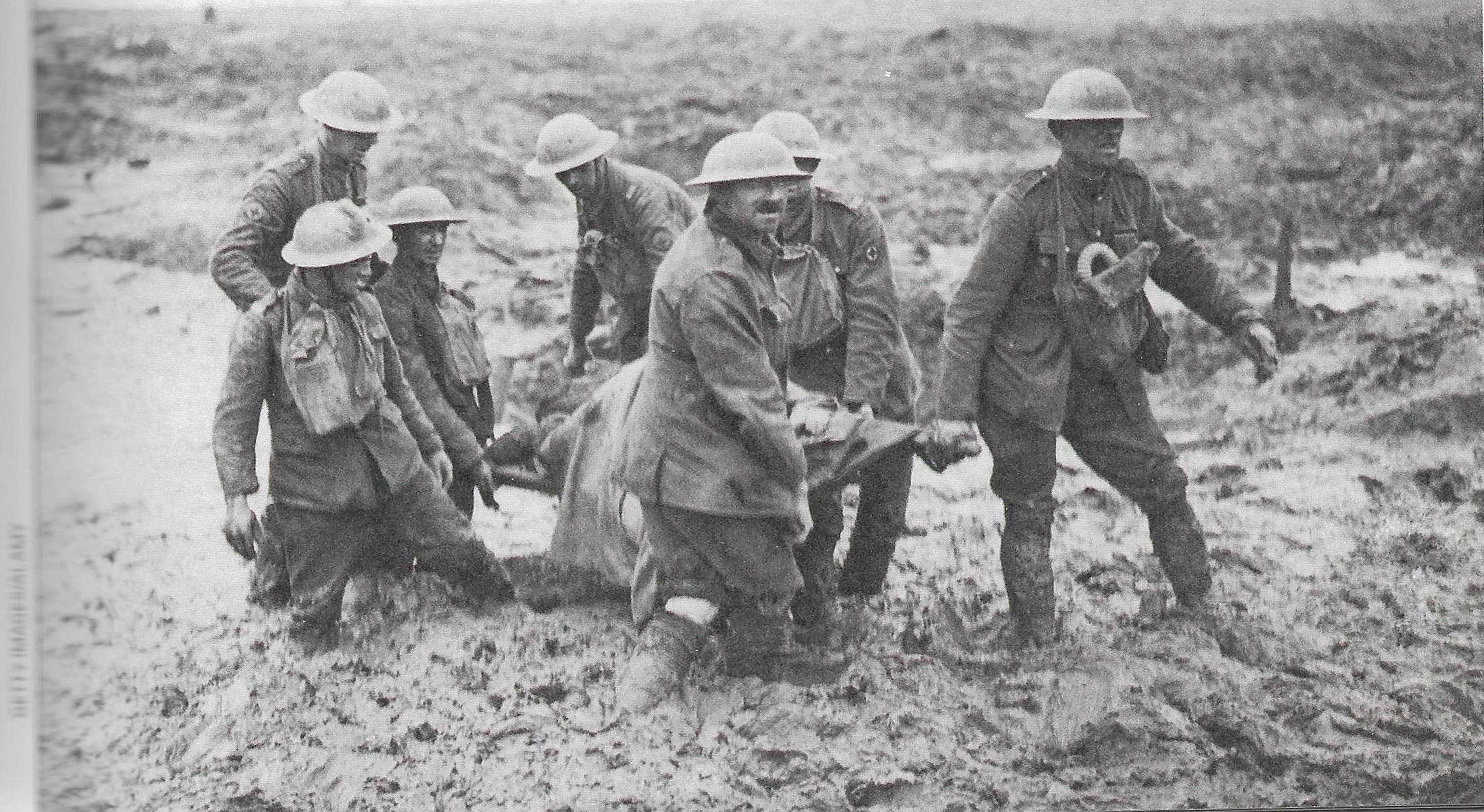
Stretcher Bearers struggle through the mud in Belgium, during the opening attack of the battle of Passchendaele, in August 1917 – Catherine Ross, History Extra. p43.
To the family, I'm so grateful to Catherine Ross for showing us all this incredible photograph and which emphasises my earlier observation about the mud becoming quicksand from which it was impossible to pull someone who had fallen in because of the suction, and as described to me by Pte Frank Marshall (Grandad) in a rare recollection in the early 1970s. KW
Administration
I also make this observation with regard to the yellow-coloured British army index card above. It is incredibly moving to pierce through the gravity of a 109 year old clerical card which in turn sheds light, colour, context and a very deep sense of dignity to William’s sacrifice.
I pause.
I quietly consider those four nouns…
LIGHT,
COLOUR,
CONTEXT,
DIGNITY.
and am gently led back to REALITY.
This is heightened movingly when I realise that Charlotte contended with the fact that – unlike our other uncles in both World Wars who lost their lives – William was never recovered.
This is the case for countless families on all sides.
It is right and proper to include here reference to the grandfather of Frau Rita Schneeweiß. He was also killed-in-action in 1914 on the Western Front, a commissioned officer in the Imperial German Army. Likewise, his body was never recovered.
It is why our family suggested to Rita that the Memorial at Lachen Speyerdorf to the Webb Crew that crashed on 17 April 1943 might be a place wherein Rita could remember her Grandfather.
Why so? …one might ask…
Two reasons.
Because the foundation that underpins all of the work of the IG HEIMAT FORSCHUNG RHEINLAND-PFALZ (Rhineland-Palatinate Local History Research Interest Group) is that…
Such work never points the moral finger.
… and as Isabel reminded me one day when I must have said something…
Ken, you must remember, not all Germans were Nazis.
Whenever I stand at Cheltenham Cenotaph and run my finger over the name of three of our uncles in memory of five of them, I realise that in all the years that I have been doing this, I was unaware of what had happened to William, the sixth relative. It is wonderful to see names on the Cenotaph and on all war memorials in every city, town and village throughout the British Isles. But they are frozen in time.
William’s record card covers the reality; specifically bringing the story of William back into the light and which, for me, means that William’s Story has been waiting patiently for 109 years.
There is no bitterness. Nor is there sadness, because we are talking of events that are more than a century past. Nevertheless, it brings into perspective another aspect to our family life when we recall Charlotte - as William knew his wife - Lottie as known to her sister Isabel and brother Arthur and parents, James and Eliza.
And here’s an interesting point, Finn. Listen to Gran’s observation.
Carol, being three years older and thus a teenager in the early 1960s, makes a pertinent point.
“Ken, it was Aunt Lottie who decided to use the name Lottie.”
I understand this. We must move on, especially when we are still young. As I write this I can see Lottie as clearly as if it is 1970 again. Her eyes, her smile, her fortitude. I giggle when I recall all of us visiting Leamington Spa for tea one weekend, except that we arrived a little earlier than the agreed hour.
Oh, Desmond! You’re early. Please drive around the block if you don’t mind.
We returned at the appointed time, previous guests had departed, and we were given a wonderful welcome. That was Lottie’s practicality and also her businesswoman’s approach in the 1960s.
Carol, Vanessa and I all have very vivid and adult memories of our Great Aunt Lottie. We were always aware that Aunt Lottie had been twice widowed. I recall dad (Desmond Webb) speaking of Uncle Bert…
“Of course, I never knew Uncle Bill as he was killed in the War and I was born a decade later in 1927. But I do remember Uncle Bert, when your Great Aunt Lottie remarried. A lovely man. ”
I therefore look at Charlotte afresh. I recall all my conversations with Aunt Lottie. We all do. I recall her laugh, her interest in all of us, her generosity, and it helps me as well to finally bring into correct focus - minus the frisbee - just what Aunt Lottie is to us all in memory. An incredible lady, passionately proud of Leslie, and of all of her Son’s achievements, and rightly so.
I remember, too, how Aunt Lottie would use the long corridor from the landing to the piano room at Pittville, as a perfect means of walking back and forth and admiring the views across Pittville Park to the long lake, “my afternoon constitutional, Ken”, and I remember laughing one day when I mentioned ‘books on the head’, and Aunt Lottie looked at me, then came her smile, and the reminder that this was how both she and Grandma had been taught to walk.
A stir deep within. Grandma had taken her quantum leap in 1966. This was now 1976 and because I was being reminded of her sister Isabel, as this was precisely what Grandma used to remind me at Windsor Street on many occasions.
It is why I love this photograph of Lottie and Isabel on Cleeve Hill in 1938. Aunt Lottie is speaking and Grandma is listening, studying her younger sister in detail. Here is family life. Here is life without the Frisbee.
This also helps me to recalibrate the relationship between Isabel, Lottie and Arthur. Another earlier ‘We Three’, hey.
In writing this chapter of Elmfield Road and Windsor Street Days, I have metaphorically let slip over the side of the Princess Maytime of Bredon those old family quips whose motor is that frisbee! We live our lives, and too often, we are apparently open books. But this is never so. None of us are open books.
I end Part IV-II very aware that at last, William Orriss, the son of Oliver Orriss, is now fully remembered. And acknowledging, gently so, the incredible bravery of a young husband and father who knew he faced the certainty of death at 05:40 on that terrifying Autumnal Dawn and opening day of Thursday 20 September 1917. I have no doubt that at 05:40 the two people in his mind would have been Charlotte and Leslie.
Part IV-III
The census also tells us that Eliza and James have a ‘boarderer’ - today we would say a lodger - Miss Constance Mayden aged 21, born in Lippfield Northamptonshire and is an elementary school teacher at Upper Boddington School (Northamptonshire Education Committee)
The 1925 Ordnance Survey Map of Northamptonshire is difficult to read. However, I have been able to list all of the towns and villages that were in place in 1925 and in A-Z order.
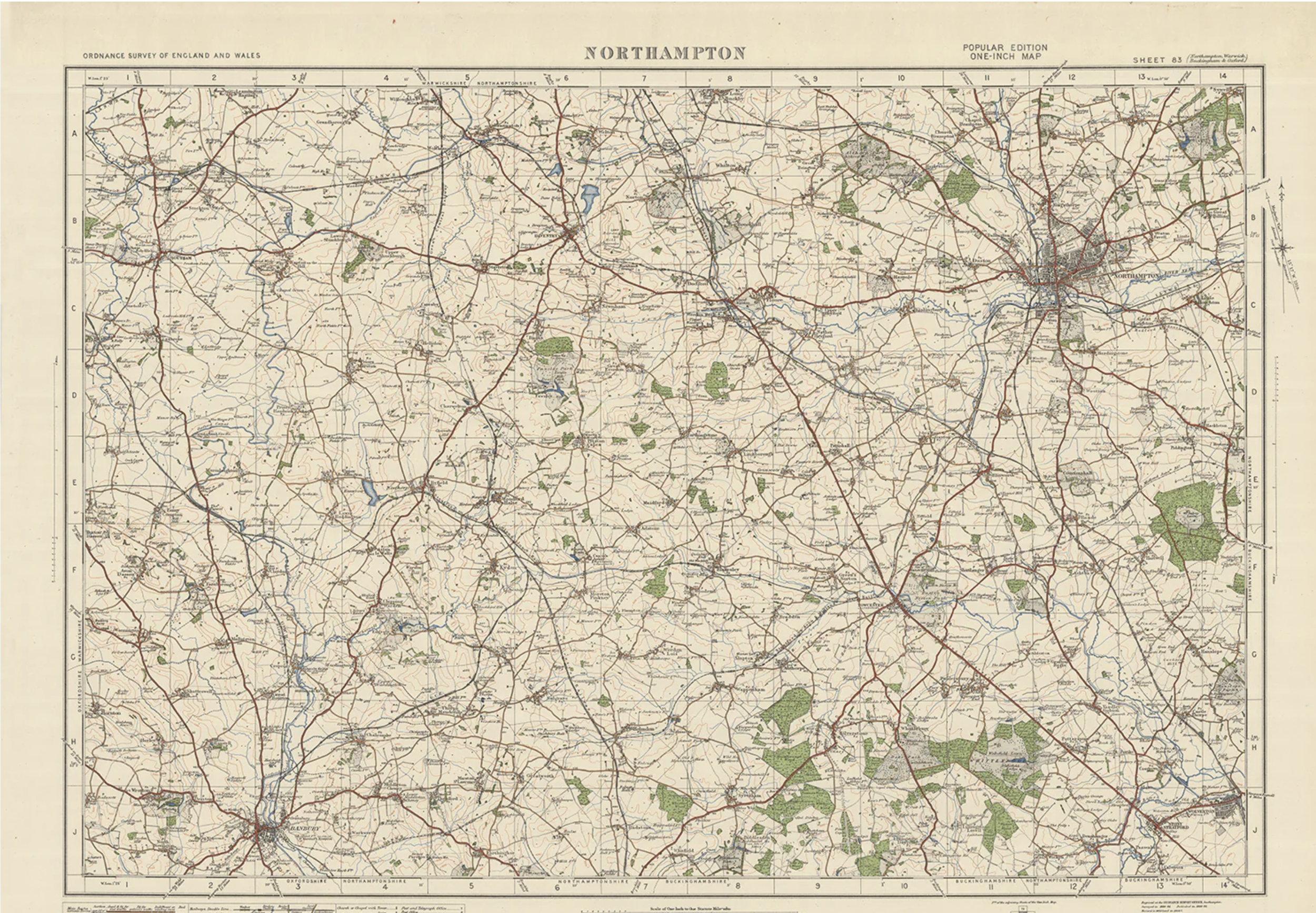
1925 Ordnance Survey Map of Northamptonshire
A-Z Index
A — Abington, Abthorpe, Achurch (Thorpe Achurch), Adstone, Ailsworth (S), Alderton, Aldwincle (All Saints & St Peter), Althorp, Apethorpe, Arthingworth, Ashby St Ledgers, Ashley, Ashton (near Oundle), Ashton (near Roade), Astcote, Aston le Walls, Astrop, Astwell, Aynho
B — Badby, Bainton (S), Barby, Barnack (S), Barnwell All Saints, Barnwell St Andrew, Barton Seagrave, Benefield (Upper & Lower), Blakesley, Blatherwycke, Blisworth, Boddington (Upper & Lower), Boughton, Bozeat, Brackley, Bradden, Brafield-on-the-Green, Brampton Ash, Braunston, Braybrooke, Brigstock, Brixworth, Brockhall, Broughton, Bugbrooke, Bulwick, Burton Latimer, Byfield
C — Caldecote, Canons Ashby, Castle Ashby, Castor (S), Catesby, Chacombe, Chapel Brampton, Charlton, Charwelton, Chelveston, Chipping Warden, Church Brampton, Clay Coton, Clipston, Clopton, Cogenhoe, Cold Ashby, Cold Higham, Collingtree, Collyweston, Corby, Cosgrove, Coton, Cottesbrooke, Cottingham, Courteenhall, Cranford St Andrew, Cranford St John, Cransley (Great Cransley), Creaton, Crick, Croughton, Culworth
D — Dallington, Daventry, Deanshanger, Deene, Deenethorpe, Denford, Denton, Desborough, Dingley, Dodford, Draughton, Duddington, Duston
E — Earls Barton, East Carlton, East Farndon, East Haddon, Easton Maudit, Easton Neston, Easton on the Hill, Ecton, Edgcote, Evenley, Everdon, Eydon, Eye (S)
F — Farthinghoe, Farthingstone, Fawsley, Finedon, Flore (Floore), Fotheringhay, Furtho
G — Gayton, Geddington, Glapthorn, Glinton (S), Grafton Regis, Grafton Underwood, Great Addington, Great Billing, Great Brington, Great Doddington, Great Harrowden, Great Houghton, Great Oakley, Great Oxendon, Greatworth, Greens Norton, Grendon, Gretton, Guilsborough, Gunthorpe (S)
H — Hackleton, Halse, Hannington, Hardingstone, Hardwick, Hargrave, Harlestone, Harpole, Harrington, Harringworth, Hartwell, Haselbech, Hellidon, Helmdon, Helpston (S), Hemington, Higham Ferrers, Hinton, Hinton-in-the-Hedges, Holcot, Holdenby, Hollowell, Horton, Hulcote
I — Irchester, Irthlingborough, Isham, Islip
K — Kelmarsh, Kettering, Kilsby, King's Cliffe, King's Sutton, Kingsthorpe, Kislingbury
L — Lamport, Laxton, Lilbourne, Lilford, Litchborough, Little Addington, Little Billing, Little Brington, Little Harrowden, Little Houghton, Little Oakley, Loddington, Long Buckby, Lowick, Luddington-in-the-Brook, Lutton
M — Maidford, Maidwell, Marholm (S), Marston St Lawrence, Marston Trussell, Maxey (S), Mears Ashby, Middleton, Middleton Cheney, Milton Malsor, Moreton Pinkney, Moulton
N — Naseby, Nassington, Nether Heyford, Newbottle, Newnham, Newton (in the Willows), Newton Bromswold, Nobottle, Northampton, Northborough (S), Norton
O — Old (Wold), Orlingbury, Orton, Oundle, Overstone
P — Passenham, Pattishall, Paulerspury, Peakirk (S), Peterborough (S), Piddington, Pilton, Pitsford, Plumpton, Polebrook, Potterspury, Preston Capes, Preston Deanery, Pytchley
Q — Quinton
R — Radstone, Raunds, Ravensthorpe, Ringstead, Roade, Rockingham, Rothersthorpe, Rothwell, Rushden, Rushton
S — Scaldwell, Shutlanger, Sibbertoft, Silverstone, Slapton, Slipton, Southwick, Spratton, Stanford-on-Avon, Stanion, Stanwick, Staverton, Steane, Stoke Albany, Stoke Bruerne, Stoke Doyle, Stowe Nine Churches (Church Stowe & Upper Stowe), Strixton, Sudborough, Sulby, Sulgrave, Sutton (S), Sutton Bassett, Syresham, Sywell
T — Tansor, Teeton, Thenford, Thornby, Thornhaugh (S), Thorpe Achurch, Thorpe Malsor, Thorpe Mandeville, Thrapston, Thurning, Tiffield, Titchmarsh, Towcester, Twywell
U — Ufford (S), Upper Heyford, Upton (near Northampton), Upton (S)
W — Wadenhoe, Wakerley, Walgrave, Wansford (S), Wappenham, Warkton, Warkworth, Warmington, Watford, Weedon Bec, Weedon Lois, Weekley, Weldon, Welford, Wellingborough, Welton, Werrington (S), West Haddon, Weston (by Weedon), Weston-by-Welland, Weston Favell, Whilton, Whiston, Whitfield, Whittlebury, Wicken, Wilbarston, Wilby, Winwick, Wittering (S), Wollaston, Woodend, Woodford (near Thrapston), Woodford Halse, Woodnewton, Wootton, Wothorpe (S)
Y — Yardley Gobion, Yardley Hastings, Yarwell, Yelvertoft
Where I write a forward slash [/] this is because the handwriting of the Edwardian Clerks’ is difficult to decipher. This is a problem encountered in all 19th century and 20th century censuses. KW
Examples:
Weedon/Weldon, Boughton/Broughton, Harrington/Harringworth, and Cranford/Cransley — Edwardian clerks' loops make these treacherous. Also, enumerators sometimes used older or variant spellings (Floore/Flore, Aldwinkle/Aldwincle, Cliffe/Clyffe).
The Boddingtons lie in a beautiful corner of Northamptonshire, nestling in the southern tip of the county into the borders and hilly terrain with Warwickshire and Oxfordshire. Because the Parish sits so close to the county boundary, we can be quite sure that James and Eliza would often cross them freely, both for work and weekly market; and indeed marriages in places such as Byfield and Aston-Le-Walls in one direction, and also Fenny Compton just over the boundary in the other direction.
Thinking of my early days at Windsor Street, all of these names were in regular use. Another lovely goose-pimply moment, for I remember all of Isabel’s lively conversations of life in Boddington. Grandma had a way of opening up a long lost world. Long dresses and dance cards that Isabel took great delight in reminding me that every dance had been booked. It is only in this century, at the same age that Grandma was when recalling these events, that I capture the whole characters and personalities of Isabel and Lottie, their brother Arthur, of their parents James and Eliza, and of the family as a whole.
For census purposes, Upper and Lower Boddington were a single civil parish (Boddington), so the numerator’s records would usually treat them together, with the distinction appearing only in the address column – often abbreviated, and often badly so. For example, ‘Upr Boddington’ suggests that a tired hand can look remarkably like all sorts of things.
So the work being done in this part of the archive is really rewarding when I measure it against those tingling feelings we all experience when we hear names and places long since out of use within the family. These form the geography of our own childhood; our route map of our family’s daily rounds a century and more before. Imagine the bicycles and horses across the Banbury lanes - exactly those border points in which our family lived, and this is why the census returns are important and at times give us all quite a chase.
Picture that wonderful photograph of Horace (Grandad) as a young man clearly on a mission to win Isabel. And win most surely, Horace did!
We learn too in the archive that Isabel also loved cycling and which continued right up until around 1956 when I was aged three. I cannot recall this, but I can recall Horace; and I’m certain that Carol will recall Isabel and ‘Flying Gert’ as our Mum (Nancy) used to call it with a chuckle.
Yes. Photography brings former times alive. Imagine this when we see Grandad here, looking incredibly like his Great Grandson Christopher John…
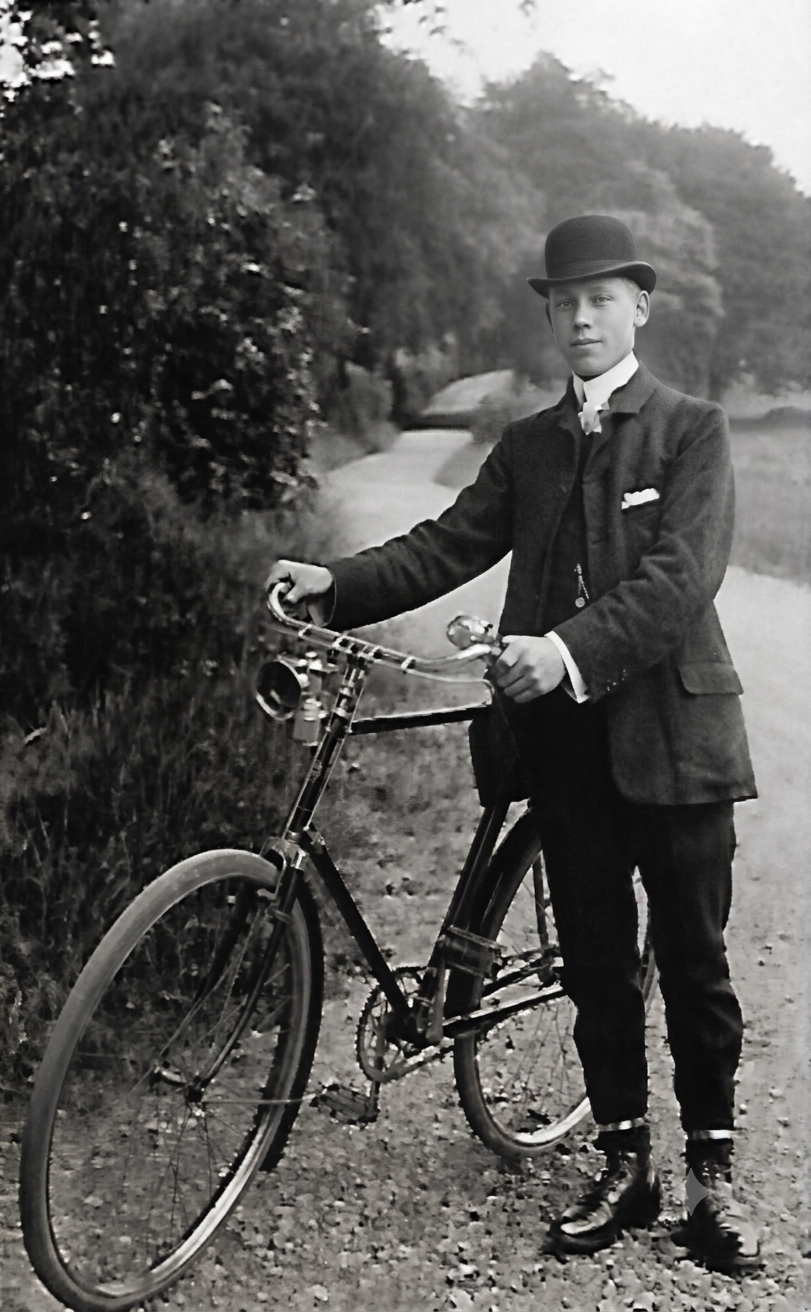
Horace Arthur Webb 1914
This is the joy of archiving, and I never forget this. The day will come when I will not do this. If others then pick up the baton, always keep this in mind…
Have fun! Be accurate!! Don’t guess!!!
Part VI-VII-VIII
Part VI
Perspective
It reminds me of the 1980s as a trainee junior lawyer at Watterson Todman Solicitors in the Promenade, Cheltenham. In those days I learned to work from title deeds, documents and abstracts of title as the National Land Registry was still a work-in-progress. I easily recall my principal, Paul Youde, popping his head round the door in our offices on the Promenade…
Ken, have you drafted that instrument yet? I requested it yesterday!
Ah, yes sir, almost complete.
Jolly good. I need it by 2 o'clock on the dot! And that's today, not tomorrow!!
How strange. I almost hear the door click gently shut afterwards, the clock ticking and the draft half-done but suddenly now pre-eminent on my blotting pad before me. A whole vanished world lies in this brief memory – the principal's head round the door, the jolly good, the 2 o'clock deadline delivered like a court order.
No email, no rail changes; just walking the longhand draft to Mr Youde’s secretary Isobel (highly qualified) - I can hear Isobel’s lovely Scots accent to this day - I recall the Promenade outside the window while I scribbled against the clock, the enormous beech and chestnut trees rustling and waving in the summer breeze, the elms too, in their final decade as Dutch Elm Disease began moving through the British Isles at lightning speed.
Looking back, I realised that there was pleasing symmetry in my day’s work, too. I spent the early 1980s producing Instruments in careful longhand for someone else to read. Now I find myself on the other side of the desk, deciphering the work by the Returning Clerks of 1921 under their own two o'clock deadlines. So I think this…
“Perhaps a little forgiveness is owed to the ones whose Boddington wobbles may well have had a principal of their own popping round the door.”
The list of towns and villages performs twin duties:
1. as a decoding key, and…
2. walking or cycling or even riding down memory lane on a map from a century that our family born in this century cannot comprehend, and with a glimpse of the old law-office discipline, long since gone.
Part VII
Bring your archive to life. I do not know whether doing so has any impact on the family. I take nothing for granted in these dangerous times. But it does not matter. I do it because I have this gift and because it is giving me pleasure. That is my measure. Genuinely, when the practical task and the pleasure of undertaking that task combine in this way, the outcome is hugely rewarding.
In this particular paper, Eliza and James are now very real people, no longer hidden behind the formality of being so many ‘greats’ in an ancestral line. And here, for me, is the key. It is therefore easy for me to imagine stepping back in time… as if I’m stepping through the glazed mirror behind Dad’s Hydrangea in the garden.
Grampy and Granny
James and Eliza Budd
Appletree Cottage
Boddington
Northamptonshire
Circa 1870s
Good afternoon Granny, Hello Grampy!
Oh, hello Ken. What brings you here?
Oh, I’m just passing and wanted to pop in. I now understand Dad, and Grandma and Grandad, and Uncle Arthur - I mean both of them - Uncle Ken too, and so much more. And I’ve learned so much about you both! About all your sisters and brothers and also your parents – goodness! My Great-Great Grandparents. And life here, in Appletree Cottage. Discovering Granny that the Parish Register that records your marriage, a couple of entries down, just a fortnight later, and your brother is getting married in the same church with the same Vicar. That was quite a find! And Granny, the work you started in 1875 when you were presented with the Family Bible - what we affectionately still call The Wimbush Bible. Well, Granny, you certainly set the pace!
Oh, I know that Ken!
And it delights me to see Theo, Daisy and Max, your most recent entries, to see the way you got Carol and Vanessa, Roger and Steve to countersign the entries, and the way you gently steered the pen that had Carol countersigning as head of the family. I really liked that, you know. I had QUITE a giggle. That was classic Isabel and Horace! Aren’t I right James?
Aye, you are indeed, Izzie.
… a pause …
Yep, … ermmm … Ken…
What, Grampy?
Aunt Lottie had quite a hard time you know, lad, and the way you have explained it, well, you definitely have firm hold of the reins.
You know Grampy, we always loved how Dad would tell us how you ordered him to get down out of the apple tree!
Haha! Scallywags - the whole lot of ‘em.
I never realised that there is so much history with the Royal Horse Artillery! Both you Grampy, you Granny your Dad, too! Oh! Another thing. Now I know Grampy why I so loved being in Folkestone and Dover. It always felt like home.
Aye, you’re right there, Ken lad. Kent’s central to the family history. In just the same way as Gloucestershire, Hampshire, Northumbria, Essex and Lancashire is now.
… Granny and Grampy giggle …
Goodness, Granny. That’s how Grandma laughs!
Haha! Well there you have it, Ken. And you know, when Grampy uses that ‘hold firm the reins’ phrase - any phrase to do with his beloved horses - you know you’ve done well.
Now pop along, dear.
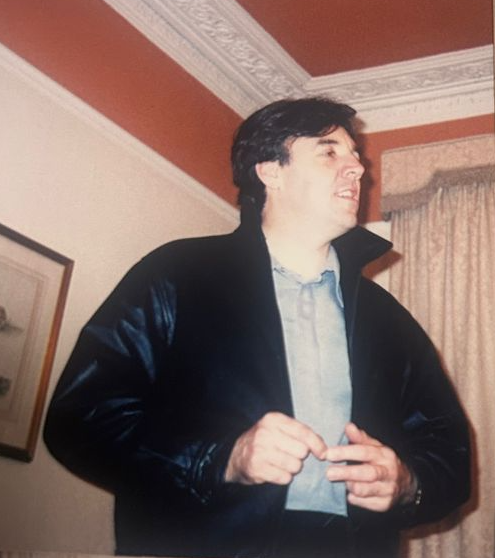
Bye Granny, Bye Grampy
Our Ancestors are the very reason we are who and what we are today. Over many centuries there will have been low points as well as high points; some may have come off the rails. But the sum total arrives here, at this point. Let us strive to always find the right balance. When we talk of ancestry we tend towards bland; and bland leads to disinterest, because irrelevance is the root of disinterest.
When we think of our ancestors though, this brings news perspectives. Live in the present, keep an occasional check over our shoulder at the past, because this makes our progress into the future safer. There is much to say in favour of yester-year. There is also much to say in favour of today.
How strange. I began legal practice in January 1982 – a very different world, still years away from even the word processor. I remember the senior partners, the senior solicitors, assistant solicitors and articled clerks ~ the enormous respect I had for them; and it makes me think of these young census clerks of the 1920s and 1930s.
In the 1980s in the legal profession we spoke differently - the Queen’s English. Twenty was precisely that, not ‘twenny’. Lieutenant was ‘leff-tenant’ not the American ‘loo-tenant’; we even dressed differently. Very formal. And I do not like my past life being mocked. Mockery and self-importance are the hand-in-glove playground bullies of Social Media aka The Wreckers.
Part VIII
All of these long distant memories suddenly come rushing down the lane because I am reviewing the lives of James and Eliza, our ancestors and our Great Grandparents on Dad’s side.
This realisation is very moving. I'm absolutely right. A clerk aged twenty-one writing the entries in the 1921 Census would have been aged 71 years when I became a constable in 1972, and 81 when I joined Watterson Todman in 1982, precisely the generation of those senior men whose gravity and formality I can so easily remember and who taught me how to practise Law, and the etiquette attached to it. I mention this, because Mr Eric Watterson, in 1982 a consultant solicitor who still worked a five day week, his junior partner John Todman taking over as senior partner. I learned so much from all of these solicitors.
I have to laugh again.
When I lean over the census page I’ve printed off and I puzzle out a wobbly Boddington, I smile. There’s a fair chance I'm reading the young hand of exactly the sort of person who later taught me how to practise law before the years and the profession had settled his own life, his own name, his own script, into that immaculate copperplate plaque on the main entrance to his practice.
To my family, I say this. There is a quiet magic in Archive Work because archive work collapses time.
It is easy to think of the 1920s as being so remote until I realise that they were simply the youth of people I knew, shook hands with, and drafted instruments for. The stiff collars, the ‘sir’, that two-o’clock deadline is all one continuous world, and here's the thing… I had the privilege of standing in the last decade of that world.
Memory works in wonderful ways, not by force but by true detail. A village name, my principal's voice at the door… unlocking the rest of it as if it has been waiting for me with great patience to do so all along.
I end on this note and in tribute to both James and Eliza, that their handwriting and the handwriting of the census clerk at Upper Boddington in 1921 is still being read with great care and a sense of knowing who they really are, a century and a half on.
End
30 August 2026
All Rights Reserved
Gloucestershire
© 2026 Kenneth Thomas Webb

Eliza with Isabel and Arthur ~ Mother, Eldest Daughter and Grandson - 1916.