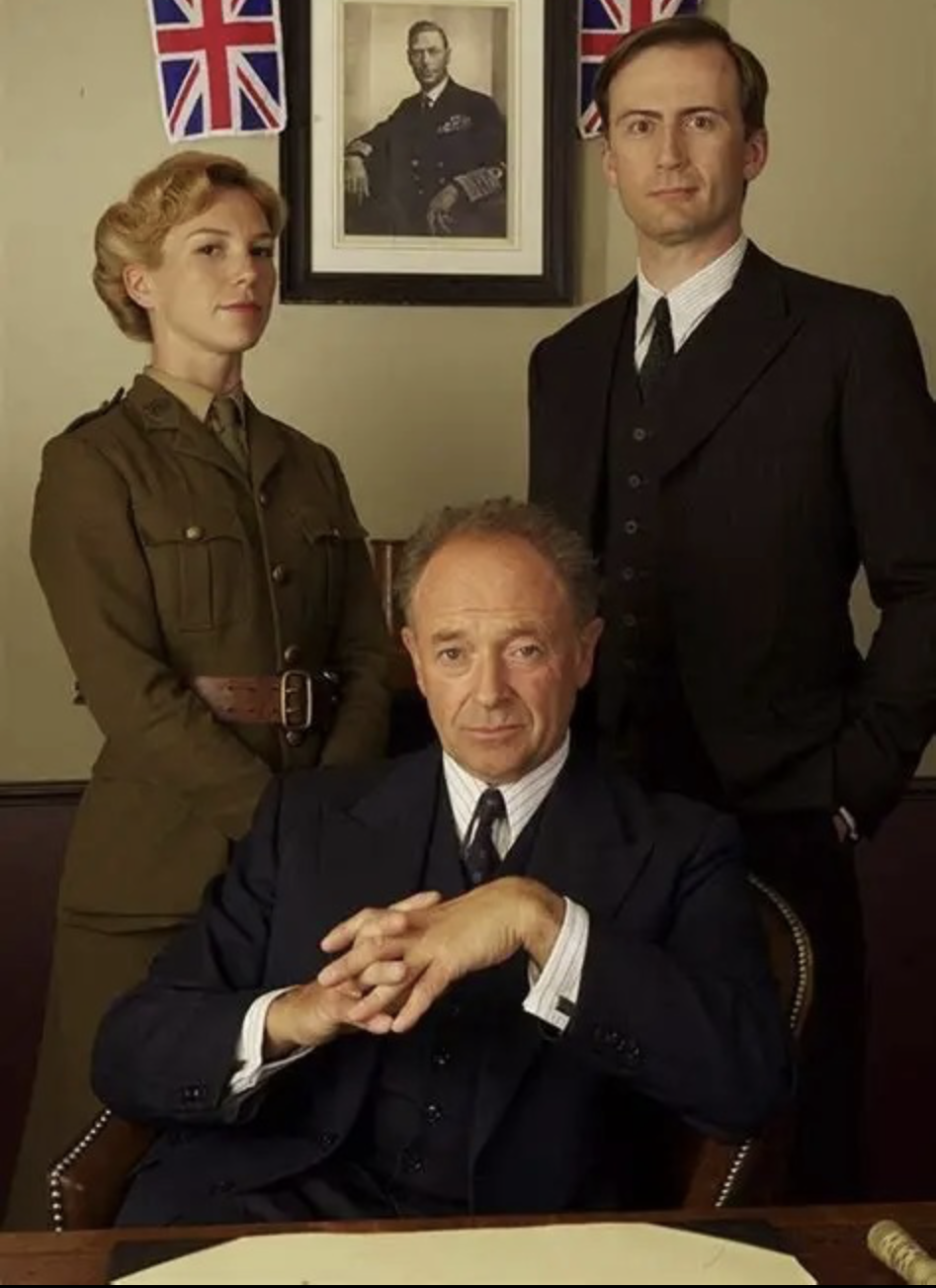
FOYLE'S WAR ~ ITV Drama Series 1-9 2002-2015 ~ Netflix UK 2025
REVIEW
FOYLE’s WAR
ITV Drama Series
2002-2015
United Kingdom
Written and Created by Anthony Horowitz
Part I
WHEN I first saw this advertised on Netflix I shied away because the drama set during the Second World War was portrayed by casts, all of whom are post war, and many born in this century. After several weeks, one evening I decided to “give it a go”…
I’m so glad I did.
FOYLE’s WAR is a superb means of giving us the flip side of the Second World War, and then almost imperceptibly crossing a divide that had once been the crucial bridge between the Allies, into the onset of the Cold War.
The episodes are self-contained, regularly very moving, and without the hint of where the storyline will take me.
The storylines are well constructed. Quite a few times they have, metaphorically, caused my jaw to drop.
Part II
In 2002, attention to detail was at its peak in British television dramas.
By Series 8 there is not quite the same accuracy. I do not put this down to things slipping with the author. Not by any means.
Rather, there is the clear transition - as between generations – when producers and directors with the eye for accuracy and detail in 2002 are giving way to their successors, the new generation taking up the reins and, at times, causing the series to drift off course by 2015.
This especially shows up in the knowledge and expertise of military uniforms. Correct dress and military formality is present throughout episode 1, and this includes the characters playing police roles.
In series 8-9 this drifts and is at times embarrassing. As a result of my Police and RAF VR careers I knew when to salute, I knew how to salute, I knew that in both the RAF and the Civil Police (and which was the precise order for all of the British Armed Forces) we NEVER saluted unless we wore headdress. We merely came very smartly to attention. In a room it was rare to place headgear to then salute, we merely gripped the cap in a very precise manner with the Crown facing frontward, and we would move very briskly, almost silently, into attention. It was forbidden to salute without headdress, and I remember the instructions clearly in both and all services…
Listen up, gentlemen, ladies, we do not follow the American armed forces as regards military etiquette. We are ahead of them. This is not a criticism of the American Armed Forces. Each country has its own systems, procedures and protocols.
There is a way to wear uniform. It is taught, and once learned, it is never forgotten.
Producers and directors in 2025 often overlook this. One recalls the endless cringe moments in every series of the excellent Netflix Drama The Crown.
It is understandable. The mindset today is civilian. Deference is a word relegated to the past.
Extras don uniform, presuming they’ll automatically look exactly like the Armed Forces they are attempting to represent. That is not their fault, which fault lies with their producers and directors. It is the fault of people who have no interest in conducting meticulous research.
This will only be realised when, in years to come, the future inevitable major international war is being played out in storylines. And it will be very different to Afghanistan and Iraq One and Iraq Two.
But the storylines are very accurate.
Part III
Anthony Horowitz brings to bear upon us the entirety of messed up human nature.
My overall view of the history of the Second World War is gained through my family, its archival notes, and my interest in military history.
My understanding of civil life in Britain during the war years is framed by the verbatim accounts by my parents and my four grandparents and my aunts and uncles. All of this juxtaposed with the loss of my parents’ brothers serving in the Royal Air Force in 1943 and 1945 respectively.
Surprisingly, I had not thought about policing during the Second World War.
My father served as a police officer and I followed in his footsteps, yet I never cast my mind back to the civilian aspect of life in Britain. I was certainly aware of the incredible work done by the civilian population in war production, in service with the Land Army, and the vital role of women in all of this as well as their military service both with the Royal Navy, the Army and the Royal Air Force.
This is one of the reasons why the character Samantha Stewart – Sam – (superbly played by Honeysuckle Weeks) remains a central part of all nine series through 13 years of filming.
Part IV
Foyle’s War has given me the perspective that I had missed all these years ~ CRIME.
Crime does not take a back seat in wartime. The story in one episode of the fuel racket, syphoning off hundreds of gallons of petrol at the height of the Battle of Britain pulled me up short.
Much more was to follow.
My father joined the police force in 1950, and I followed in 1970. Both of us would have recognised in Foyle’s War our Force ~ the Gloucestershire Constabulary. I recall, too, that the Detective Chief Superintendents I served under were officers who, when the DCS walked the corridor or operations rooms, things went quiet. And in this respect, I can recognise at least two DCSs in the Gloucestershire Constabulary in the 1970s that perfectly fit the character of Detective Chief Superintendent Christopher Foyle (superbly played by Michael Kitchen).
I remember once doing something that a constable should not have done and suddenly being aware of the DCS. I was uniform not C.I.D. I hasten to add.
PC Webb I suspect you wish you hadn’t done that! with an impish look. (He and my father had joined about the same time).
No… no sir. I’m so sorry, sir.
Erm. You will be if you do this again. Here you are, correct the statement, initial it and return it to Detective Inspector E. And brace yourself. DI E will give you something of a ticking off. Just accept it.
I duly did! The DI’s ticking off was something of a tour-de-force and I learned much! And have remained grateful to him ever since.
The misdemeanour? In my haste to do a good job, my statement of evidence read that the defendant had not committed the offence for which I had arrested him. As my Dad said to me some time later…
Ken! Think, for god’s sake. I know what you meant to write. You know what you meant to write and the defending solicitor will most certainly know what you intended to write, but the solicitor will have a field day. Always remember those dread words in court… CASE DISMISSED!
During the Second World War there was an unprecedented wave of serious organised crime. The police service was efficient, and Parliament was vigorous in passing legislation that would be unprecedented in peace time, raising serious criminal offences such as theft, (larceny as it used to be called), looting and the like to the status of Capital offences.
That alone surprised me and the manner in which Anthony Horowitz presents different storylines, emphasises that this was a nation with a Government of National Unity, and a government with teeth.
I thoroughly recommend Foyle’s War.
10 January 2026
All Rights Reserved
Liverpool
© 2026 Kenneth Thomas Webb