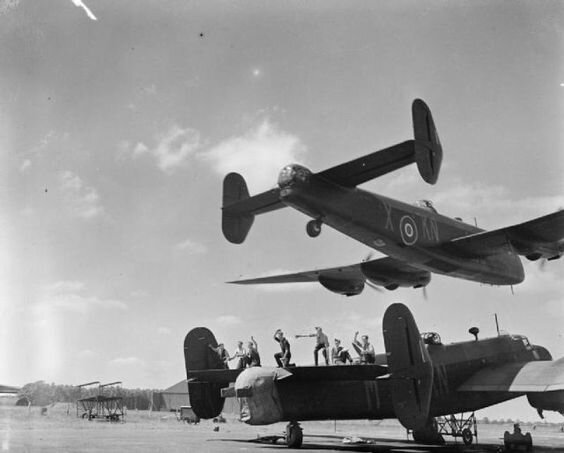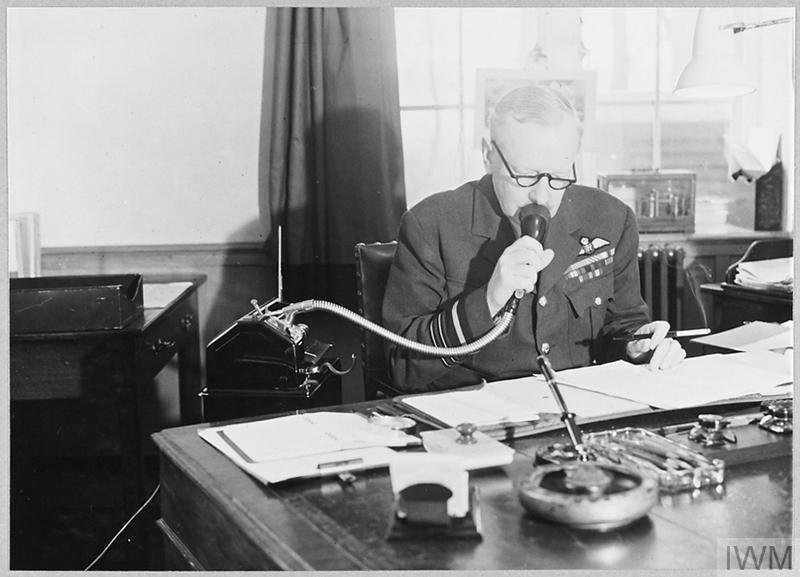
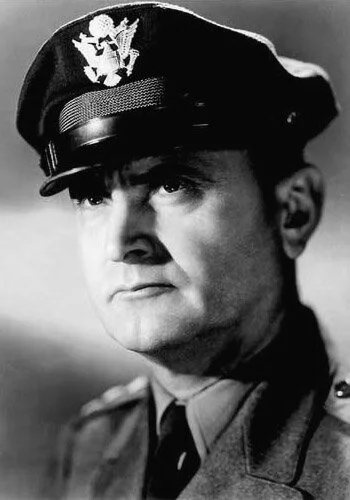
RAF 10 Lt. General Ira Eaker, US Air Force : His Foreword to Murray Peden
Foreword
by
Lt. Gen Ira C. Eaker, USAF (Ret.) C eco-, USAF (RET.)
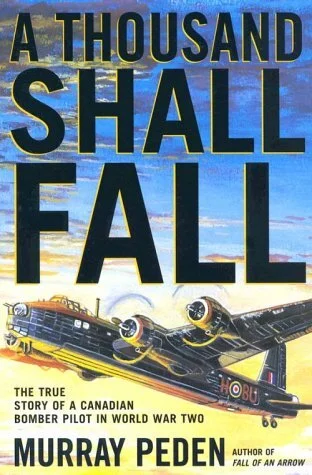
“A Thousand Shall Fall”
by
Murray Peden
One of the characteristic features of 1980 seems to be a revival of interest in the air battles of World War II. This was impressed on me since it has come to my attention recently that several books and motion pictures are in preparation for early release on phases of these aviation campaigns. New editions are also appearing of several recently released books on aviation subjects in response to this revived interest.
Among the best of these is Murray Peden’s “A Thousand Shall Fall.” This is an unusually entertaining and factual account of the air war which Britain and her principal ally, the U. S., waged against the vaunted German Luftwaffe. Eventually won decisively by the former, it made the sea and land victories possible.
Peden was an 18-year old Canadian who enlisted in the Royal Canadian Air Force in 1941, was sent to England the following year, and served the next three years with courage and distinction as a bomber pilot.
Two U.S. Air Force officers who participated in some of the air campaigns of this period read the book, "A Thousand Shall Fall", noted its unusual qualities and contacted the author: General Robert Dixon and Lt. General Ira C. Eaker. The former was a contemporary of Murray Peden in the RCAF, (a Spitfire pilot with the RAF) and prior to his retirement last year from the U.S. Air Force was commanding general for five years of Tactical Air Command.
I, as Peden knew, had commanded the U.S. Eighth Air Force from October 1942 to January 1944.
We have each agreed, at Peden’s request, to write a foreword to the new edition of this book, each discussing it from his own experience, I from the co-operative aspect of command and control and Dixon from the viewpoint of the courageous combat crews.
From my arrival at the Headquarters of the RAF Bomber Command, October 20, 1942, with a directive from General Arnold to understudy the bomber operations of the British, prepare the plans and launch our bombing forces when “I can get you some planes and crews,” the RAF co-operated fully, in every possible way at all levels from Air Chief Marshal Portal, Chief of Staff, down the line and especially including Air Chief Marshal Harris and all his commanders and staff of Bomber Command.
Murray Peden mentions one of the retired Royal Air Force seniors, Lord Trenchard, with deep affection and respect, as the father and founder of the RAF. All American leaders recognized Lord Trenchard, as did the RAF, as the author of the concept of strategic bombardment in World War I. He commanded the Independent Air Force in the late days of World War I, with a charter to conduct bombing operations beyond the battlefields of contending armies, against depots, rail networks and reserve forces, in order to affect decisively the land campaign.
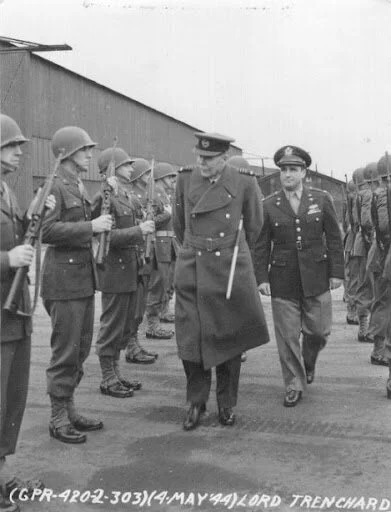
Marshal of the Royal Air Force Lord Trenchard inspecting U.S. Forces in England in 1944.
It was Trenchard who influenced General William Mitchell and inspires his postwar campaign for a separate U.S. Air Force, which ultimately resulted in his court martial in 1925.
General Spaatz and I has contacted Lord Trenchard soon after arrival in England as observers in the Battle of Britain. He was always kindly and courteous in a fatherly fashion. The visits of this world-famous patriarch to our combat groups, during the early operations, proved a valuable morale factor.
The day prior to one of these visits, I read in the London Times that Lord Trenchard had just lost his last son as a casualty in the “Western Desert," the seventh son he and Lady Trenchard were to lose in World War II. I immediately called Trenchard saying I had seen that account, expressing my condolence and saying I would not call for him as planned, as we certainly did not expect him to leave Lady Trenchard in such a tragic time. He promptly stated that the visits to our groups should not be cancelled. His loss only confirmed his determination to carry on, doing whatever he could to destroy the Nazi menace. He did say that he would appreciate it if I could arrange that no mention of his late loss be made to him on the upcoming visit to our bases.
With the revival of interest in the air campaigns of World War II, much ill-conceived propaganda is being written, the general tenor of which is that RAF Bomber Command under the leadership of Sir Arthur T. Harris, deliberately and without reason attacked civilians, including women and children.
No one can read Murray Peden’s book without learning of the gallant effort bomber crews made to find and destroy their assigned military targets.
I can testify to the fallacy of this anti-humanitarian charge against British leadership, political and military.
I had many appointments with Prime Minister Churchill in order to show him the photographs of the U.S. Eighth Air Force Bomber strikes or to discuss with him the great advantage of ‘round-the-clock bombing – the British by night, the Americans by day.
Never at any time did he propose or encourage wanton attacks on civilians. No bomber strike was ever scheduled which was not aimed at an important element of the enemy’s war-making capacity.
Sir Arthur Harris is now bearing the brunt of the charge of unnecessary "civilian brutality” by RAF Bomber Command. No one knows better than I that such charges and claims are entirely false and wholly unfair. For nearly two years I had daily conferences with him, concerning features of our joint bombing effort, targets, weather, results of the previous day’s attacks, etc.
I can understand how present historians and pacifists with a pathological prejudice against warfare, even in defence of a nation and its people, can find some grounds which may be distorted to support such claims.
We were faced with constant Nazi propaganda designed to have the Allies call off their bomber campaigns as ineffective. To defeat this enemy effort, Air Marshal Harris devised a stereo box, showing his bombing attacks which showed workmen's homes without roofs in the Ruhr and elsewhere. They were surrounding vital targets, tank, airplane and gun factories. Such photographs were appreciated and approved by British subjects who saw the evidence of German attacks on Coventry and London.
Air Chief Marshal Harris believed, as I do, that the civilian who makes a weapon bears as much responsibility for warfare as the soldier who carries it into battle. When showing his stereo slides to members of Parliament and the news media, he often made the point that destruction of workmen’s homes was a valuable contribution of the bombing effort: the reduction of the enemies' weapons capacity. This undoubtedly played a part in the Labor government’s hostility to the Air Marshal and its failure to properly recognize the gallant combat crews as it did the veterans of other combat echelons.
No one who reads Peden’s book can fail to recognize the unforgivable unfairness of this policy.
Another great satisfaction I derived from this book, was confirmation of the fact that the young volunteers of Britain, the Commonwealth and the U.S. did not suffer irreparable damage from this demonstration of patriotism. The three or four years out of their normal education opportunities provided compensating advantages.
This is well illustrated by the life and career of the author as a distinguished member of the Canadian bar, in addition to providing us this historical and biographical masterpiece, “A Thousand Shall Fall.”
Robert Dixon, who joins me in this foreword, is another outstanding example of this observation. He, like Peden, enlisted in the RCAF, but at age 21, after college, became a fighter pilot, and was sent to Britain before the U.S. entered the war.
Despite his loss of postgraduate education during his war service, this did not interfere with his education, through his own effort while in postwar military service. This is attested by the fact that he ultimately became a four-star general and commanded one of the U.S. Air Force’s most prestigious organizations, the Tactical Air Command, for five years. After his military retirement, he became president of one of our leading aircraft manufacturing companies.
Finally, readers of Murray Peden’s “A Thousand Shall Fall” will be with rewarded by learning many of the reasons for our success in eliminating the Luftwaffe, leading to the destruction of Hitler and his Nazi tyranny.
Some of our present failures to deal properly with our present international crises will also become apparent.
Ira C. Eaker,
Lt. general USAF (Ret.)
10 February 2022
All Rights Reserved
Liverpool
© 2022 Kenneth Thomas Webb
Ken Webb is a writer and proofreader. His website, kennwebb.com, showcases his work as a writer, blogger and podcaster, resting on his successive careers as a police officer, progressing to a junior lawyer in succession and trusts as a Fellow of the Institute of Legal Executives, a retired officer with the Royal Air Force Volunteer Reserve, and latterly, for three years, the owner and editor of two lifestyle magazines in Liverpool.
He also just handed over a successful two year chairmanship in Gloucestershire with Cheltenham Regency Probus.
Pandemic aside, he spends his time equally between his city, Liverpool, and the county of his birth, Gloucestershire.
In this fast-paced present age, proof-reading is essential. And this skill also occasionally leads to copy-editing writers’ manuscripts for submission to publishers and also student and post graduate dissertations.