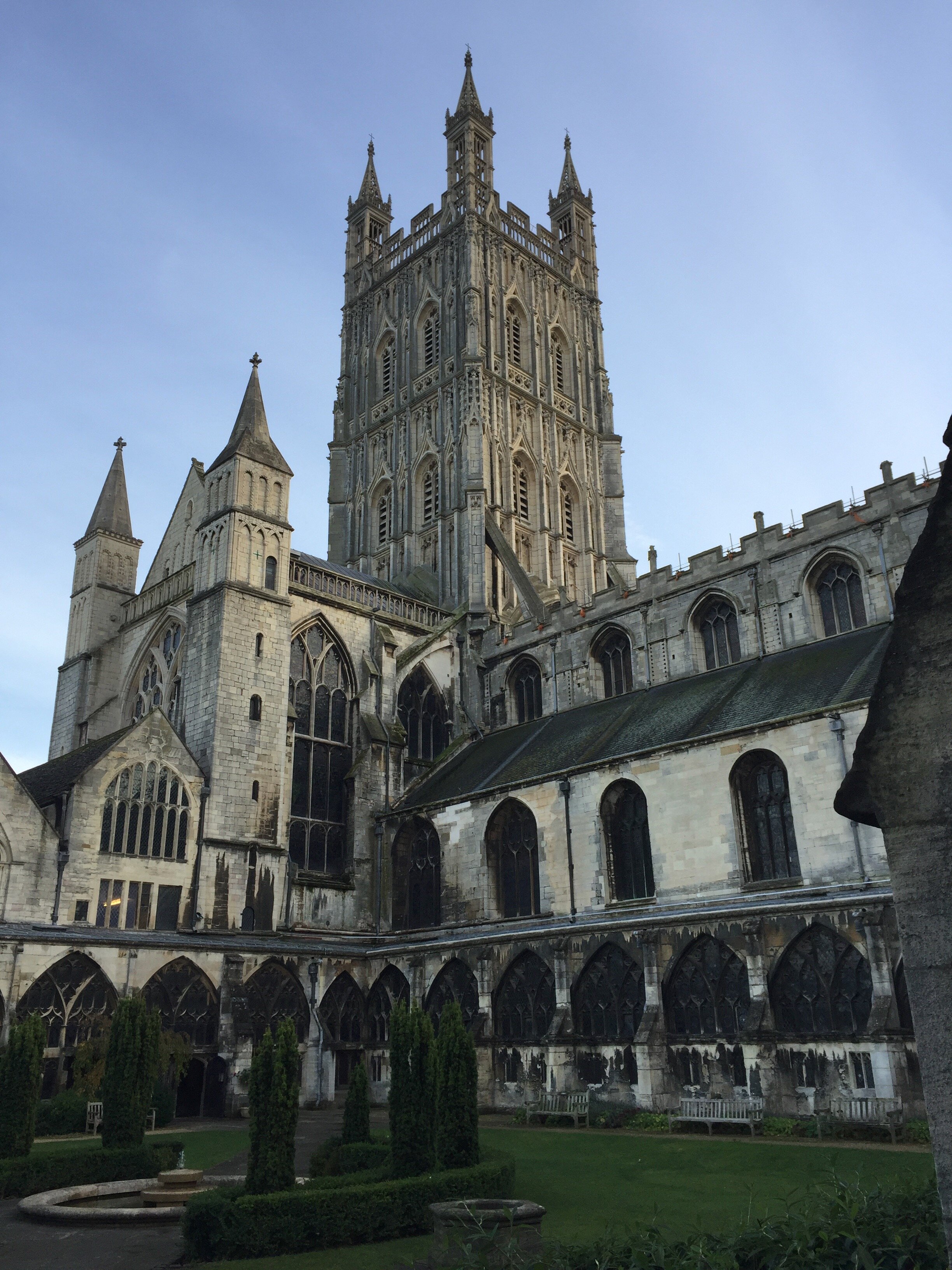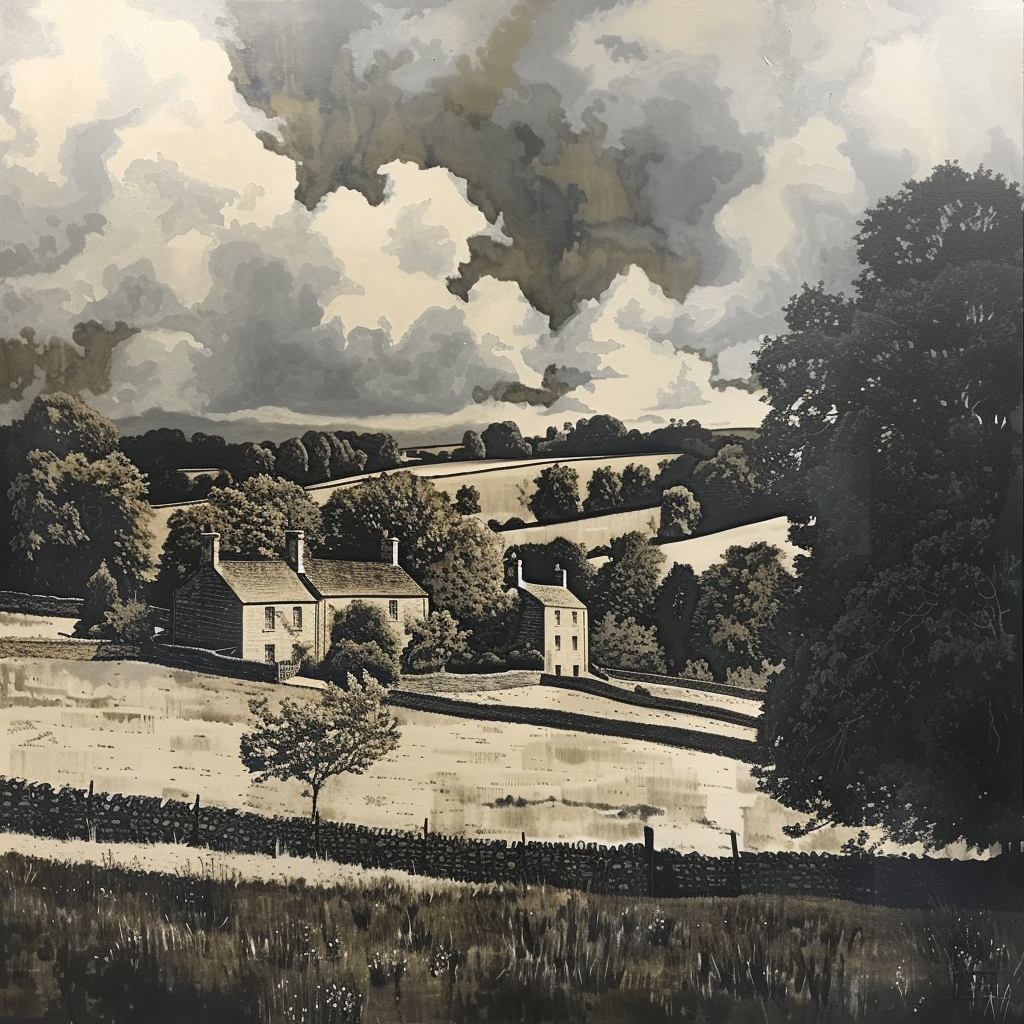
Gloucestershire ~ Cleeve Hill, Cotswold Escarpment

Gloucestershire
Cleeve Hill, Cotswold Escarpment
High above Cheltenham
The beautiful backdrop to the world-famous Steeple Chase Race Course
Preamble
It is 2025. How time flies. This started as a longhand Fountain Pen entry in the 2009 Journal whilst I was in legal practice in Lancashire and living at 16 Lord Street, Blackpool, a few hundred meters from Blackpool Tower, and only a short walk from the sea on Blackpool front. The entry is dated 24 August, and informs me that it was written at Thamasha, an Indian restaurant. Almost sixteen years on, and Thamasha is as vivid now, with pleasant memories. That this entry was written there testifies to the peace and friendship I always received. There is something very special about dining alone, yet not lonely, the lighting tending towards candlepower, and seeing the reflection of my pen as it moved across the lines and over each page.
On that evening, I thought of Cleeve Hill in Gloucestershire. It has always been my life’s constant. Not just me, but the wider family, too. I wrote the article using imperial units, so I’m keeping them as they are. You have your smartphones for conversions. Better still, self-discipline has stepped in and we know the unit by which to convert from imperial to metric and vice versa.
To my generation, 305 meters just does not do justice to the height by which I’ve always known Cleeve Hill ~ one thousand feet at the trig point. I find the same with ocean depths and heights of cloud formations. Informed that a ship lies on the seabed at 959 meters, that robs me of the wide-eyed wonderment I experienced as a child that said shipwreck lay at 3,146 feet ~ just short of a mile. Or those great Cumulous Clouds reaching 8,800 meters is, craning my neck to its summit, 29,000 feet. Ah! That’s more like it. I giggle. Obviously, those who know only the metric system of measurement will still experience the same majestic wonder, awe. Each generation moves on along the timeline, the Roman mileposts are still mileposts but the kids instead see a milepost as a relic from the past which actually denotes 1.6 kilometers.
Enter now the mind of a writer in 2009 on the northwest coast of England, it is late August, oddly it seems a tad colder this year. He pauses. Is my greatcoat here or at home in Liverpool? He makes a mental note to bring it out of the wardrobe even though he has a rule never to wear it before 1 October. But he has a feeling. When 1 September arrived four days later, he was indeed correct. Tuesday 1 September 2009 was vicelike as he walked out the front door at 16 Lord Street. Flippin hek! A quick about turn, a laugh from Mark the proprietor, back already Ken? A giggle. Greatcoat! His giggle continues and follows me up the flight of stairs. At the bottom, in the hall, he laughs again… righto, second attempt! See you this evening. Have a good day, lad.
Wonderful memories. The snows did indeed come early that year, and I’ve much to thank the greatcoat for.
Chapter One
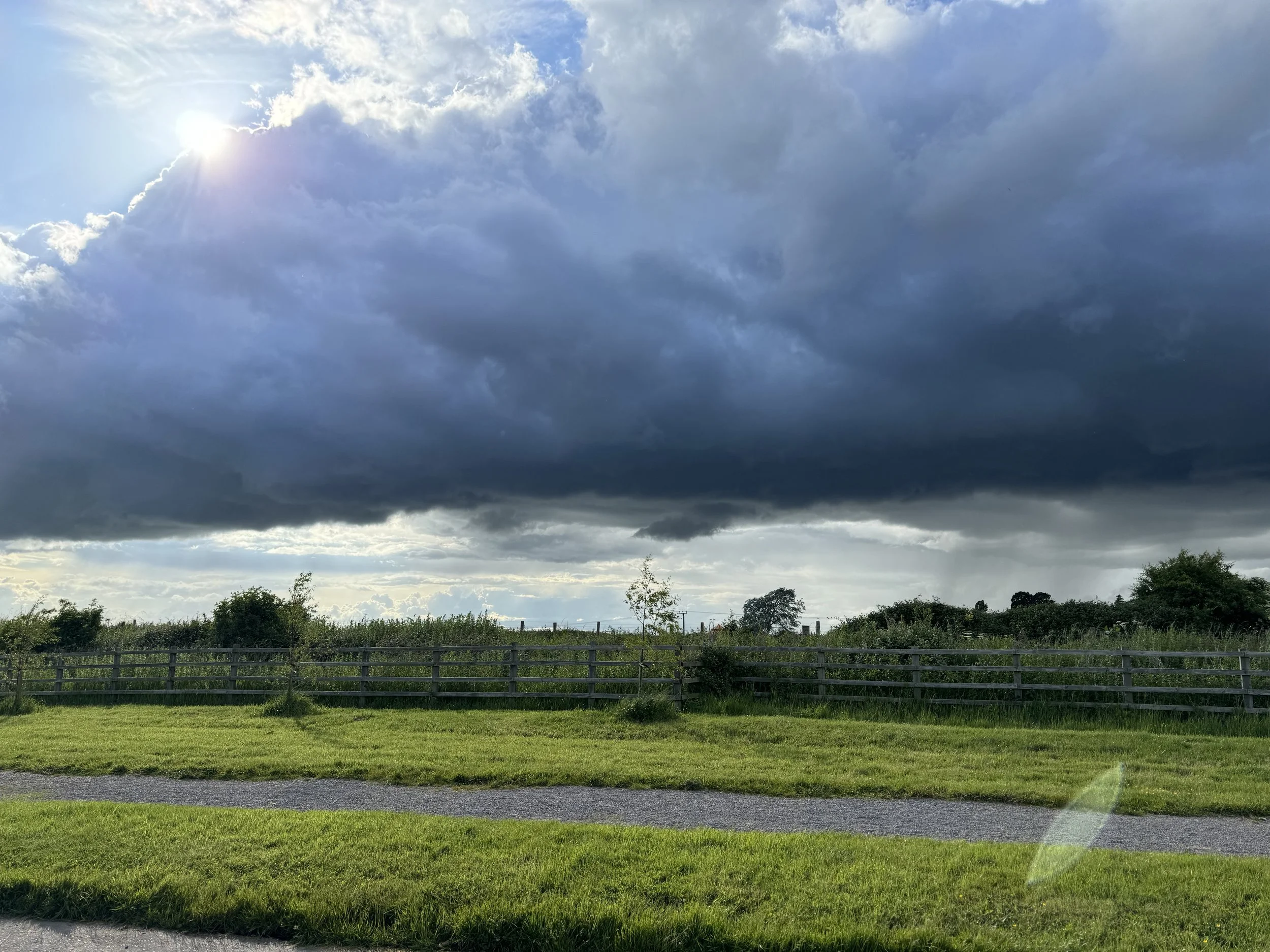
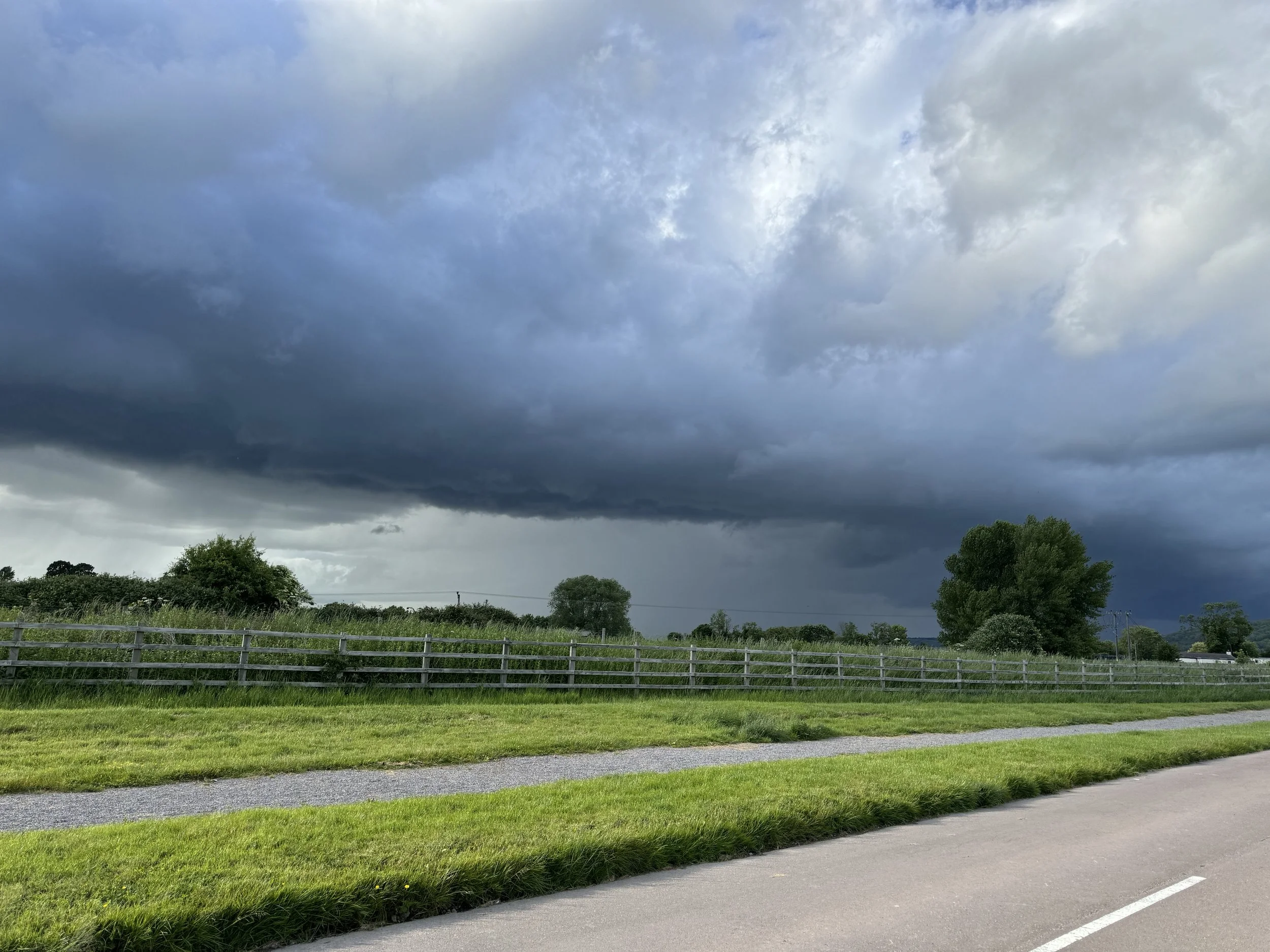
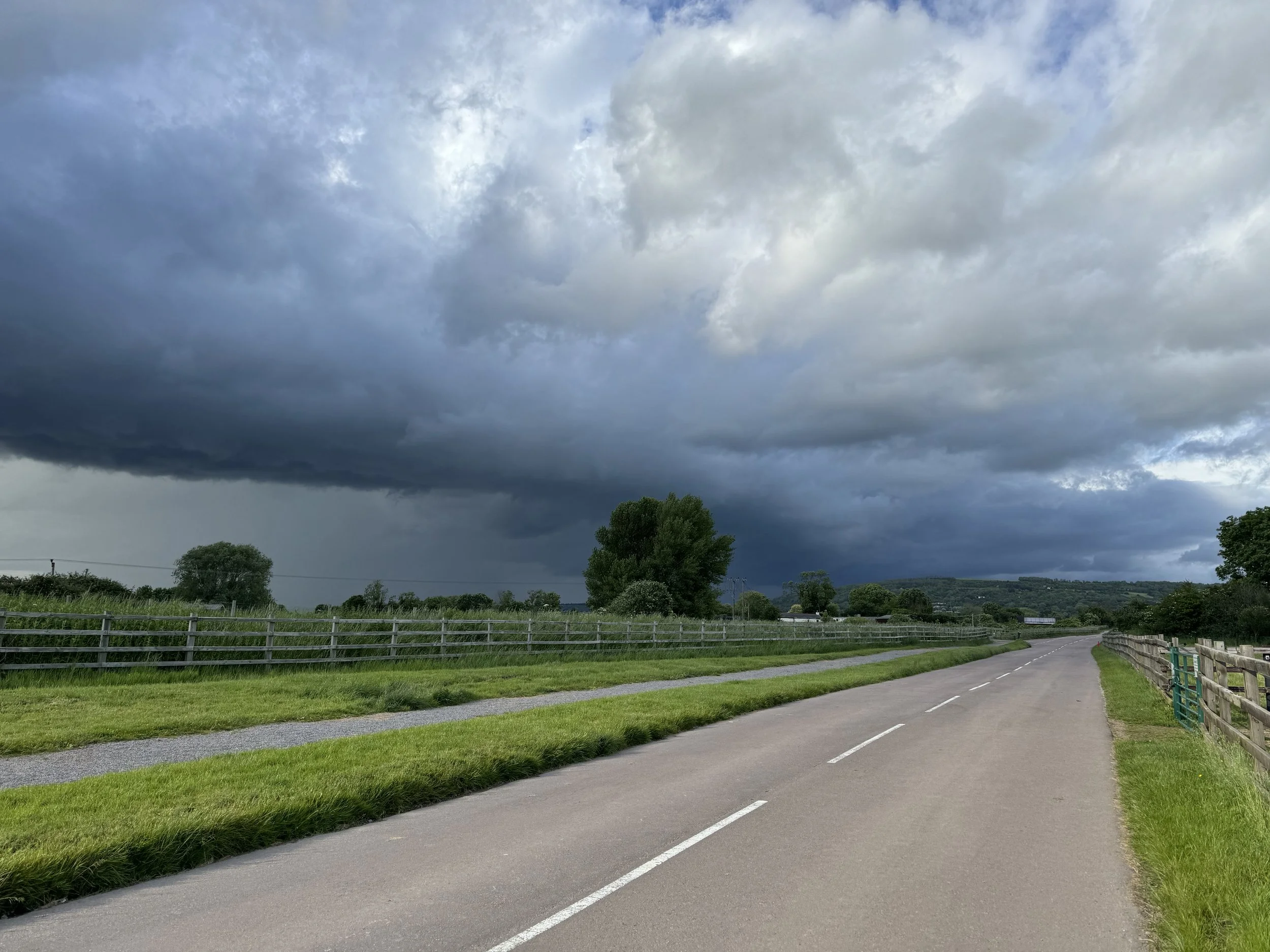
WALKING OVER THE ESCARPMENT it is good to feel the wind straight off the edge as it glides the formations from southeast England – great cumulus clouds that must be sixty thousand feet or more and, I guess, somewhere over Oxford or maybe a little further.
Where I am, there is a long diagonal line that mirrors itself so that what I see is a depiction of angels’ wings. They stretch from their tip high above Cheltenham down over the south wolds onto the Vale of Gloucester and their apex is somewhere over Bristol.
The light is remarkable.
As I glance back I turn to gaze across the great plains of the midlands (the mid lands) but as we now say, ‘the midlunds’, the Vale of Evesham to my right, Tewkesbury crowned by its Abbey just ahead, and to the right of me, Winchcombe, down in the hollow of the valley, with Sudeley Castle nestling gently within the deep, steep contours of Cotswold.
These angels’ wings catch my eye again – for that’s how they appear to me ~ awesome, wondrous, and colossal ~ and I can easily imagine the figure into which those wings are knit ~ beautiful, assuring.
Of course, it’s all in my mind I know, nothing more. But it gives me faith. It gives me hope. It gives me vision, without endangering my insistence to myself to look at everything scientifically, to the consternation of some narrow-minded or downright dotty flat-earther friends.
We all need these three essential ingredients of life – faith, hope, and vision. All of them are intertwined. They cannot stand singular. Even if I only have hope, the framework of faith and vision will also be there. And that’s a mathematical equation for me. Certainty.
So, there I have it. The component parts of Certainty – faith, hope, and charity. And the greatest of which is indeed, Love (Charity). In 2009, that was my view.

The Component Parts of Certainty
Digital Artwork by KTW © 2025
But in 2025 I discover that Certainty leads to repression in the wrong hands. There has to be doubt. There has to be a desire to ask for forgiveness. This in turn leads to faith. Faith that will at times, be shaken.
As is it written in Aramaic, "Eli, Eli, lama sabachthani?"
Mein Gott, mein Gott, warum hast du mich verlassen?
My God, my God, why hast thou forsaken me? 2
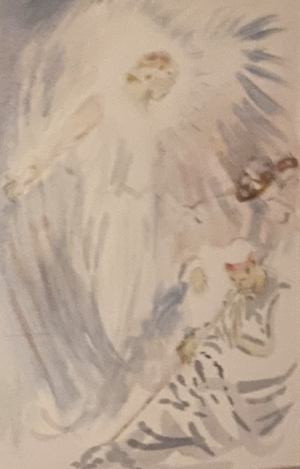
Do not be afraid
And the brilliance and glory shone out all about and around him.
A watercolour rendition of a favourite scene in my Children’s Bible given to me for Christmas 1958, the watercolour is by my father Desmond Webb circa 1989.
Observing these wings, my inward eye catches a glint of silver, or is it mercury? Or is it liquid silver as one sees being poured onto an anvil or in the thin channel of a metal mould from which will be fashioned a beautiful ring, amulet, or brooch?
It is the River Severn. Geographically in my mind’s eye, perfectly equidistant between the landfall of South Wales and its counterpart the Mersey landfall, just across from the rugged and tempestuous coastline of North Wales and that mystical town of so many happy childhood memories ~ Llandudno.
And shimmering in the haze is one of the new wonders of the world – well that’s how I saw it when, as children, we watched the construction of the Severn Bridge joining Wales and England and making it less exciting as we journeyed to this far-off country that I could just see on a clear day from Cleeve Hill on the one hand, but staring in wide-eyed wonder the first time we used the bridge, and wondering, too, whether it would hold all five of us, our luggage and Kim our ‘almost’ golden retriever, up! Happy days indeed!!
Chapter Two
78 Squadron RAF Breighton
The Howes Crew
Handley Page Halifax MZ 311 EY-
Flt Lt C M Howes RCAF Pilot +
Fg Off E Freeman RCAF Flight Engineer +
Fg Off G W McCartney Navigator RCAF +
Sgt E Harris Bomb Aimer RAF +
Sgt J McArdle RAF Wireless Operator +
Fg Off J Glenn Mid Upper Gunner RCAF +
Flt Sgt H B Hamilton Rear Gunner RCAF +
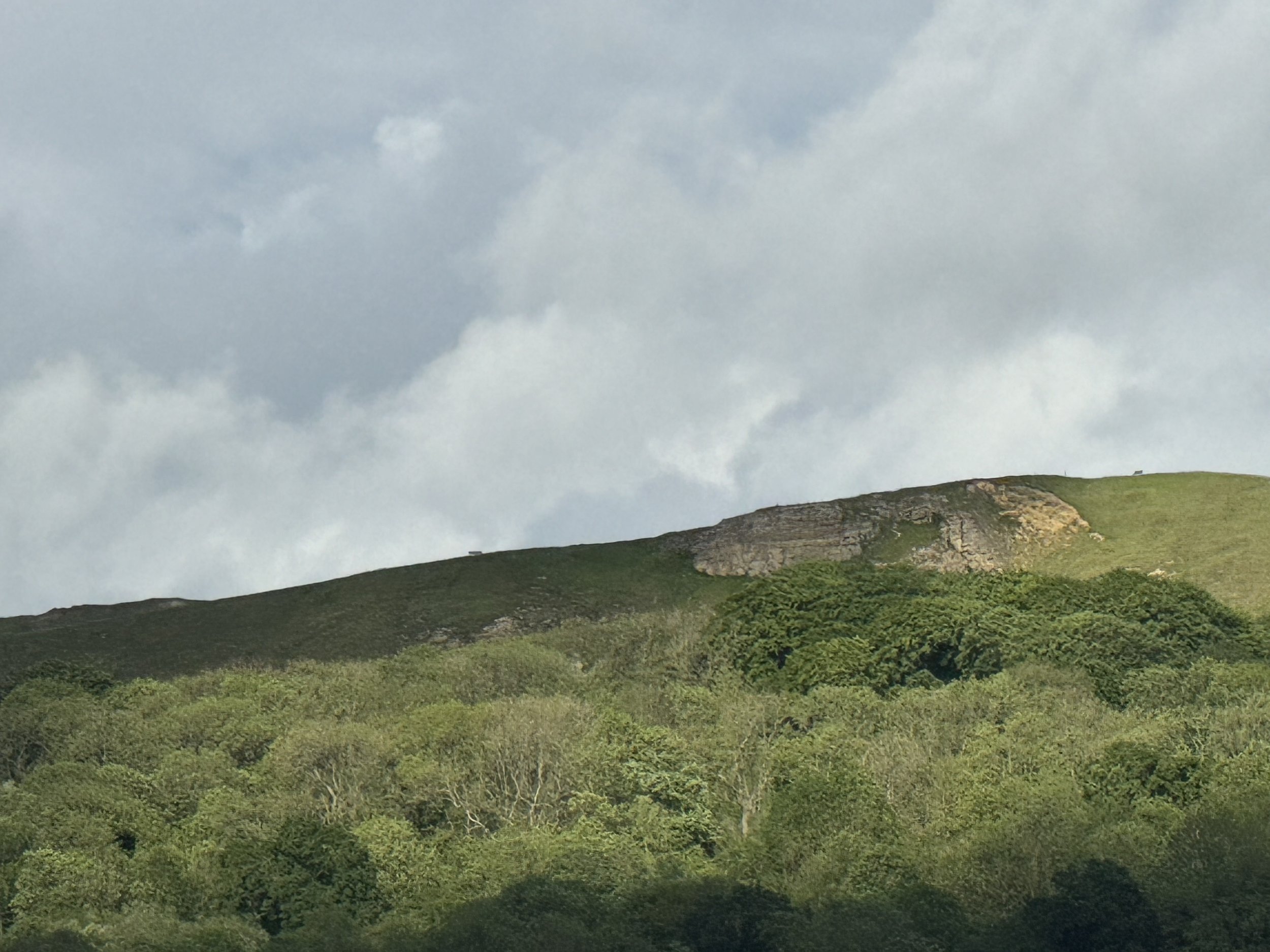
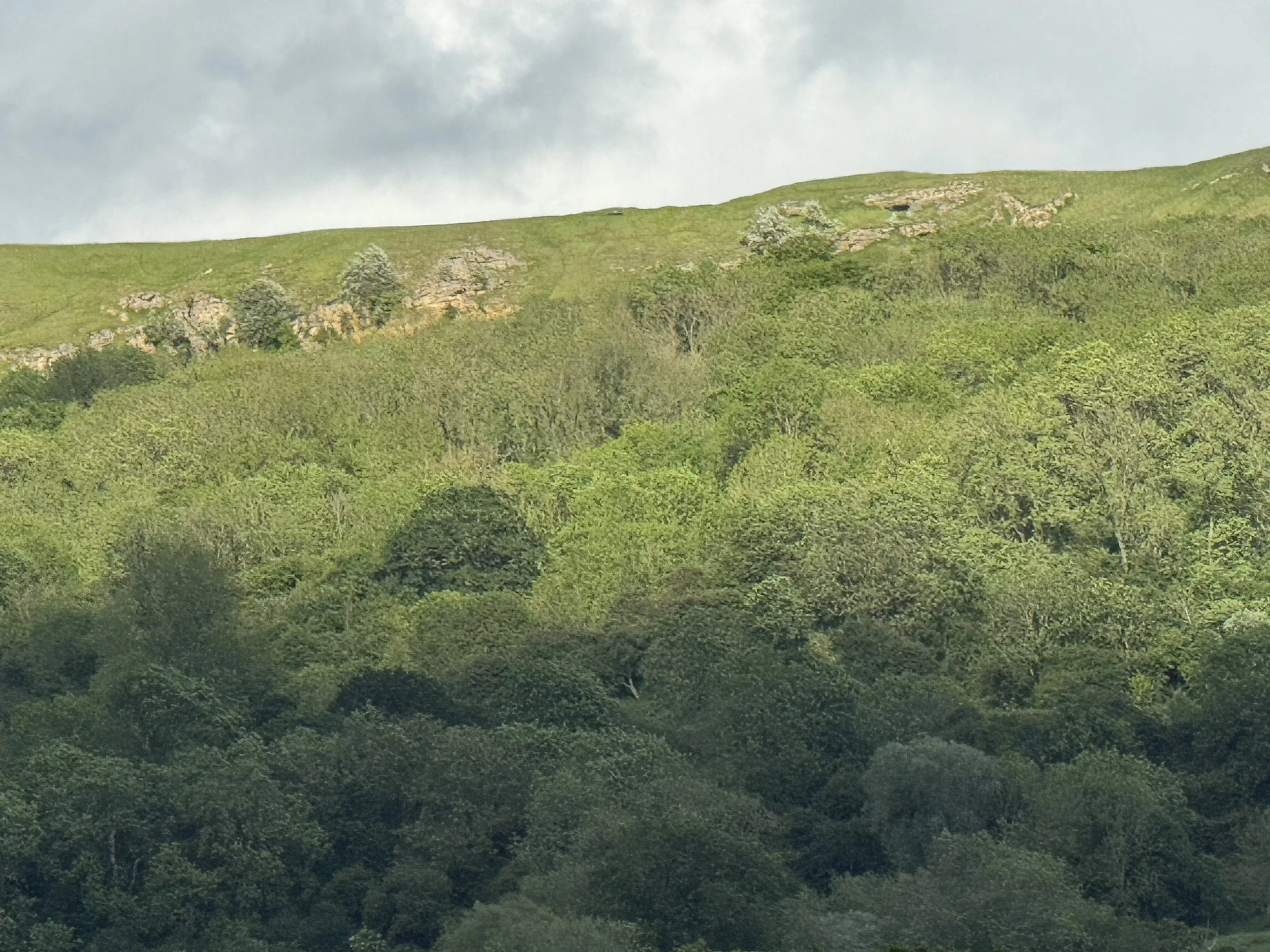
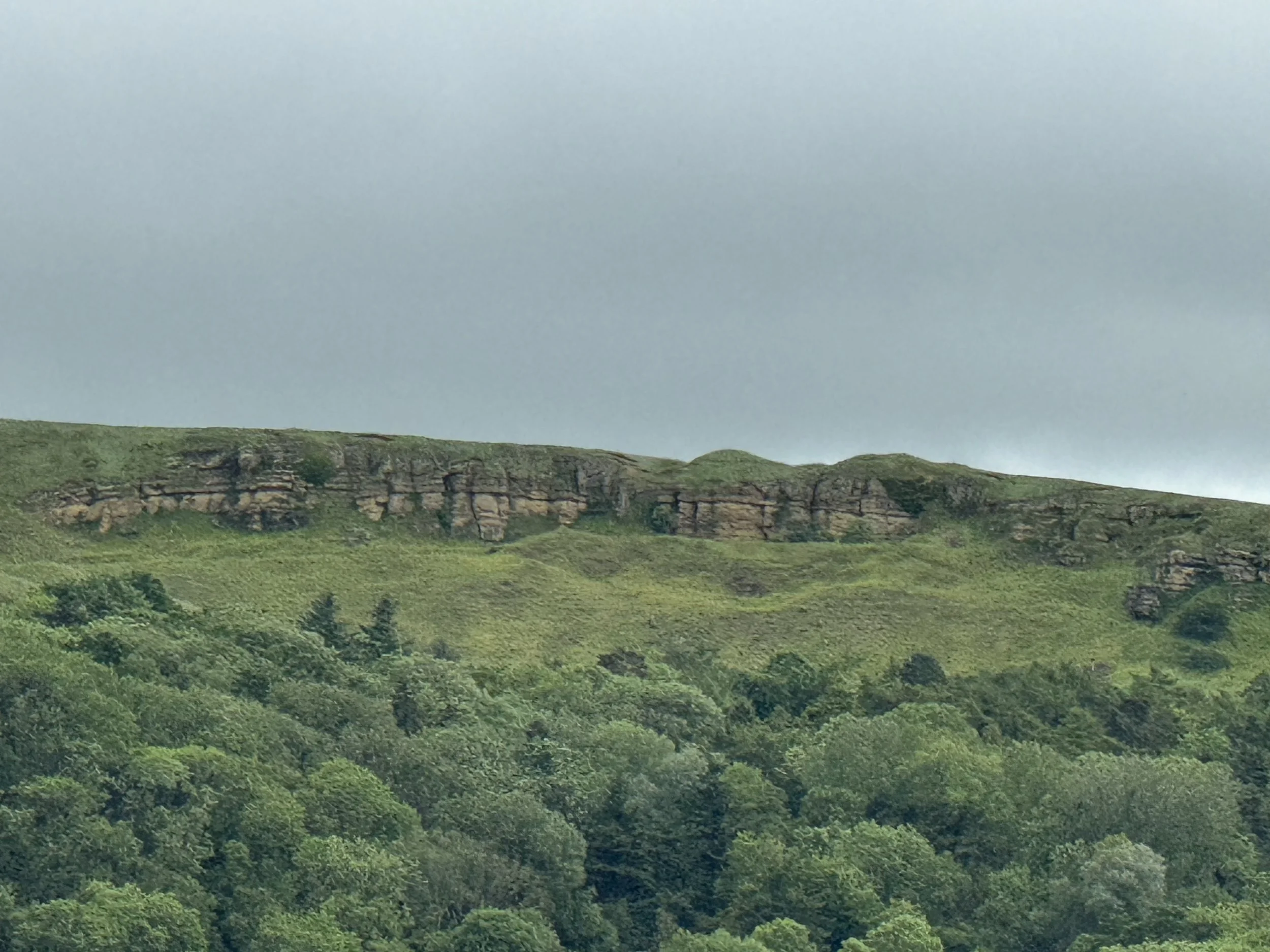
As I walk over the escarpment, I see large horse chestnuts nestling into the hillside far below the Trig Point – grassy, very uneven – crater-like, it seems.. That is actually quite accurate, though caused not by falling asteroids or meteorites aeons ago, but the impact-point of a Handley Page Halifax four-engine heavy bomber on 26 August 1944 on a part of a quarry on the escarpment.
For a long while, I relied only upon family anecdote.
Our father’s family had visited the crash site, as Dad said, to enable them to obtain a better idea on the loss of the Webb Crew on 17 April 1943. I ponder.
Apart from seeing the Halifaxes flying way above, this would have been the closest they had ever been to one. Dad recalled the assistance given by local officials - possibly a Home Guard Unit - who were very sympathetic and understanding when his parents explained that their son had been flying a Halifax when it came down over Germany in April 1943.
Fortunately, I have three research sources:
1 The W R Chorley Bomber Command Losses Volume Six 1944 by William R Chorley, and
2 Wings Over Gloucestershire by John Rennison (first published in 1988 and the revised edition in 2000)
3 The Cleeve Common Trust ~ the Trust’s website is an excellent website.
*
I learn from both Bill Chorley and John Rennison that this relates to the Howes Crew, serving on 78 Squadron RAF Bomber Command stationed at RAF Breighton, a heavy bomber squadron in Yorkshire. The Howes Crew were flying Halifax MZ311 EY-.
Mr Rennison accurately pinpoints the crash site as a quarry on Cleeve Common near Bishops Cleeve. Indeed, if I look up from my home in the village I can see clearly where MZ311 came to its sudden final rest.
All three sources confirm that the mission had been to lay mines in the sea off the important French port of La Rochelle.
I pause for a moment. It is soft underfoot. I look out from the crash site ad see Cheltenham immediately below, Bishops Cleeve below to my right and growing into a small town as it inches towards Gotherington. Beyond, the sun catches both Gloucester Cathedral beyond Cheltenham, and looking towards the Malvern Hills, I see Tewkesbury Abbey, the ancient town’s Herald and a reminder of debased human nature in the Abbey on that terrifying morning following the Battle of Tewkesbury in 1471.
I quickly bring myself back to 1944.
The Normandy Invasion is now two and a half months past, and yesterday - in the mind’s eye - on 25 August 1944 Paris was liberated. The enemy were nevertheless persistent. La Rochelle had to be denied to the Germany Navy.
The Cleeve Common Trust confirms that Operation Gardening was laying mines off the coast near La Rochelle.
As I write, we have this summer (2024) commemorated the Eightieth Anniversary of D-Day and the Invasion of Normandy. This quietly reminds me that the liberation of Europe was a terrifying undertaking. Putting this into context, Paris was finally liberated only yesterday. Surely it will all be over by Christmas?. Surely!
Thirteen days later the first V2 rockets launched, chiefly against London, Antwerp, Liege, Brussels and Paris. Between 3 - 6 October 1944 V2s were launched even against Norwich and Ipswich, though thankfully fell short. The last V2 launch was as late as 27 March 1945 against London. The V2 attacks resulted in an estimated 9,000 deaths of civilians and military personnel. In London alone, more than 2,700 civilians were killed. Unlike the slower V1 Doodlebug, the V2 rockets arrived without warning.
I glance at the timeline because it always helps me to step back and obtain a glimpse of 1944 and 1945.
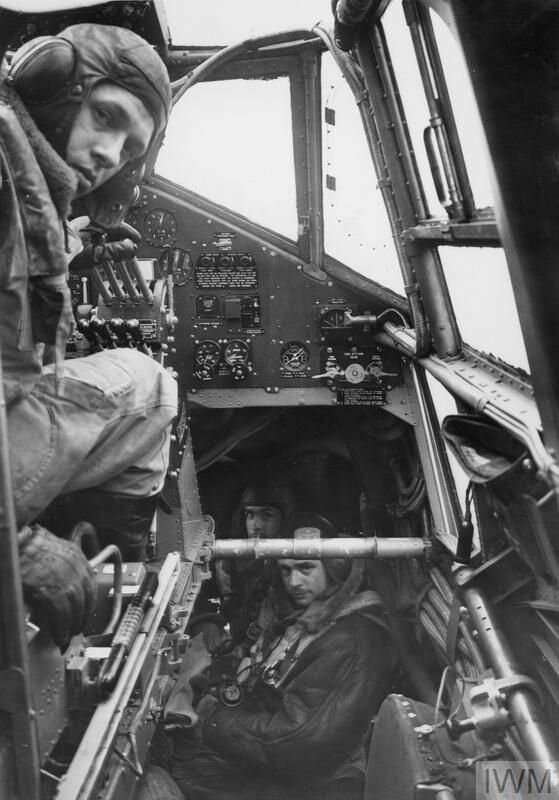
The Pilot ~ Handley Page Halifax
What was that?
Below, are possibly the bomb aimer and wireless operator before take-off. The navigator is stowed immediately beneath the pilot’s seat. The reason we see them is that the folding seat (next to the IWM logo) is folded. Raised, this is where the flight engineer sits.
The Engineer also works behind the pilot, but on take off he is able to assist the pilot with the controls. In effect, engineers were emergency second pilots. This was essential given the high numbers of pilots killed or seriously injured but leaving the aircraft flyable.
The eight levers we see the pilot’s hand resting on, requires the engineer to assist by holding maximum revs so that the pilot can gain speed, lift and height before a fully laden four engine aircraft runs out of runway.
At the Yorkshire Air Museum (formerly RAF Elvington ~ the home of the Free French Air Force Halifax Squadrons) a Halifax is most certainly an incredible sight to see.
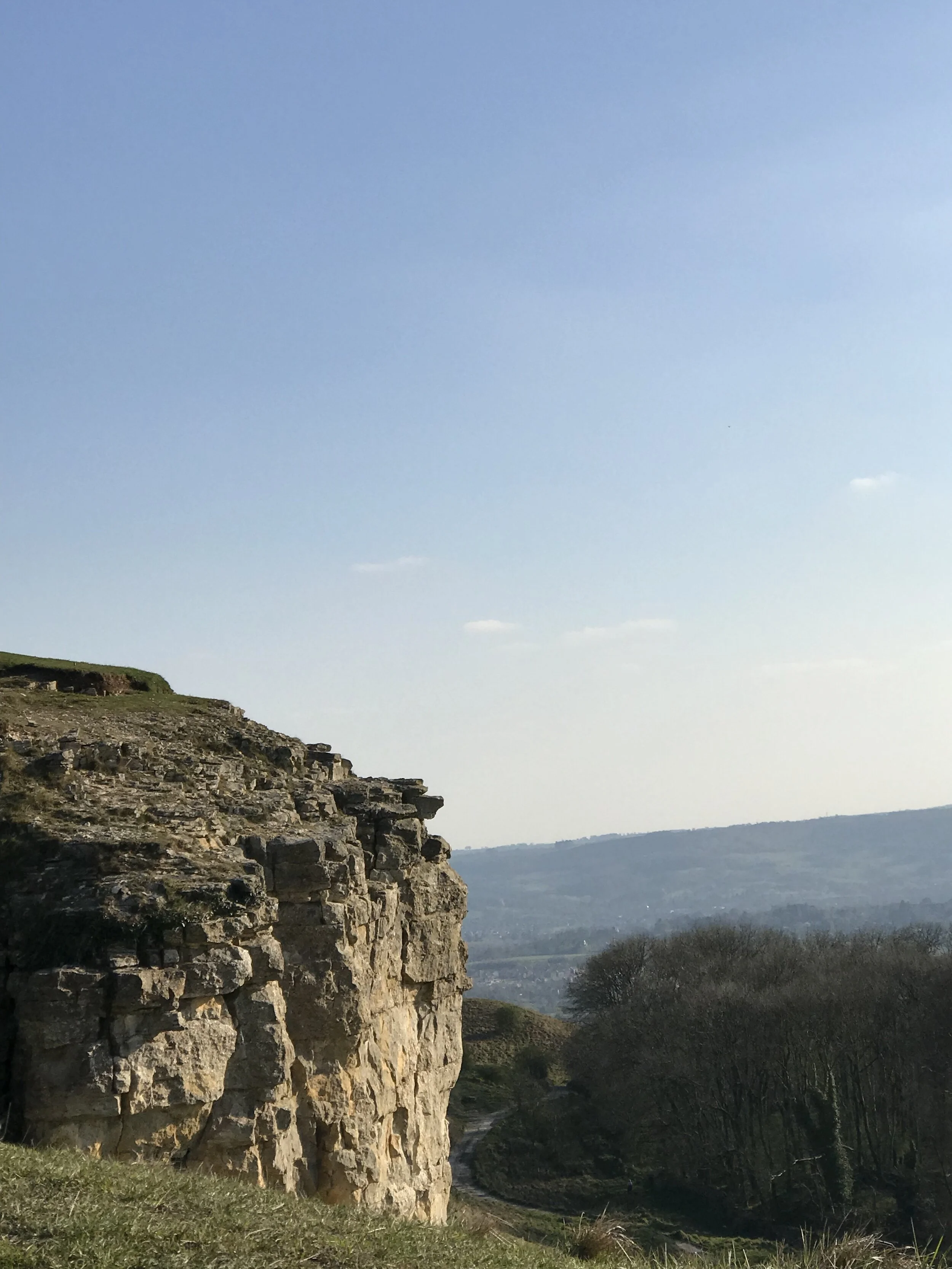
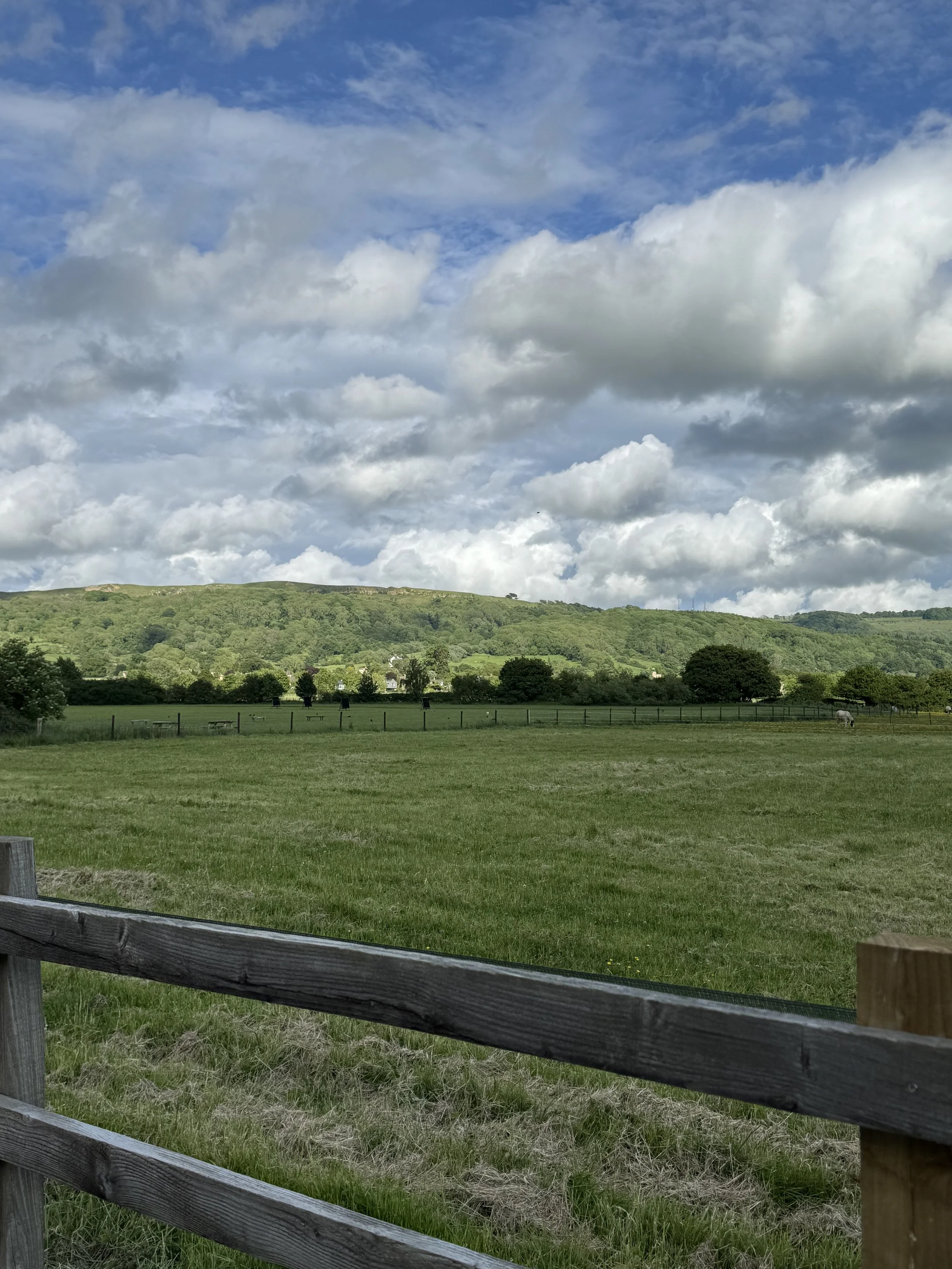
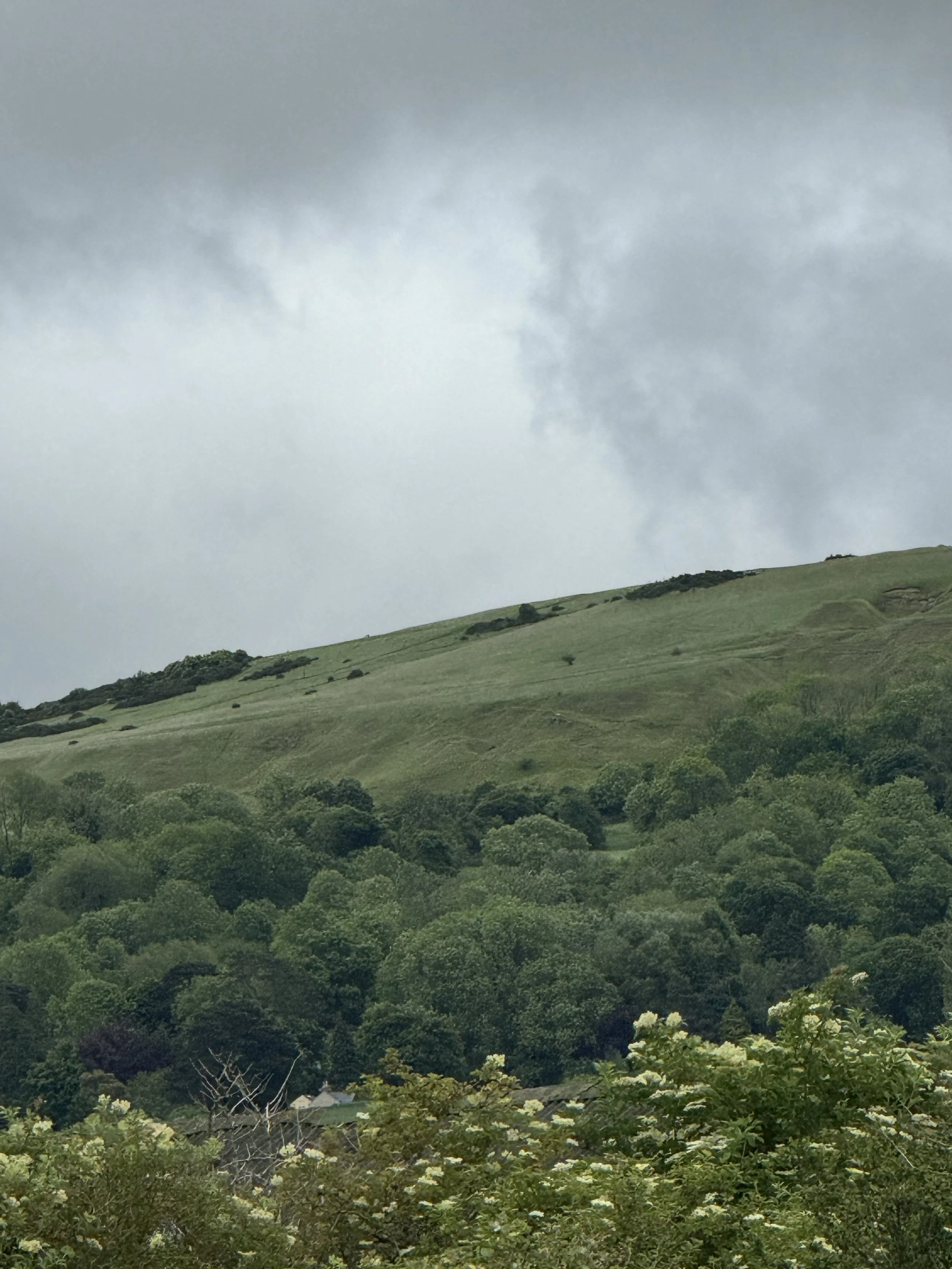
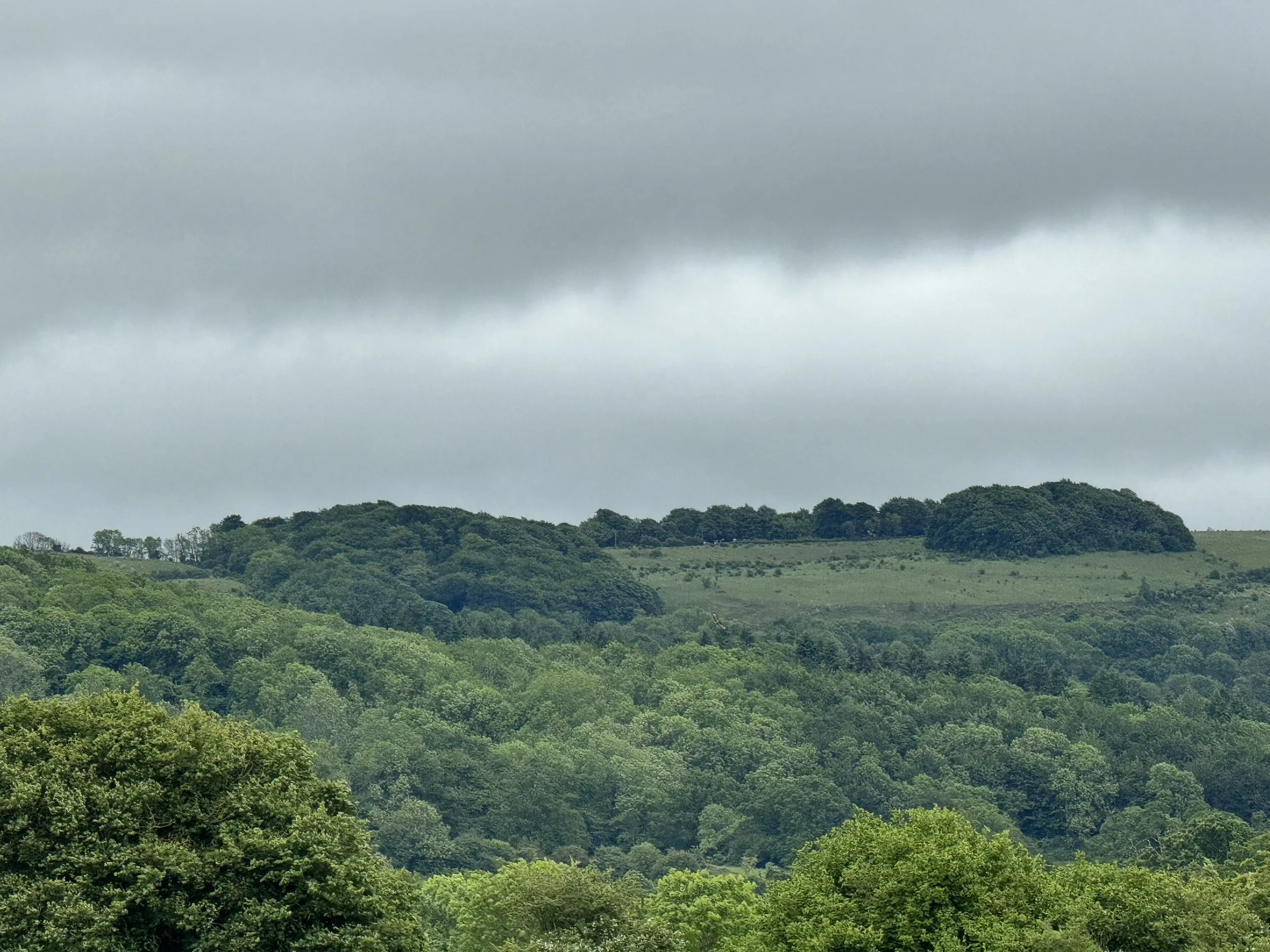
Cleeve Cloud, Cleeve Hill standing at 1,083 feet (330m) at its trig point and with Leckhampton Hill in the far background, Cheltenham nestling in between the two. This is the Escarpment of Cotswold that gives spectacular views into England, north and east, and west into Wales.
I took this image at 5.39pm Thursday, April 11, 2019 - the hint of Spring, and after an especially gruelling winter. It was therefore physically, mentally and spiritually uplifting to be back on the top again. KTW
Chapter Three
The Three Sisters
(as penned in 2009)
I continue my walk past the stables and the house that enraptured me as a boy and certainly influenced my purchase of Abbots Croft in Leckhampton in 1989 – a schoolboy’s classic drawing of a house – a door in the centre, windows on either side and three windows across the top and over a beautiful gabled arch and porch doorway.
Yes, I was indeed blessed to own such a home, and I realise now I should not have sold it. How foolish we are “in the moment”; how wise we are ‘in hindsight’.
“How foolish we are “in the moment”; how wise we are ‘in hindsight’.”
I must not dawdle. That wind is more than fresh. It can cut as keenly as a knife!
I’mon the top now, and gosh it’s windy. A gale more like, and I'm glad I've got my sweater. I’ll leave it off as long as I can, and thereby enjoy it all the more.
I'm walking around the escarpment on what is now a public path, well-worn, and with very pleasant mossy grass on either side, but which is rooted in an old sheep path. Large flocks still dot Cleeve Hill, and so in a way, this is a dual-purpose path, with the occasional clump of wool or droppings.
Traversing the southwest face, the wind is strong but not unpleasant; I still have the warmth of high summer and in the high cumulus clouds I have wonderful contours – greys, blues, yellows, ochre, all blending so incredibly beautiful, they are nothing less than in symphonic harmony.
When I fly, I love following the contours of these great mountain ranges, hills and valleys of the sky – this other realm – haha – who said that? How does it go? ‘...this other Eden, demi paradise.’
*
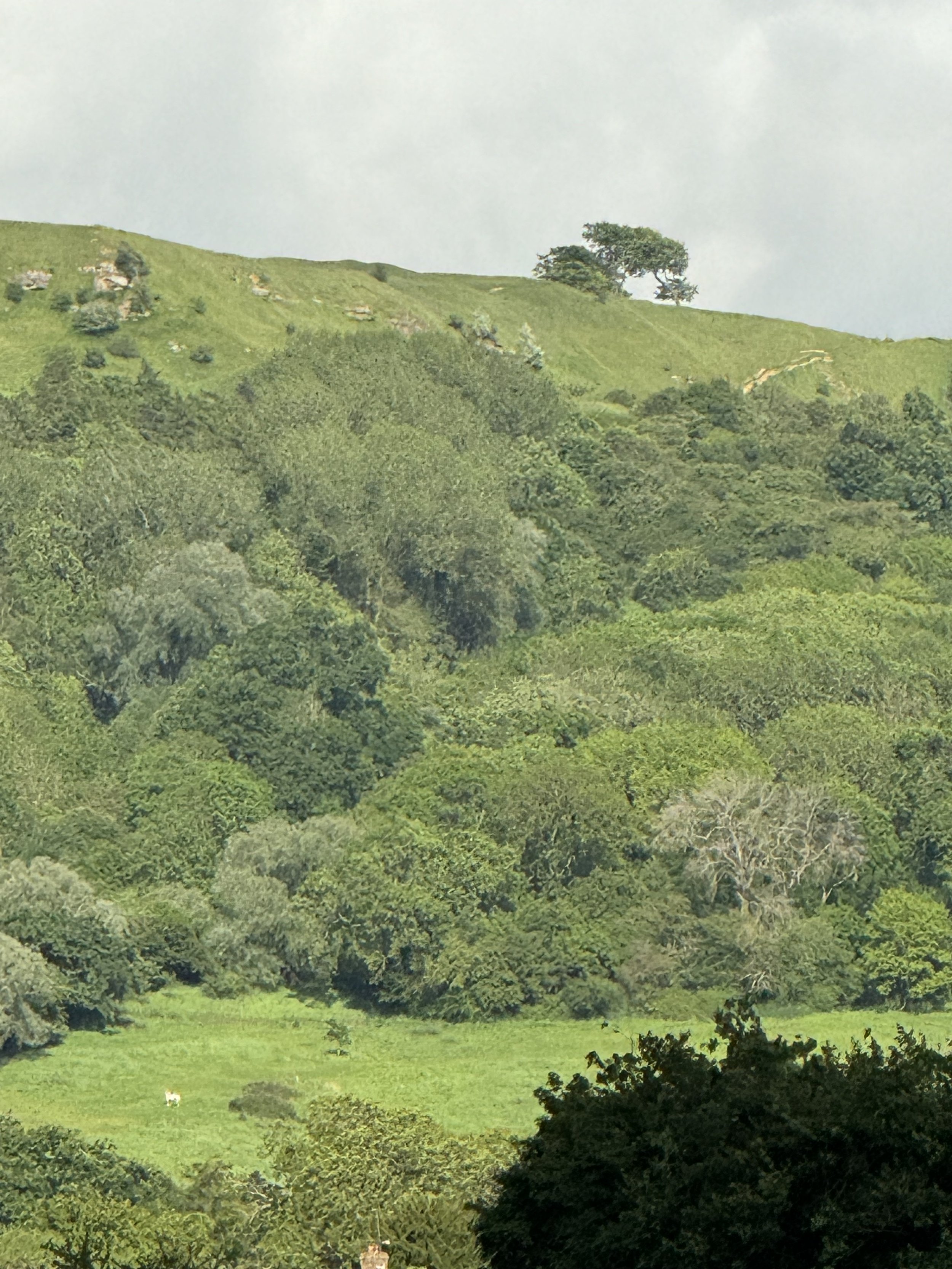
Climbing the gently listing slope to gain the high ground, two trees and a smaller third one – a sapling – come into view.
“The Three Sisters”
Legend has it ~ I emphasise legend ~ that in the dark past of warped Christianity and frightening fundamentalism, three sisters in Prestbury Village at the foot of Cleeve Hill were accused, and found guilty, of witchcraft. As befits that warped society at that time, they died horribly. Then, as so often happens, the spirit of enlightenment – or is it a guilty conscience? discovers the maladministration of justice.
Shock – horror!
Weeping, wailing and gnashing of teeth, beating of breasts and then remorse of a sort.
Vicious, spiteful tongues are, for the moment, quieted.
So, the legend goes, three trees were planted in their memory on the very edge of Cleeve Hill immediately above Prestbury, like three sentinels standing guard and as a warning to all; especially, I guess, to those who are perhaps just a tad too literal and dogmatic in their faith. And even now, four hundred years later, there are still plenty around who prefer the literal event!
I grew up in their mystical, powerful, other-world embrace. As kids and teenagers and latterly adults – they always seemed to have this impromptu pilgrimage. And still do, to this day.
*
In the early 1990s, the weakest of the three finally succumbed to the elements, and I’m glad that it took a sapling has been planted. Likewise, the bench. I've used it many times. And from there I would look beyond to Leckhampton, until I located one of the largest trees in Cheltenham at the end of Asquith Road. To me, this beautiful tree gave me the sound of the sea from the veranda in Churchill Road. I’d be happy to transport it up here in Liverpool, I admit. Warm and cosy, spacious in the winter, airy, light and cool in the summer.
Looking over the Common with my back to the escarpment just a few yards away is the Copse ~ some trees within a fenced and natural sheep pen. Incredibly warm there, too.
Many times have I been glad to shelter from howling winds, rain, hail and snow. In all seasons the copse offers some form of protection even when on military exercise, but in summer it is bathed in the beauty and glory of leaves of many shades of green; an artist’s dream of textures and delight.
If I look closely on the main trunk in the south-west facing corner there are some carvings in amongst the hearts and forget-me-nots of true love and adolescent cravings two, in particular, are a statement – a proclamation – faith, hope and vision again: Hebrew for YHVH is known as the Tetragrammaton, the ineffable name of God ~ "Yod Hey Vav Hey" when I read them from right to left.
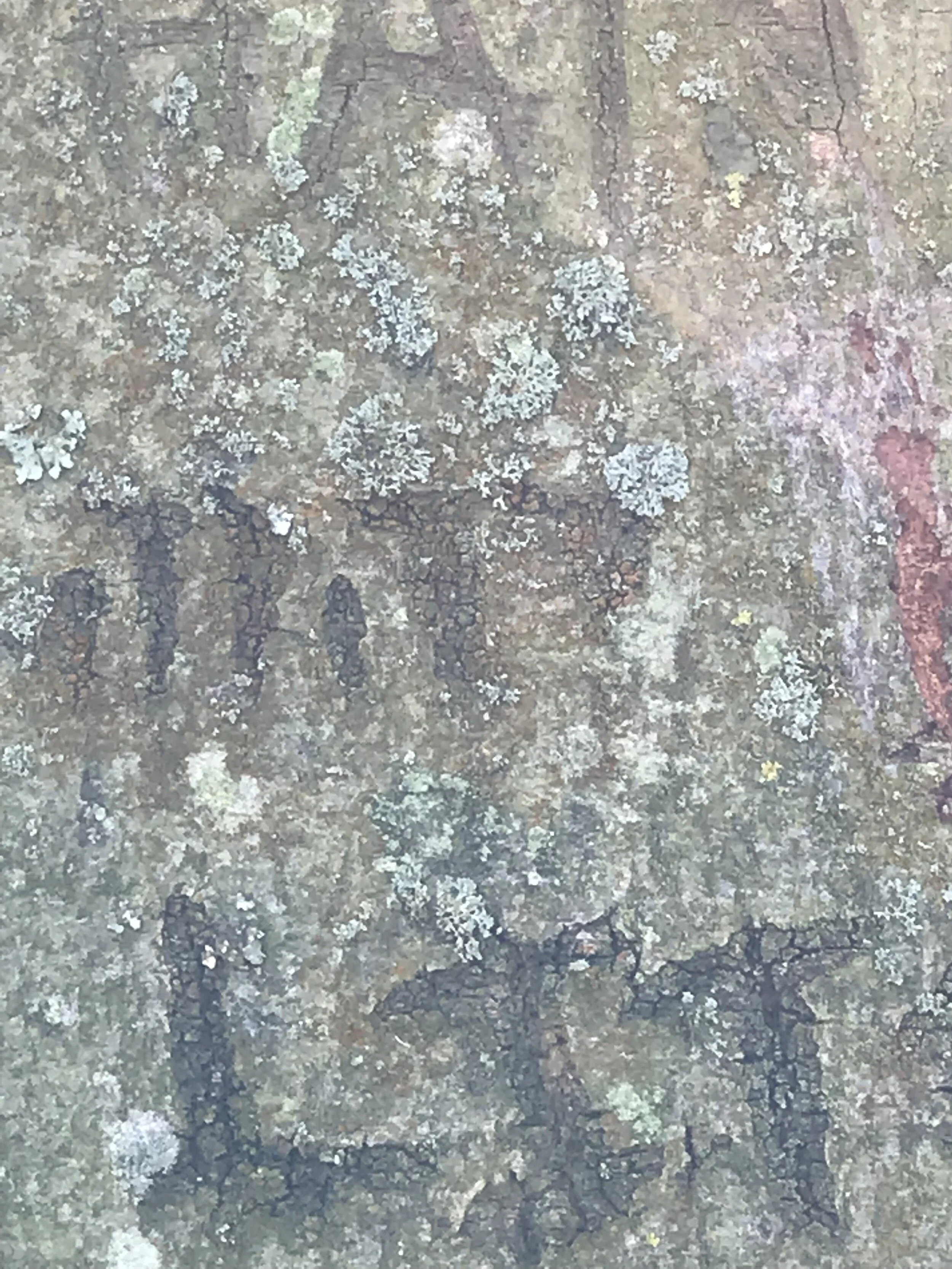
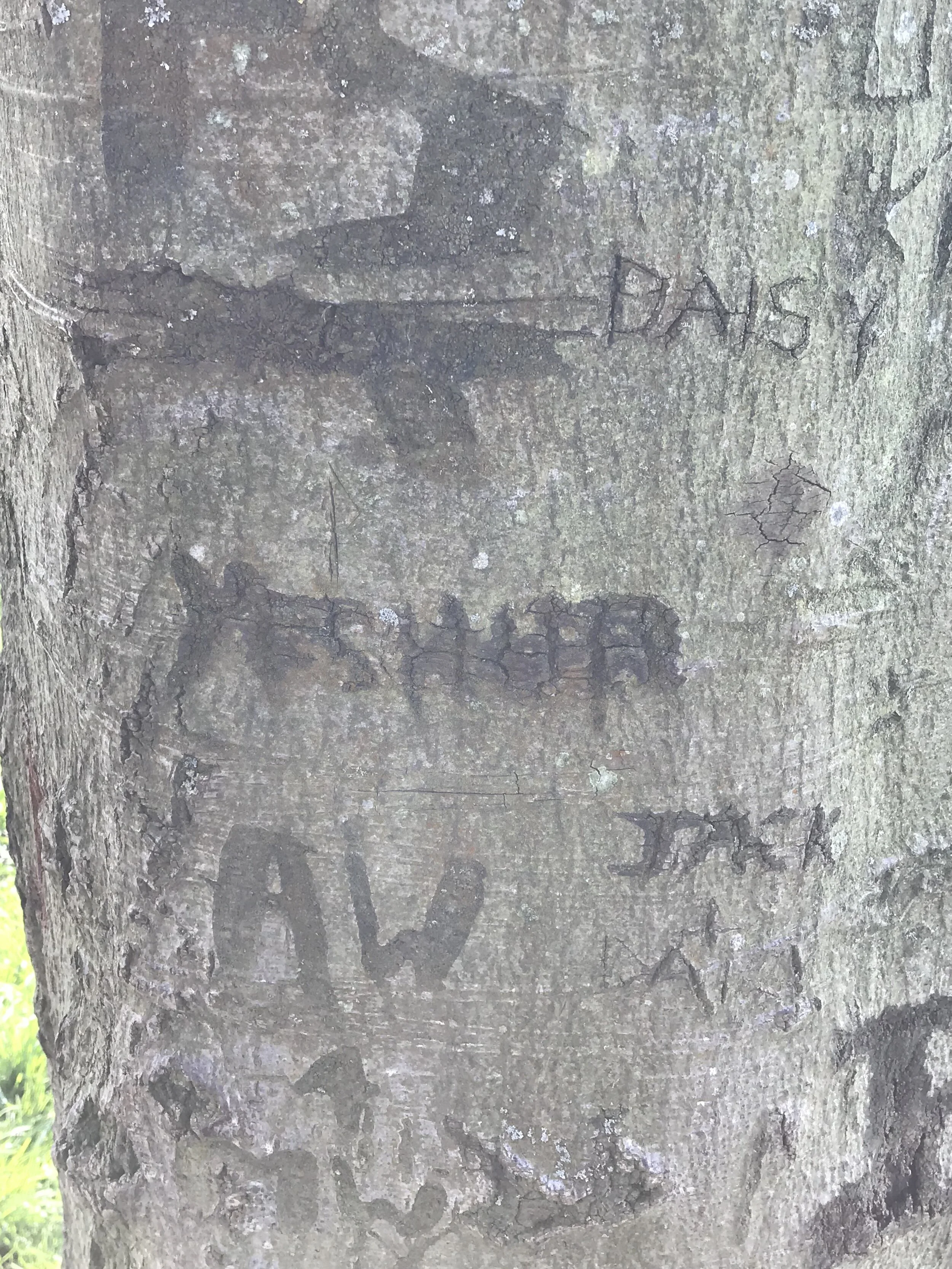
It’s windy here. Time to stride on!
Chapter Four
Gorse Bushes
Cleeve Common is well endowed with Gorse. Their yellow flowers resplendent in high season belie their weaponry. Don’t become entangled in a gorse bush!
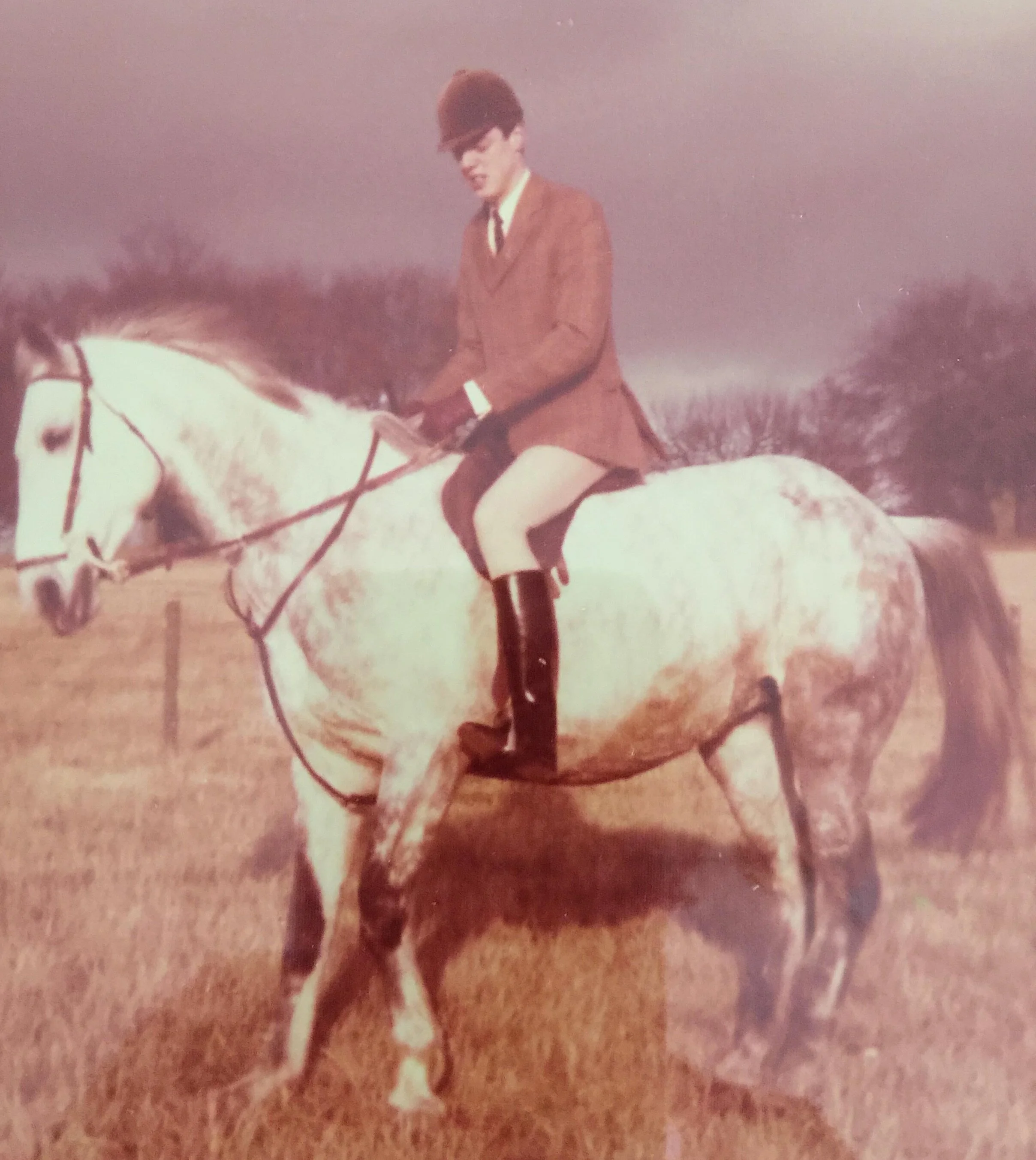
In 1972 I was on a very fast ride across the Gallops, a famous part of the Common above Cheltenham Racecourse (online followers of the races and the Cheltenham Gold Cup will recognise the hills and skyline as they contemplate their winnings or, more likely, hastily approaching losses), that my horse and I temporarily parted company! I remember jumping the gorse bushes (all those yellow flowers) but the next instant flying through the air.
Crash-landing head-first, I saw the bellies of the other horses jumping over me; the noise too!
I actually found my horse down on the escarpment below The Three Sisters, grazing. The concussion came later. And, perhaps, a couple of other things swell, but that is for another day. It is so good to be up here again.
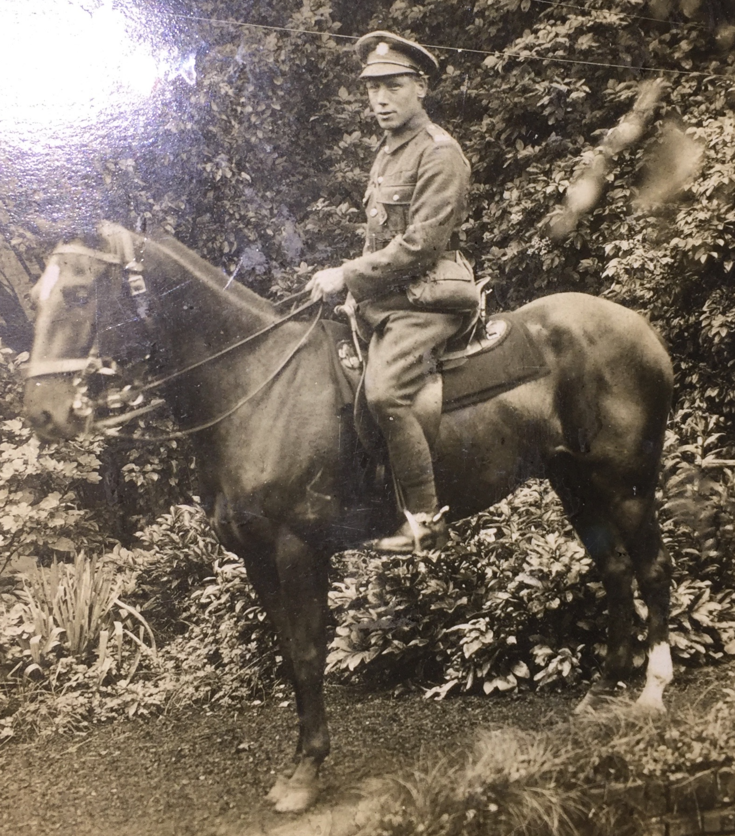
The tumble didn’t stop me from riding. Of course not. Riding is in my blood, and though I have never said this to the family, on all the countless wonderful rides I've had up here, (and elsewhere on Cotswold) I would imagine Grandad Webb, a very fine horseman, riding beside me, encouraging me, teaching me to sit tall and straight in the saddle, to push the heels down, to ride with one hand to keep the saluting hand free to pay compliments, to go ‘with’, not ‘on’, my horse, and to not fear, when I then leaned down and in towards the neck, streamlining as we went into the full gallop. Yes, truly marvellous times. I must also put the record straight. Falling from my horse alone did not lead to career change. I look back now and recall at least three public order situations in which my head took knocks. Apart from being “a little shaken”, one would have a mug of tea and be back on the town within an hour or so. But I now realise I was collateral damage was building.
*
Oh, what a horrid day that was on a bleak January morning, wandering around Cirencester town centre, realising that I no longer had my police warrant card and that by the month’s end I would never again be the holder of that most ancient office of constable.
I must move on; for a career change and a whole new life that had not been planned or prepared for, beckons.
Often we are at the mercy of circumstances beyond our control. I think of the hundreds of British servicemen and women who’ve lost their lives in Afghanistan; the wreckage to entire families and circles of friends that will never be fully healed. And the same is true of earlier wars, tracing back along the timeline of history as far back as time itself permits. I’m reminded afresh of the Howes Crew on the Escarpment just across the way.
As I walk on, heading due south with my back to Cheltenham and in the distance behind me are that wondrous line of hills running south to north that seems for all to be the very backbone of England, The Malverns.
I approach the police wireless masts.
*
I am now right at the top of Cleeve Hill; to my left is the trig point and it is in the middle of great moorlands. And yet when Graeme (now a squadron leader in the Royal Air Force) flew me over Cleeve Common I was amazed to see just how small the common is. Is THAT where we held all those military exercises? Only the gallops are as long a thousand feet above as they are at ground level.
The winds are strong as I head up to the trig point. Today I have clear skies and cumulo-nimbus. But the clouds reach sternly down to the ground, and then it’s very unpleasant, wet, dank, and miserable; and that is what makes Cleeve Hill so unusual. For it takes on the character and personality of places like Cadar Idris, Helvellyn, Snowdon, Striding Edge and Ben Nevis or the massive Pennine Range.
*
People are easily lost on Cleeve Hill. I've been lost several times but because we spent so much time as kids up there, we always found markers and got our bearings. For the unsuspecting visitor, it can be daunting. On one occasion I found and followed a familiar wall its full length its length. I cannot see anything because the cloud base has completely covered the hill. But all was fine. I knew this wall. I knew these tufts of grass, this track, these sheep droppings, these gorse bushes dripping wet. I come to its end. Ah! Not the wall I thought it was, now I’m more lost than ever.
On the occasion, I found the correct wall, and reached the end in good order, only to discover I’d been walking on its wrong side and thus walking further away from the car with every step. Once back at the car and changing boots and clothing, I thought quite a lot about the dangers of flying in cloud. Many airmen and airwomen across a century have experienced this, and many failed to survive the impact.
Chapter Five
The Gallops
For me, Cleeve Hill adds mystique to the character and personality of Cheltenham which it dominates and casts a lofty glance at its smaller, flatter sister, Leckhampton Hill, above the heights of Cheltenham, south, on the way out to Swindon, Newbury and the rolling landscape of Wiltshire, the Downs, a brief glimpse of beautiful Somerset and on hence to the gorgeous county of Hampshire.
Sweeping into Gloucestershire on the M5 from Birmingham, Cleeve Escarpment is rigid and proud, in sharp contrast to the grandeur of the Malvern Hills twenty-eight miles away and running parallel. And of course, as I've said, it’s known to millions who watch the Cheltenham Gold Cup every March, the herald to Liverpool’s Grand National the following month and all the other meetings throughout the year.
*
And across the top, cutting a swathe through the moorland and in places so smooth one would think it is a runway for light aircraft not Gallops.
What joy and privilege to ride hunters, at the trot, sitting then rising, rolling into the slow canter, easing into the fast canter and then (remember, Meriel, at the full gallop!! Wow!!!?) Or ambling along at the walk on a loose rein. Remember our long leather riding boots shimmering in the heat, chatting away, our helmets in our laps and the swish of the tails, laughter, fun? Wonderful. Oh, happy times indeed, and now the priceless gems in the vast storehouse of my memory. Then the dread inner moment that even now catches me unawares ~ the hassle of living in plain sight.
Mmmmm. That’s why the name Fleming will always have a special place in my heart and even more so, this beautiful name, Meriel. How I loved to speak it then, and still do now, albeit only to myself. But in my family, both names are very important and it is good when I see that glint, that smile in the eyes from my sisters ~ we know, Ken. It wasn’t meant to happen. But don’t worry. We’re always here for you. And this therefore constitutes an essential element of what will, one day after I've long ridden over the hill’s brow, be my history.
Riding, as I say, is in my blood – inherited from at least three generations of professional horsemen to my own knowledge, not to mention the many generations before and in the far distant past.
Chapter Six
Scree Run
Another exciting discovery as an eighteen year old police cadet was the sport of scree-running, long before the days of skateboard and the modern sports that now thrill young and slightly older people alike. The scree is a rockface equivalent to sand dunes; a seven-hundred-feet near vertical descent, but which felt like anti-gravity.
“Lean back, lean back, leap, leap, but lean back as you take each stride.” What joy to traverse downwards at fast pace the steep contours that lead down to the famous sheep dip just above Winchcombe and Sudeley Castle.
It has water in it, the sheep dip that is, clean and fresh. I remember a Christian baptism in it. This is the joy of writing, for until four lines ago, I’d not recalled the sheep dip in fifteen years and only remembered it in recalling the excitement of the grey slate scree slopes.
Having pondered the dip, imagine the hundreds of thousands of sheep that have been dipped even to this day (1989). I’m at the lowest point of Cleeve Common and now begin the climb up the leeward side eventually arriving at the Quarry Car Park and the views of Bushcombe and Nottingham Hill and tea in the golf club – or is it still ‘members only’?! Knowing the golfing fraternity, I’d say, yes! Funny lot, golfers! An unjustified generalisation, but we all have our moments.
It’s windy again here. I’ve come full circle and am now atop the escarpment again but at its commercial end – car parks, dogs, prams, cuddly toys, screaming kids, wellies, anoraks and ‘how much further? I'm tired!’
I don't like this end though I use it often enough.
Of course, it’s nothing quite like Liverpool city life. It bridges the gap between city boy and country lad as I adapt each working week to the Fylde of Lancashire, the twisting lanes, fields of wheat, grazing cattle, enormous tractors down single-track lanes at a snail’s pace and already running late for the free-will-review for Mrs Smith, who’s been waiting for a week for this most important appointment – the first appointment in years, putting aside her daily career. And deep down, I will one day become a shire lad again.
Chapter Seven
We Three
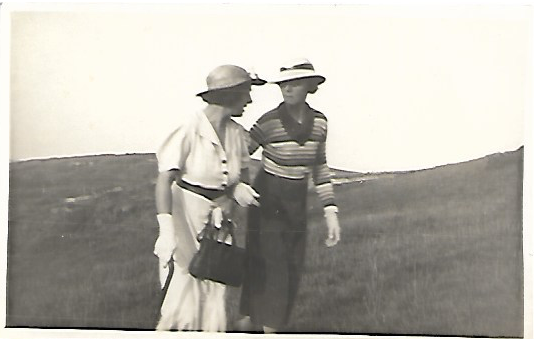
Cleeve Hill, holds many happy memories. A family of successive generations traversing its slopes. That famous and quite beautiful 1930s black-and-white photo of two sisters in summer frocks, big hats, dress gloves, clutching handbags, striding, and leaning into that ever-present wind and in most earnest conversation. I often wonder what my grandmother and great-aunt were speaking of. I know they didn't always see eye to eye - a little like two sisters two generations later.
But that’s their hassle. It’s family life. I'm in the middle, and each knows too well to try and make me take sides. I love them equally and that’s that. Their squabbles are their own. I know this too. They have their relationship and it is not for me to try to influence events. They have their perspectives. I am not automatically privy to those perspectives. What does this mean? Simply this. That the most important phrase in my family that outranks the family motto Life is Good, is We Three. There is no order. Siblings move sideways, three branches moving horizontally outwards and reaching for the light of the sun, the freshness of the rain, the nurturing that comes from the frosts, the gentle embrace of snowflakes.
Up here I can see the Severn Estuary on a very fine day. But I still can’t see the sea! So that’s where, for me, Cleeve Hill must take second place. I must always be by the sea, or within close priximity. I don't know where this comes from. Is it a generational thing? Genetic? In the blood in the same way as my natural love for riding lay? I suspect our roots reach back to Scandinavia, hence my very natural love for the North Sea, Denmark, Norway and Sweden, and the Baltic States. We are all seafaring peoples. The sea is the salt in our blood.
So, I'm glad of my years in Liverpool and Lancashire, up north and my regular visits across Northumbria to Newcastle-upon-Tyne and Whitley Bay. I'm glad I can write about my former life in Gloucestershire, and go down memory lane, for I do have many happy memories. That memory lane is a lifetime away now but I have turned back. Once again, I am in Gloucestershire with regular and vital returns to Lancashire and Liverpool. I realise, though, that I have returned to my roots. This did not happen overnight. I know this.
I am so, so glad I turned back. And where I live, the coast is only 55 miles away on a good day. Grand. And this paragraph, therefore, explains the next paragraph!
Epilogue
How strange! How I change with the time. Indeed, my love of the sea is as strong as ever; but that old saying is also true, absence makes the heart grow fonder. Most assuredly, that is what has happened as I now look forward to 2017 with excitement and a sense of relief too, to be returning to Gloucestershire, my home, and where my roots are. I shall not of course turn my back on Liverpool. It is too large a part of my life, but it is good to close down this final chapter in the county of my youth and much of my working life, as well as its peace and tranquillity that I really do now enjoy.
I stand one more time on the escarpment - on ‘favourite rock’ – that tiny piece of incredibly ‘dangerous’ rock jutting out and with nothing underneath it except freefall. It’s amazing. We all regarded that as our personal private rock, and no one else ever seemed to be on it. And, no doubt, countless other families lay rightful claim to this outcrop too down the centuries.
Up here it’s gale force as I tip-toe to the edge of Favourite Rock. I’m not so sure on my balance these days. God! Imagine mounting Rocka! On one side and promptly falling off the other side, and then the nuzzle and hot breath. Shall we try that again? Concentrate!
Somewhere in the loft at Albemarle Gate is a pencil drawing, part of my school artwork, I recall. I have not thought of it until now in forty years. But I can see it as clearly as if I had seen it today. How astonishing, powerful and wonderful is the brain!
If I leave Cleeve Hill now, in my mind’s eye I can drive through Prestbury Village, briefly thinking about the story of three innocent women, siblings. I drive on over to Leckhampton, calling off at Morans in Bath Road for coffee and then proudly onto my drive by the red Japanese tree from Carol and Rog (now, I think, in Rectory Cottage Garden), and walk around to the front gate, into the black and white porch, and through the ancient front door of Edwardian days and into the kitchen that spans the house; its imitation beams adding strength and history, and the amazing fireplace with the great oak beam, blackened, an old railway sleeper complete with the bolt marks, now softened with age and rain. I like that, especially. Our family were in service to gentry, we were miners in Northumberland, and we drove and stoked the great steam locomotives when they were state of the art cutting edge technology.
To the left of this railway beam is the climbing Wisteria ~ now right up the wall, across the ceiling and intertwined within the miniature bell chimes.
As I boil the kettle and make a pot of tea, and from there, with a slice of Mum’s fruit cake, I retire to the lounge - quite beautiful, very peaceful – burgundy sofas and armchairs and a scent and the streaming beams of sunlight through the original windows, and the open Dale Forty piano, built by Mr Betteridge in1938 when he worked at Dale Forty in the Promenade opposite Neptune’s Fountain; and lovingly restoring it fifty years later when I bought it and was looking for a piano tuner; and who should come to tune it but Mr Betteridge; a remarkable day, and even more so to hear him play. There is no such thing as coincidence!
Erm. Burgundy! Another coincidence. How strange, that I then discovered the Burgundy Livery of Liverpool!!
I ponder afresh that delicious quotation : coincidence is to the serious scientist the product of a lazy scientist’s mind! I like that. I love this room. All of it is in place. And so, in the mind’s eye, I relax and ponder and call it a day.
References and Footnotes
1 Banner Image by Courtesy of the author's artist and photographer Alexander Petricca of Liverpool and to whom all rights are reserved
2 Psalm 22 verse 1
ƒinis
A longhand Journal Entry in Fountain Pen
Thamasha,
Blackpool
24 August 2009
21 June 2025
All Rights Reserved
LIVERPOOL
© 2025 Kenneth Thomas Webb
The Indian restaurant in Blackpool closed a long while ago.
Readers might also enjoy reading An English Country Garden and which can be found here
Ken Webb is a writer and proofreader. His website, kennwebb.com, showcases his work as a writer, blogger and podcaster, resting on his successive careers as a police officer, progressing to a junior lawyer in succession and trusts as a Fellow of the Institute of Legal Executives, a retired officer with the Royal Air Force Volunteer Reserve, and latterly, for three years, the owner and editor of two lifestyle magazines in Liverpool.
He also just handed over a successful two year chairmanship in Gloucestershire with Cheltenham Regency Probus.
Pandemic aside, he spends his time equally between his city, Liverpool, and the county of his birth, Gloucestershire.
In this fast-paced present age, proof-reading is essential. And this skill also occasionally leads to copy-editing writers’ manuscripts for submission to publishers and also student and post graduate dissertations.