Evensong ~ The Dust Diaries by Owen Sheers
Dimension
EVENSONG
2011 ~ 2026
Review
The Dust Diaries
by
Professor Owen Sheers

EVENSONG
Dimension is simply personal reflection, often jotted onto paper or my smartphone, capturing the moment, the thought, before meaning and purpose vanish.
Being ‘outside-the-box’, standing back from organised religion, enables faith to move, to breathe, to give, to become malleable.
The Bible is a central plank to my upbringing, and happily acknowledge that. These days I’m more likely to write in lowercase, similarly so any deity, that subtle hint at my ‘pilgrim’s progress’! My method of reading it these days is far removed from those fearful times in the 1990s when I found myself in a deep trench where anything less than literal interpretation was unacceptable.
A long time ago I used to ride horses, and removing the blinkers and letting the horse gallop free in the field, I thrilled to watch these magnificent animals leaping for joy, aware of their wider perspective and unfettered vision.
Then there is the other view. Horses drawing a carriage or coach relax more easily the moment the coachman places the blinkers on them, removing fear and threat of sudden invasive movement from a hidden quarter, soothing them as they do so; the horse feels safe again when moving through traffic.
I sense this only because my father’s father was a coachman-chauffeur, that gentle distinction reminding the world at large that we were shifting from horse drawn to mechanical, and that important reminder that things do not happen overnight.
Revolution begets revolution, and always there is the interim. We cannot sidestep this. When we do, we dare to challenge Nature and Evolution, fixing our ‘five-year-plans’, we create chaos and horror in the process.
I’m not a fifth-columnist or an enemy at the gate when attending a church service.
In 2022, I wrote…
Last evening, reading Dust Diaries ~ An African Story by Owen Sheers, I found I had marked a paragraph on page 66. I must have done this in either 2011 or 2018 according to my annotated note which reads:
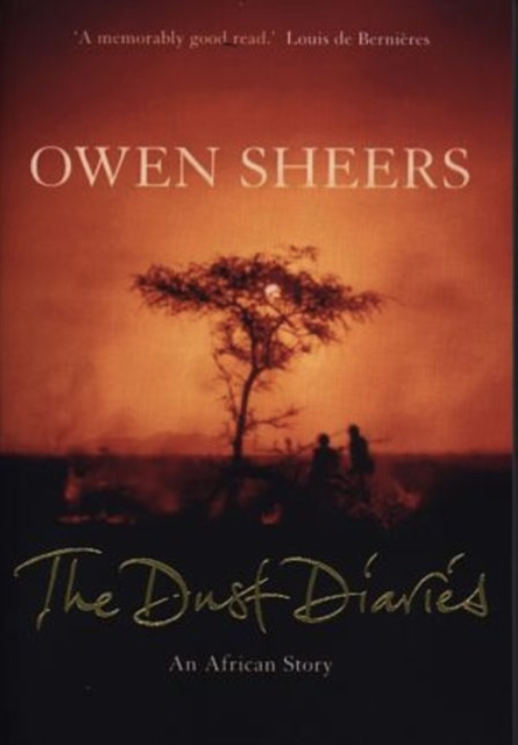
Dust Diaries by Owen Sheers
I must have marked this in either 2011 or 2018. But only now, on 4 October 2021, on finding it fresh just two hours after I've revamped Dimension Fables ~ do I grasp the meaning.
In Tewkesbury Abbey, Gloucester Cathedral, Liverpool Cathedral and Worcester Cathedral did I find this in Evensong, but it is Owen Sheers who has given me the beatific description.
Owen Sheers writes into The Dust Diaries a most wonderful description into the mind and the character of one of his ancestors, an ordained missionary in the Anglican Church in the newly developing British colony of Rhodesia as it then was, that we, of course, rightly know as the fully independent and sovereign Nation state ~ Zimbabwe.
Sheers writes thus …
“I don’t think I will ever have a relationship with a god in the way you did. Perhaps the modern imagination will not allow such a thing, or perhaps I know of too much harm done in the name of gods. As I sat there, however, with that singing uncoiling into the air, something happened: a tuning in of the mind, a spiritual awareness, a consequence of sound and place – call it what you will, but there, in that evensong, I felt a connection with a presence larger and greater than the present and the self. Perhaps it was the clarity of the notes clearing my consciousness, but I was aware of it, whatever it was, out there, beyond the thick stone walls, past Epstein’s pale Lazarus, outside the hushed cloisters. History, the collective soul, I still have no name for it, and I didn’t then either. I just knew I wanted to be part of it, always pitched at a higher note, and I knew that would be impossible, and that is why I wanted it.”
Upon completing The Dust Diaries, I had learned a great deal about the mindset of British colonial rule, the attitude of the Anglican Church within that rule, and indeed the role, even, that it was within which to engage, and which would, today, be distasteful to us to say the least. That confirmed what I had long suspected.
I emphasise the vital importance of Sheer’s work enabling me, the reader, to grasp a much wider perspective of our history, the strengths and weaknesses, and often abject criminal activity of the Church and the attitude of people generally regarding colonial rule during the lifetime of Owen Sheers’s ancestor who was, himself, most often completely at odds with his Church.
Owen Sheers gives, in this superb title, an extraordinary and uplifting study, rebalancing of the scales, enabling me to examine the reality of colonial rule and the narrowness of mindset within the Church that both he and his ancestor dared to confront.
This, for the moment, is a pen note; my chief concern is to highlight the crucial importance of descriptive writing.
At School in the 1950s-1960s, so often in history lessons we were reminded of the Dark Continent. Africa was always referred to as the Dark Continent. There is anything but dark about the Continent of Africa. What is dark is that which outsiders have brought to it over the centuries, and which teachers tended to emphasise at school, often unwittingly.
The phrase "Dark Continent" was used by Henry Morton Stanley, a British explorer in the late 19th century in his 1878 book, The Dark Continent to describe Africa. In short, Stanley was highlighting the limitation of European knowledge of the interior geography of this vast Continent of Africa.
It symbolised the "unknown" unexplored, unmapped land mass. But over the century, the term became suggestive firstly, of the almost complete absence of civilisation, and secondly, of backwardness within the indigenous peoples. In both respects this was a gross abrogation of the truth.
“Why did you emphasise darkness as dangerous, backward, malignant? You have done much damage. You have unwittingly belittled millions of people who are no different to me and you and, moreover, often surpassing us both.”
We often move within and without (outside) denominations. This does not in any way undermine our stance, and as His Majesty the King demonstrated last week when he broke the back of five hundred years of history as powerfully as when the rod was ceremonially snapped in two over the coffin before the Late Queen Elizabeth II was then lowered into the vault.
As I gaze upon the Sixteenth Century Reformation and the Seventeenth Century tide of Puritanism, I reflect upon the deeds of apparently righteous men and righeous women ~ on all sides.
I think of my anger and perplexity when ISIS laid waste to Palymra and beheaded the Curator. I compare the three events.
My God. The curse and blight of Iconoclasm.
This morning my eye fell upon a book in the hall... The extraordinary life of the American First Lady Eleanor Roosevelt, a Lady I have always admired, as too her husband, FDR.
My God! I pondered again.
The East Wing has gone. The Rose Garden that I always link to the First Lady, Jacqueline Kennedy, too.
My God! I uttered aloud.
Do the American people realise what is being done apparently in their name?
The total destruction of their history.
I walked into the study and sat still. Rather crumpled.
“My God. My God. Why ... ... ... ... ... ?! (in the old English).”
This morning, the news announces that the Kennedy Centre has been renamed in honour of the 47th president.
It will not be too long before the American people, having finally divested themselves of a man intent on self-destruct both of himself and them, will quietly touch the rudder and reaffirm the Kennedy Centre. A glittering needless ballroom might also disappear.
The Dust Diaries recalibrated my mindset.
Professor Owen Sheers, one of our greatest contemporary poets and playwrights has given us all this Gem.
I will go a step further. I see no reason why Professor Owen Sheers will not one day be Poet Laureate.
March 2026
All Right Reserved
Gloucestershire and Liverpool
© 2022 Kenneth Thomas Webb
1 November 2025
First written 24 November 2022 and reviewed and updated on 31 October 2025

Ken Webb is a writer and proofreader. His website, kennwebb.com, showcases his work as a writer, blogger and podcaster, resting on his successive careers as a police officer, progressing to a junior lawyer in succession and trusts as a Fellow of the Institute of Legal Executives, a retired officer with the Royal Air Force Volunteer Reserve, and latterly, for three years, the owner and editor of two lifestyle magazines in Liverpool.
He also just handed over a successful two year chairmanship in Gloucestershire with Cheltenham Regency Probus.
Pandemic aside, he spends his time equally between his city, Liverpool, and the county of his birth, Gloucestershire.
In this fast-paced present age, proof-reading is essential. And this skill also occasionally leads to copy-editing writers’ manuscripts for submission to publishers and also student and post graduate dissertations.